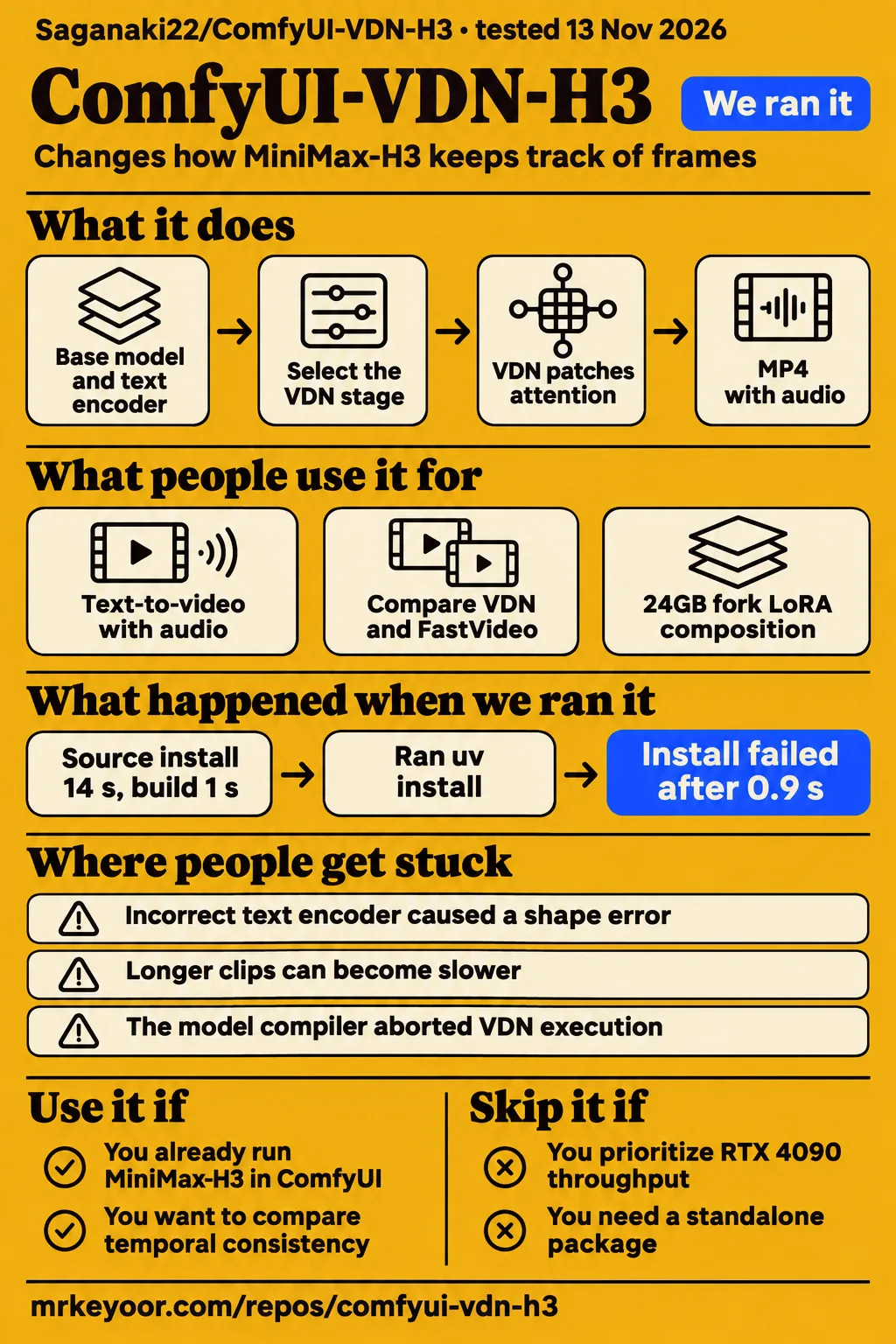
ComfyUI-VDN-H3 is worth considering if you already run MiniMax-H3 in ComfyUI and want to experiment with motion consistency. In our sandbox, installation succeeded in 14 seconds and the build in 1 second, but pytest stopped with six collection/setup errors because it could not import torch. Choose this for an attention experiment you can evaluate on your own scenes. For a throughput-first RTX 4090 workflow, the upstream author recommends SLA instead.
What people use ComfyUI-VDN-H3 for
People have used these nodes for text-to-video with audio, while the separate 24GB fork has reports of longer clips and character LoRA composition. Keep the project names attached to the results: a successful fork workflow does not tell you how upstream behaves.
| Who used it | What they did | What came out |
|---|---|---|
| RunComfy, using Saganaki22's nodes | Published a text-to-video workflow with separate VDN and FastVideo branches | RunComfy says its included examples came from the VDN branch; both branches produce MP4 with audio. |
| ryukbk, upstream issue #8 | Retried the example workflow after correcting its text encoder configuration | The reporter confirmed it worked with the INT8 ConvRot VDN stage after reconfiguration. |
| NoMouse9610, author of the 24GB fork | Tried longer generations and character/style LoRA composition on an RTX 3090 24GB | The author reported successful clips from 5 to 20 seconds at 0.4 MP, plus ten seconds at 0.8 MP and working LoRA composition. |
| DoctaRoboto, on Reddit | Tried the 24GB workflow and raised resolution | The user reported blurry, deformed hands and more than twenty minutes for a ten-second 0.6 MP clip. The fork author disputed the setup. |
That last disagreement matters if your work depends on faces or hands. The fork author also reported a small sampling-speed cost after correcting adapter mapping. Read those examples as accounts of particular scenes and configurations. A before-and-after video can help you choose a scene to try, but it cannot settle which attention method will suit every prompt.
What happened when we ran it
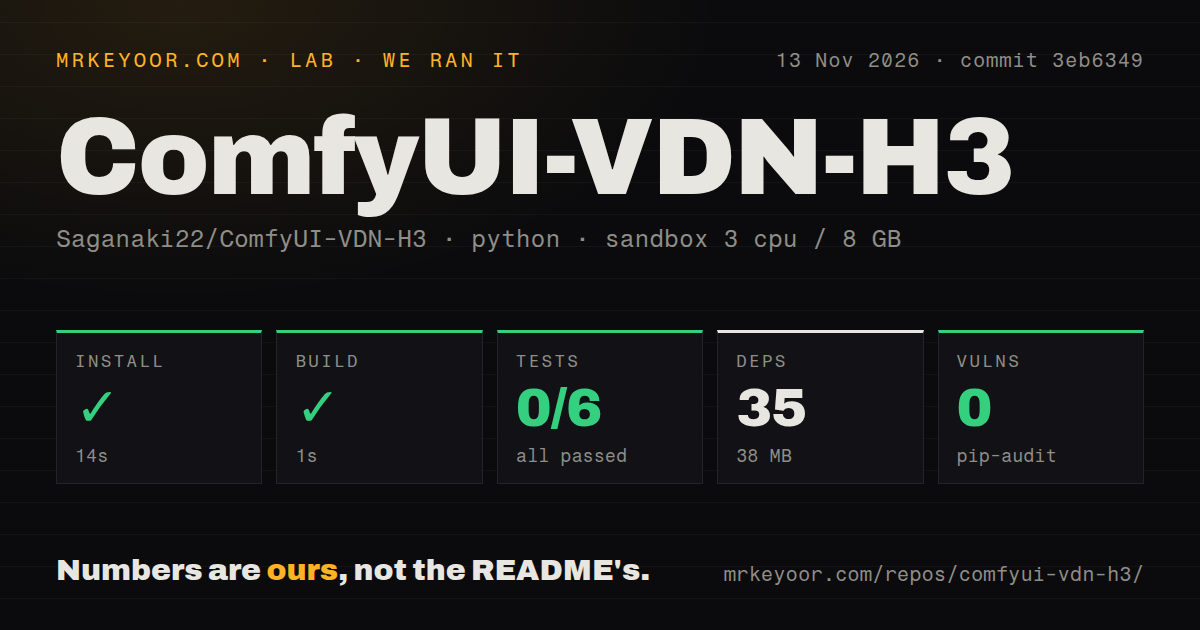
Our source-install step succeeded in 14 seconds, the build succeeded in 1 second, and the test command exited 1 after 2 seconds with six collection/setup errors. The run used commit 3eb6349 on 13 November 2026 in a sandbox configured with 3 CPUs, 8 GB RAM and image label ghcr.io/astral-sh/uv:python3.12-bookworm.
| Check | Our recorded result | What it tells you |
|---|---|---|
| Install | Succeeded in 14 seconds; 35 dependencies recorded, 38 MB on disk | The harness completed its dependency step. |
| Build | Succeeded in 1 second | The configured build command completed. |
| Tests | Exit 1 in 2 seconds; 0 passed, 0 failed, 6 collection/setup errors | Collection stopped before test results could assess the implementation. |
| pip-audit | 0 known vulnerabilities | The recorded dependency audit found no known advisories. |
| Repository scan | 31 files, about 3,963 source lines, 7.3 MB checked out | This is the source checkout footprint. |
| Project signals | One CI workflow file, a tests directory, no Dockerfile detected | The source includes test and automation scaffolding. |
The decisive line is ModuleNotFoundError: No module named 'torch'. The affected files were test_bypass_reinject.py, test_fused_epilogue.py, test_review_regressions.py, test_vdn_math.py, test_window_dispatch.py and test_window_flex_mask.py. All six appeared in the error summary. Zero failed tests here means collection never reached a useful pass/fail assessment, not that the suite was clean.
The README's intended route is a custom node inside an existing ComfyUI environment, using its PyTorch installation. That explains the supported setup route without proving why our harness omitted torch. The supplied log shows the missing import. It does not show a diagnosis of the environment or the dependency recipe.
A separate quickstart-lib attempt in the research records stopped at a package-registry lookup: the resolver could not find comfyui-vdn-h3. That was a different route from cloning the custom node. Its recorded teardown completed. We keep that failed lookup separate from the successful source-install result above, and use the source-run block for all install, build and test numbers.
Where people get stuck: similar symptoms need different fixes
The issue tracker records a confirmed text-encoder correction, an adapter filename fix and a compiler workaround; memory reports need their own diagnosis. Match the log to the fix before changing models or reinstalling everything.
| Symptom and source | What the thread says to change | Recorded outcome |
|---|---|---|
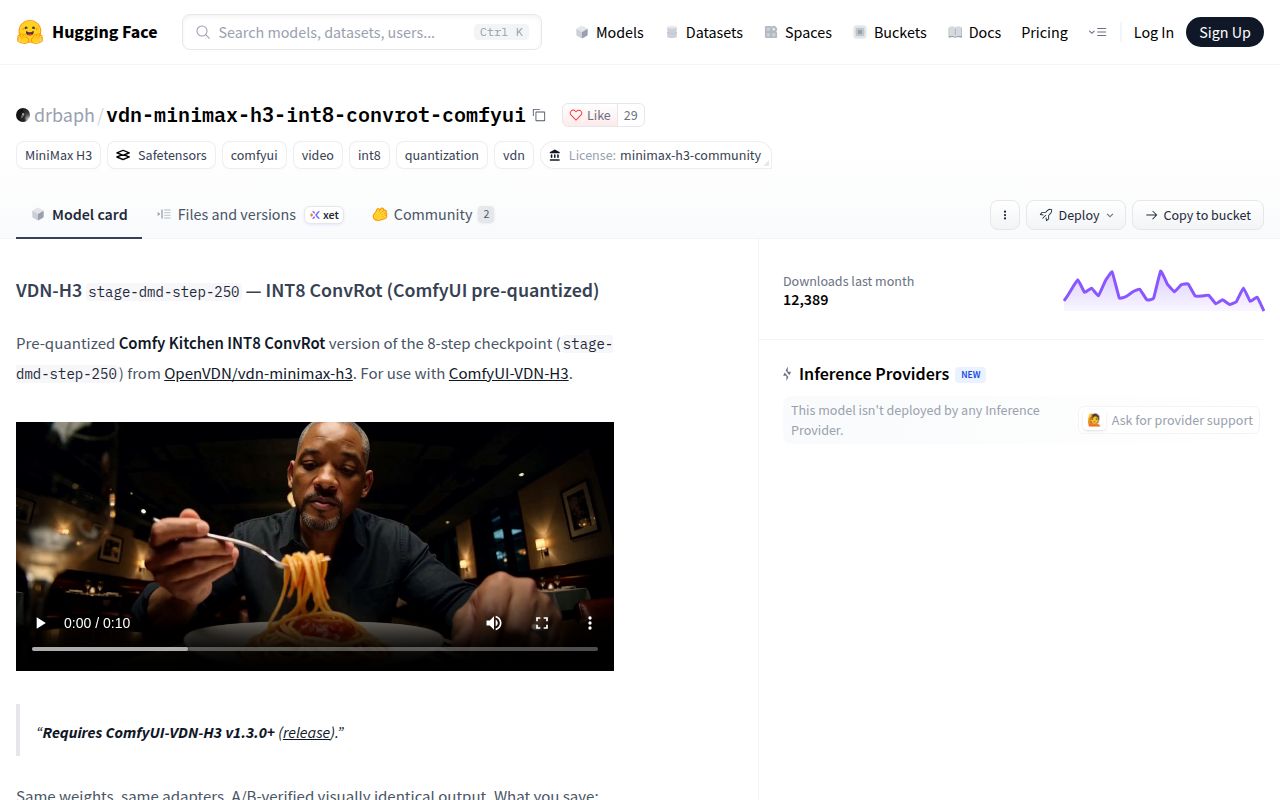
| Matrix multiplication shape error, issue #8 | Explicitly select the MiniMax-H3 Qwen3-VL encoder and set CLIPLoader type to minimax | ryukbk confirmed the workflow worked again, including with the INT8 stage. |
| False missing Stage-B adapter, issue #12 | Update to v1.5.2, which handles adapter_spec.json | The author reported the correction; the release says no checkpoint renaming is needed. |
| Aborted process alongside a broken-pipe report, issue #11 | Add --disable-comfy-compiler and update the node | The reporter said the flag fixed it; the author identified the Comfy model compiler aborting inside VDN forward. |
| AdaLN reshape errors on a pruned base, issue #5 | The historical merge-path correction landed in v1.1.2 | The author completed a render with the errors removed, while warning that 51 incompatible AdaLN deltas were skipped. |
| Stage download command cannot select the directory, issue #2 | Use the --include stage-directory wildcard form | The author said the README command was corrected in v1.1.1. |
Issue #8 is the clearest recovery story. The user tried both the ordinary and INT8 stage and still hit a matrix-shape error. The author traced the failure to a point before VDN execution and asked them to reselect the encoder file and loader type. Reconfiguring the workflow restored operation. Swapping VDN stages was addressing the wrong part of the graph.
Issue #5 contains two different problems in one conversation. Fixing the pruned-base reshape path removed its repeated adapter errors. The author separately identified system RAM and pagefile exhaustion while staging the text encoder and diffusion model. A warning disappearing from the console did not remove that machine's memory constraint.
Longer clips can become slower because weights stop fitting
The author attributes the severe slowdown in issue #7 to memory offloading after a longer clip exceeded the GPU's resident working set. Attention complexity alone does not predict elapsed generation time.
There are four clocks to distinguish. Attention cost describes part of the algorithm. Per-iteration time measures a denoising step. Sampling time adds the steps together. End-to-end time also includes model loading, text encoding, decoding and output assembly. An eight-step label tells you only part of that story.
In the duration thread, the author read the logs as a move from computation to weight-transfer overhead. The recommended mitigations were a pruned INT8 base, the smaller INT8 ConvRot stage, streamed branch weights and merge mode, or shorter segments. Those choices aim to reduce the working set or keep each segment inside available memory.
Other reports put a concrete workload around the risk. Issue #6 describes a ten-second 1800×1012 run on an RTX 5090 that never passed its first step. The author pointed to v1.3.0 disk-to-GPU branch streaming and the smaller stage. Issue #4 reports a REF2VA freeze or OOM at 736p on an RTX 3090 24GB; the response recommends merge, streaming and less demanding clips, and asks for logs to separate system RAM pressure from VRAM exhaustion.
Issue #9 adds another distinction: a cudaMallocAsync allocation failure during a six-second 1344×756 workload and separate Comfy Compiler interference. The author marked compiler interference addressed in v1.4.0+. Removing compiler interference and fitting that workload into VRAM are different tasks.
ComfyUI-VDN-H3 vs SLA, Plus, the 24GB fork and T8
Choose SLA for the upstream author's RTX 4090 throughput recommendation; choose a VDN variant according to the model and runtime contract you intend to use. Fork names are part of the configuration, not interchangeable download mirrors.
| Option | Why consider it | What the evidence belongs to |
|---|---|---|
| Upstream ComfyUI-VDN-H3 | Experiment with released hybrid attention in native ComfyUI | Saganaki22's portable implementation and its issue history. |
| SLA attention | Prioritize consumer-GPU throughput | The upstream author's recommendation in the RTX 4090 discussion, not a benchmark from our lab. |
| ComfyUI-VDN-H3-Plus | Need documented pruned/INT8 handling and coordinated integrations | xmarre's fork explicitly says behavior may intentionally diverge from upstream. |
| ComfyUI-VDN-H3-24GB | Want to follow its RTX 3090 Windows profile and duration-aware memory policy | A separate fork with a required LongCache core hook and launch settings. |
| MiniMax H3 Audio T8 | Need its bundled model selection and multimodal OpenVDN workflows | T8's integration, including its curve-projected adapter and bounded compatibility runs. |
| LightXv2 four-step turbo | Want another speed-oriented H3 route to compare | ComfyUI Wiki relays community comparisons favoring its speed and VDN's fast motion. |
The ComfyUI Wiki account reports VDN at 2:04 against LightXv2 at 1:24 for 1280×736 on the same hardware. These are secondary community timings. They are useful grounds to include LightXv2 in an evaluation, rather than a reason to budget every render at either duration.
For pruned models, adapter fidelity deserves as much attention as memory. Historically, upstream issue #5 removed errors by skipping incompatible terms. Plus now documents projecting the AdaLN weight update and its constant bias into curve coordinates, requiring the matching affine data and failing on mismatches. A render completing after an error-suppression fix is a different claim from applying the released adapter faithfully.
The T8 model card reports nine successful pruned-base compatibility runs on a 16GB GPU, with only a narrow free-memory margin in some modes. That evidence belongs to T8's selected models, resolutions and adapter handling. It is no basis for relabeling Saganaki22's node as generally safe on 16GB.
The upstream defaults protect the trained attention path
The upstream README recommends merge mode for eight-step DMD stages and warns against stacking Scheduled Sol Attention over VDN. These settings affect whether you are running the intended model, not just how fast it runs.
Nearby frames retain exact softmax attention while a separate branch carries distant temporal context. The node sits between the MiniMax-H3 model loader and sampler. You still supply the base diffusion model, the H3 text encoder, video and audio VAEs, and a complete VDN stage directory containing its specification, branch and adapters.
For an upstream starting point, use the supplied workflow and its trained settings. The README describes bypass rounding noise degrading DMD output, and labels Advanced fast kernels as an ablation option with a drift warning. Avoid treating every available switch as a free optimization.
The node listing explains the Scheduled Sol conflict: both patches own the attention-forward path, so a Sol-handled call can skip VDN's linear branch. Plus documents separate coordinated Sol support. Advice for that integration must come from Plus's own contract rather than from a successful upstream graph import.
Security and licensing need separate decisions
Our pip-audit result was zero known vulnerabilities, while the upstream README says the model weights carry a separate MiniMax H3 Community License. A dependency audit and permission to use weights answer different questions.
The code is Apache-2.0 licensed. The upstream README flags territorial exclusions in the weights' license, so read the exact terms for your location and intended use before downloading them. Keep code and model licensing separate when considering redistribution.
There is also a practical maintenance difference between the forks. Upstream describes runtime model patches without modifying ComfyUI core files. The 24GB fork documents a reversible change to the MiniMax block loop for LongCache, with a backup and a restore command. If you share a ComfyUI installation across workflows, that core change belongs in your update and rollback notes. Successful coexistence of node names is a smaller claim than identical runtime behavior.
English documentation exists, but some fixes are discussed in Chinese
The upstream README provides English documentation and a linked Chinese version, while the detailed duration diagnosis in issue #7 is in Chinese. English readers can follow the setup instructions, but some of the most useful explanations require translation.
Read translated issue replies with the logs beside them. In the duration discussion, the distinction between linear attention work and slow weight transfers is the explanation that matters. Flattening that reply into a generic promise of faster long clips removes the condition the author was explaining.
The public repository was reachable through GitHub's anonymous API on 13 November 2026. GitHub reported its last push on 12 September 2026, and the latest release was v1.5.2, addressing adapter metadata loading. The issue record shows specific maintainer responses and corrections. Those dated facts are a more useful maintenance picture than either a release age alone or a claim that every closed report ended in a successful retest.
What the other reviews get wrong
RunComfy's extension description misidentifies the project as interface visualization and dynamic navigation; the actual node patches MiniMax-H3 attention. Its separate workflow page describes the video use much more accurately.
The Comfy.icu node listing tells readers to expect gains near the architectural 2.6× figure. The upstream author's RTX 4090 reply instead recommends SLA for throughput. Treating an architectural figure as a consumer-card purchasing guide skips the implementation and memory conditions that decide the result.
The supplied Facebook guide implies longer, higher-resolution clips necessarily improve VDN's payoff. Issue #7 supplies the missing condition: enough resident memory to avoid transfer-dominated execution. RunComfy's claim of broad VRAM accessibility also needs that workload qualification, given the upstream freeze and memory reports.
Two smaller wording errors can mislead your setup. The node listing's claim that nobody discusses it on the usual forums is contradicted by the supplied Reddit thread. RunComfy's workflow title says it is without LoRA, although VDN stages include LoRA-shaped adapters. The useful distinction is that the VDN turbo adapter replaces an additional community Turbo LoRA.
Questions people ask
ComfyUI-VDN-H3 changes H3's attention at runtime, and the right repository depends on which implementation you intend to run.
What is ComfyUI-VDN-H3, and what does it actually do?
It applies Video DeltaNet hybrid attention to native MiniMax-H3 in ComfyUI: exact nearby-frame attention plus a linear branch for distant context. The base model, encoder and VAEs remain necessary.
Where is the ComfyUI-VDN-H3 GitHub repository?
The upstream ComfyUI-VDN-H3 GitHub repository is Saganaki22/ComfyUI-VDN-H3. Plus and the 24GB project are separate forks with different behavior and requirements.
Why is the original author's GitHub page unavailable, and which fork should I use?
An older Reddit reply said the page was unavailable and directed readers to Plus, while explicitly saying the reason was unknown. Our anonymous GitHub request succeeded on 13 November 2026. Choose Plus for its documented integrations or the 24GB fork for its specific RTX 3090 profile, rather than assuming upstream is gone.
How do video resolution and duration affect VDN speed and memory use?
Increasing either increases sequence work and memory demand. Issue #7 attributes a severe slowdown to crossing a VRAM threshold and moving weights repeatedly, even though the attention mechanism scales linearly.
Can VDN reduce color drift, changing faces and unnatural limb motion?
The upstream author says its temporal context can mitigate color, identity and style drift and flicker. The same reply separates those from malformed anatomy, missing small-face detail and prompt-following problems. More temporal context does not repair all base-model defects.
How do VDA, VSA and sol-engine compare?
The Reddit thread asks exactly this, but supplies opinions rather than a controlled comparison. Keep the upstream Scheduled Sol stacking warning in mind: combining patches can change whether VDN's branch executes. There is no measured winner across those options in this review.
Does the 24GB fork work on RTX 5000-series cards?
Its author says they only have an RTX 3090 and cannot promise RTX 5000-series behavior. Upstream's own RTX 5090 experience belongs to a different implementation.
Can I use the 24GB fork without its custom BAT launcher?
The fork author warns that omitting its settings can cause instability or OOM. You can transfer the supplied settings into your own ComfyUI startup file; the author says those settings are necessary each time, rather than a one-time patch-and-forget step.
How long does generation take on an RTX 3090?
The 24GB fork author reports about 2:05 to 2:08 for sampling a ten-second 0.4 MP clip. That is a fork-author report, excludes the rest of the output pipeline, and carries the configuration described in that discussion.
What we have not tested yet
Our sandbox result stops at source setup and failed test collection; it contains no completed GPU video generation or independent motion-quality assessment. The image label is a recorded configuration, not evidence of the actual Python or operating-system version. The 38 MB dependency footprint excludes any claim about a complete H3 model stack.
We have not tested the supplied workflows, Plus, the 24GB fork or T8 on GPUs. Reported GPU timings, including the disputed Reddit result, have not been reproduced by our lab. No controlled comparison across VDN, SLA, VSA and Sol is available in the supplied evidence. The ten-second RTX 5090 workload and the affected memory-exhaustion machines have no successful retest in those extracts.
We also have not audited the node's code for security, observed its network traffic, checked model-license eligibility for a particular user, or measured support responsiveness over time. All four rating dimensions are N/A: source setup outside a supported ComfyUI runtime cannot rate setup ease, and this research does not support a numerical docs, community or maturity score. Start with a working native H3 workflow, save its configuration, then compare one VDN scene at the same prompt and seed before increasing duration.