One node wraps more than 10 MiniMax H3 workflows
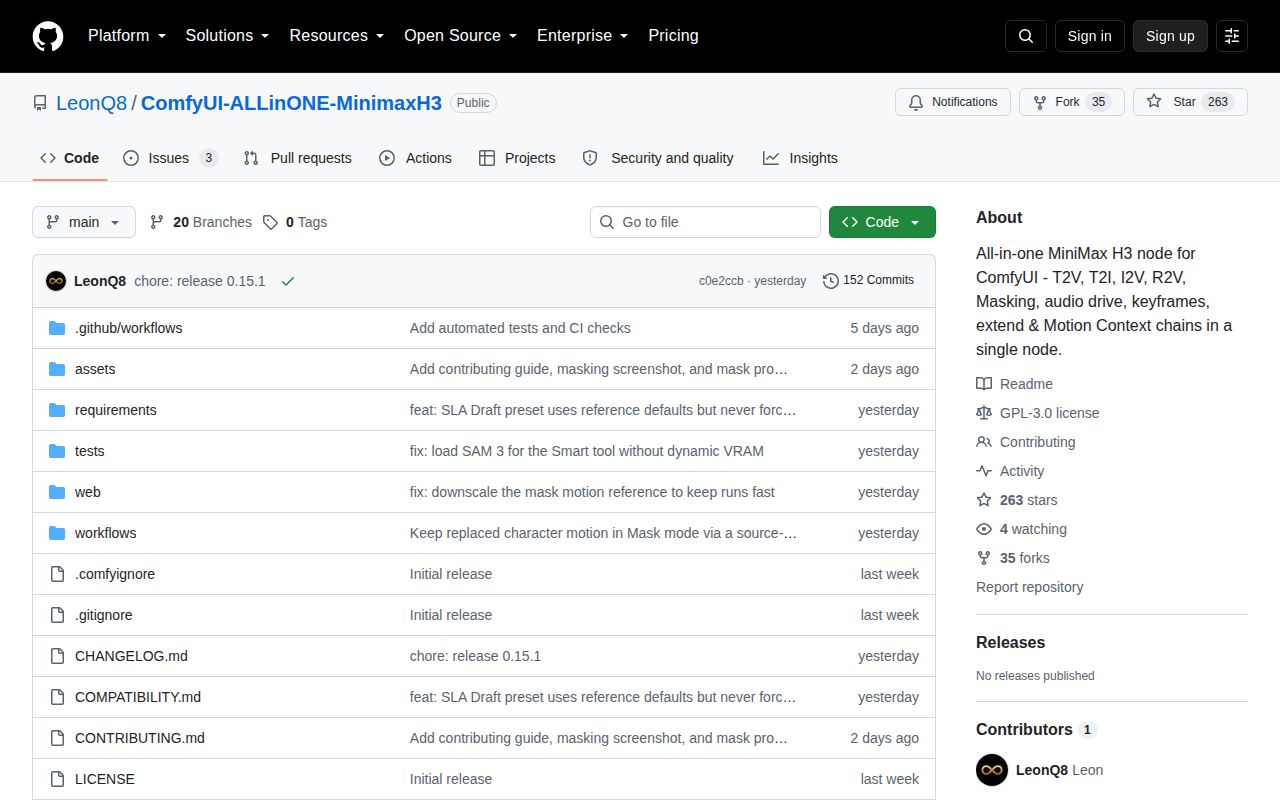
ALL-in-ONE MiniMax H3 replaces a large visible ComfyUI graph with a tabbed node. Its modes cover still images, text-to-video, image-to-video, reference-driven video, audio-driven lip movement, keyframes, extension, chained continuation, regional masking, and upscaling. A history and library panel keeps outputs searchable, while Compare and Stitch can play 2 to 4 clips together and export a side-by-side video at 24 fps.
The simplification is at the interface, not the runtime. Our checkout had 41 files and about 15,144 lines of source, and the repository's requirements name separate diffusion models, a 32-billion-parameter-class text encoder file, video and audio VAEs, optional checkpoints, LoRAs, and community node packs. The single node constructs those workflows for you. It does not make their model files, GPU memory needs, or version relationships disappear.
Three video modes stay closest to ComfyUI core
Text-to-video, image-to-video, and reference-to-video need no extra custom node pack beyond a recent ComfyUI, according to the requirements guide. They still need the official MiniMax H3 model files in the expected folders. Starting with one of these modes is the least fragile way to decide whether the panel, prompt controls, output handling, and model quality fit your work.
Everything beyond that expands the stack. Chain, Keyframes, and Extend use ComfyUI-H3-Motion-Context-MultiRef. Audio Drive has another pack. Mask mode needs MaskVidExperiments plus a SAM 3.1 checkpoint. Image mode uses H3 Studio and 2 additional Qwen3.5 text encoders. Compare and Stitch needs VideoHelperSuite, and live preview adds KJNodes plus another decoder file. Install one mode at a time and keep a record of each commit.
What happened when we ran it
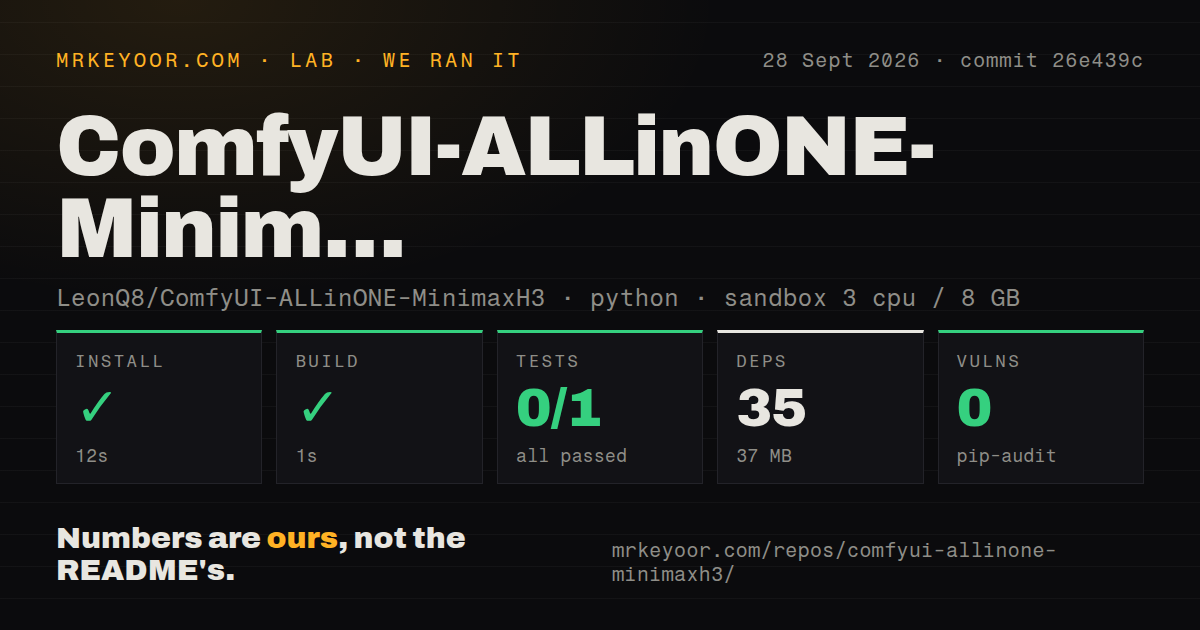
Our sandbox installed 33 Python packages in 17 seconds and occupied 36 MB. Building commit c0e2ccb succeeded in 6 seconds. Pip-audit reported 0 known vulnerabilities. The unprivileged Python 3.12 Debian container had 3 CPUs, 8 GB of RAM, and no secrets. The small checkout had 2 CI workflow files, no Dockerfile, and a tests directory.
Pytest failed during collection after 5 seconds, before it could execute a test. The single error came from tests/test_backend.py: importing the package loaded nodes.py, which attempted import folder_paths and raised ModuleNotFoundError. The harness therefore recorded 0 passed, 0 failed, and 1 collection or setup error out of 1. The log supports only that missing import finding; it does not tell us whether tests pass inside the documented ComfyUI host.
The pinned Windows stack is the recovery map
The author develops against ComfyUI 0.33.0, Python 3.12.10, PyTorch 2.9.1 with CUDA 13.0, and portable ComfyUI on Windows 10 or 11. The compatibility file also pins commits for 10 community packs and versions for others. You do not need every pack, but those pins matter when a mode stops working after an update.
One conflict is documented in enough detail to act on. A MiniMax H3 cache pack globally replaces a model method and drops arguments needed by Motion Context. On ComfyUI 0.33, that breaks Chain and Extend even when the cache node is absent from the graph. The suggested recovery is to disable that pack while using those modes. A separate R2V shape mismatch affected ComfyUI builds from August 6 through August 13, 2026 and was fixed upstream.
Masking and speed presets trade convenience for more variables
Mask mode supports either painting a region or describing a target for SAM 3, then supplying a replacement reference. The README says manual inpainting combined with a text prompt did not work well in the author's testing. Open issue 27 adds a user's report that the supplied Mask workflow was convenient but not consistently successful. That is enough reason to keep source video, masks, seeds, model choices, and output review in the acceptance process.
Quality presets can add Turbo LoRAs, SolAttn, SageAttention, Comfy Kitchen, or an SLA draft path. The guide states that SLA uses 6 default steps and recommends an 8-step Turbo LoRA, while warning that prompt adherence is weaker and multishot actions can change order. Accelerator chips are mutually exclusive in some combinations. Presets save graph work, but they also create more installed-code and driver combinations to reproduce.
Active beta work has no tagged release yet
GitHub recorded the last push on August 25, 2026, with issue activity continuing on August 26. The repository had 280 stars and 3 open issues and pull requests when fetched. GitHub's latest-release endpoint returned no release, and the README labels the node beta. That is a small, active project with direct user contact, not a versioned component ready for unattended updates.
For an experienced ComfyUI user, this node can save real graph maintenance. The 17-second package install is the easy part; matching ComfyUI, CUDA, models, packs, and optional accelerators is the job. Clone it into a separate ComfyUI test setup, prove one core mode, record the exact stack, then add Chain, Mask, Image, preview, and upscale only when each one earns its place.