Tailor the draft before it reaches each social account
Choose LinkedIn alongside Mastodon and CogSend gives you separate versions of the same draft. That's the useful part: you can change the wording for each destination before scheduling it, instead of discovering after publication that a thread became an awkward wall of text. The editor has a card for each post, image alt text, and automatic splitting for long drafts. Published results appear per account, so a partial delivery is visible.
CogSend fits someone who wants control over their publishing queue and can own the infrastructure behind it. Our checkout was 3.1 MB, but installation expanded the environment to 479 MB. The application runs on your Cloudflare account, with drafts and credentials in D1 and media in R2. That is a specific hosting commitment. A spare server with Docker is not the documented deployment route, and our scan found no Dockerfile.
What happened when we ran it
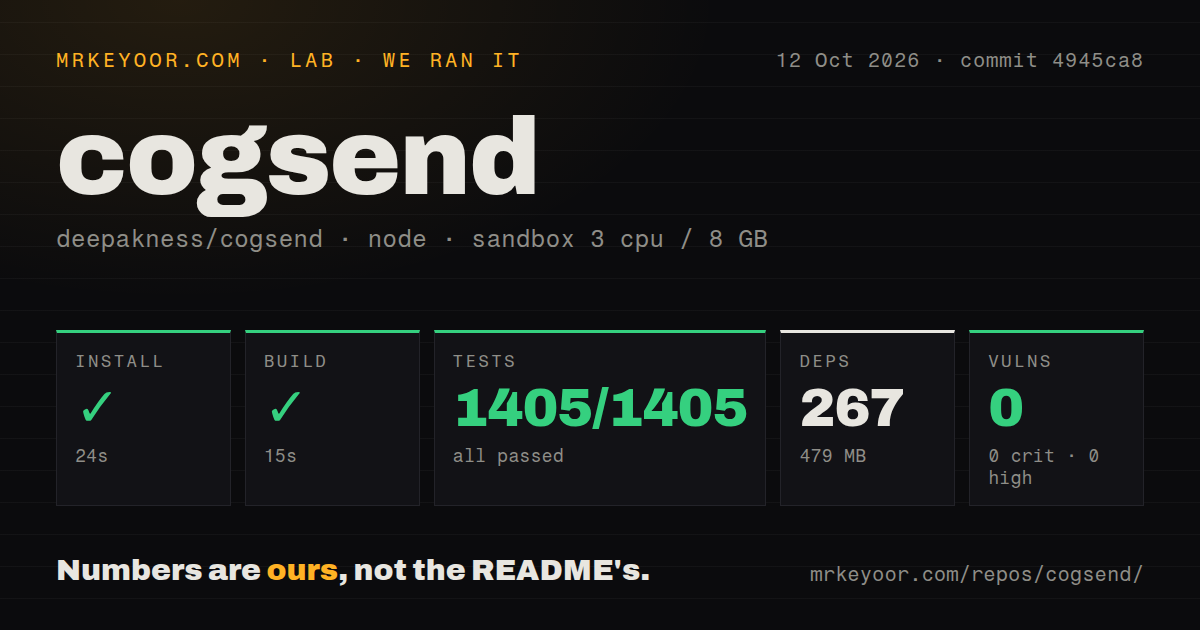
Our run installed CogSend commit 4945ca8 in 24 seconds, built it in 15 seconds, and passed all 1,405 Vitest tests in 60 seconds. We ran it on October 12, 2026, in a fresh unprivileged Debian container using lab-node:22, with 3 CPUs, 8 GB of RAM, and no secrets. The install added 267 packages. Those are reassuring results for someone planning to modify the code.
Npm audit reported 0 known vulnerabilities, and the repository scan found 3 CI workflow files plus a tests directory. The checkout contained 477 files and roughly 77,753 source lines. These measurements establish that the recorded install, build, and test steps completed successfully. They don't establish delivery to a real social account: the sandbox had no credentials, and the supplied measurements contain no live publishing or scheduler accuracy result.
Cloudflare setup still leaves social authorization to you
The deployment instructions offer a prebuilt button installation and a terminal route through npm run setup. Both need Cloudflare Workers, D1, and R2. Keep the encryption key: losing it means reconnecting every social account. Admin setup also requires an authenticator and recovery codes. R2 needs a payment method on file even when usage fits the free allowance, so a free application still asks you to establish a billing relationship.
The 24-second sandbox install did not include social authorization. Mastodon and Bluesky have the simpler connection paths. LinkedIn, Threads, and X need developer apps, or you can route publishing through Zernio's approved apps. The OAuth guide documents those requirements. Zernio reduces that paperwork while adding another service to delivery. If your reason for self-hosting is keeping every publishing credential and request under direct control, choose the connection route deliberately.
The free Workers plan can leave a backlog due
Cloudflare's request budget affects when posts leave the queue. The scheduling guide says a free-plan backlog drains a post or two per minute, with later posts waiting for another tick. That is acceptable for a personal queue and awkward for a coordinated announcement across accounts. Exhausting the account's cron allowance requires an external caller. Deployment can succeed while scheduled publishing still waits for that caller to exist.
Passing 1,405 tests gives us confidence in the tested code paths, but it doesn't override the documented delivery limits. CogSend also treats ambiguous publishing responses carefully: when X, LinkedIn, or Threads may have accepted a post without returning an answer, it stops automatic retries and asks you to check. That's a sensible choice. It also means unattended publishing needs a person who will read failure messages instead of assuming every item marked failed is safe to resend.
MCP write access can publish without a CogSend approval step
CogSend exposes a Streamable HTTP MCP endpoint authenticated with a personal API key. A read-only key lets an agent inspect drafts and the queue. A read-write key can create drafts, schedule them, or publish to real accounts. The documentation explicitly puts confirmation in the client: CogSend marks the tools, but only the client can pause and ask. Give your assistant read-only access if you only want help reviewing the queue.
The 60-second test run contains no evidence about your MCP client's confirmation settings. Treat that integration as publishing authority you configure yourself. The MCP interface also excludes media, insights, settings, and account management, so it won't replace the full application. There is another concrete platform limitation: the OAuth documentation says LinkedIn video upload ships disabled because its live upload path has not been verified. Pick another scheduler if LinkedIn video is central to your work.
Recent fixes support a trial for a personal publishing queue
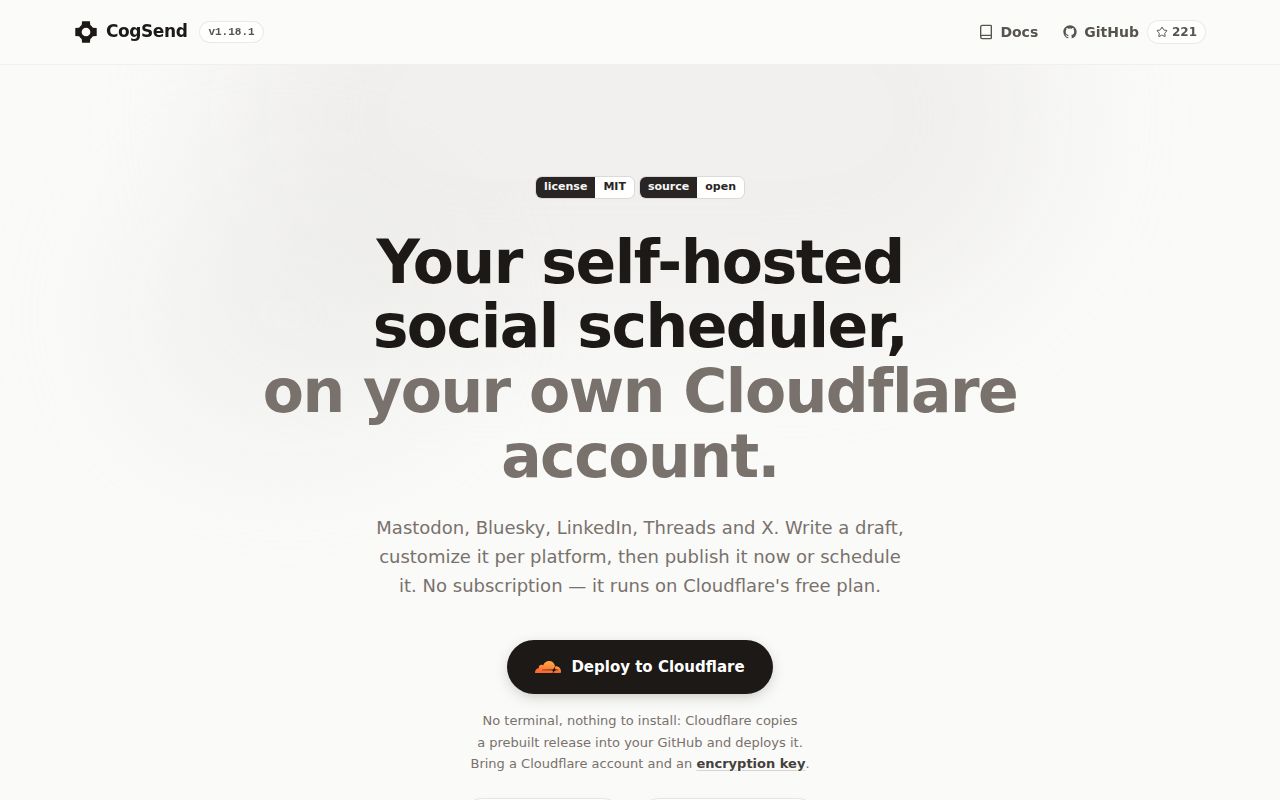
The repository's last push was October 11, 2026. GitHub listed 221 stars and 0 open issues and PRs on October 12, while recent closed pull requests covered the framework migration and deployment updates. Release v1.18.1, published October 11, fixes saves crossing between composer drafts. Those changes show current maintenance around everyday editing. The empty open queue alone would tell us much less about how actively the project is maintained.
Our 479 MB installation and successful checks make CogSend a reasonable codebase to try if Cloudflare hosting suits you. Choose Postiz when team collaboration and a broader management application matter, or Mixpost when its workspaces and publishing calendar better match your operation. For CogSend, make the acceptance check a real scheduled post to each account you need. Our sandbox's green build cannot tell you whether your platform credentials will deliver that post.