Terraform templates turn infrastructure into repeatable workspaces
Coder is a control plane for development environments that run on infrastructure you choose. A Terraform template can describe an EC2 virtual machine, Kubernetes pod, Docker container, or another provider resource. Developers create workspaces from that template and connect with an existing IDE, SSH, or a browser-based editor. Idle shutdown can stop unused resources, while administrators manage the environment definition instead of asking each developer to assemble one by hand.
This model pays off when a team has many developers, regulated source code, expensive compute, or uneven local laptops. It also transfers responsibility to the platform team. Templates need versioning, images need patching, providers need credentials, and network paths must work from users to workspaces. A bad template can affect every new environment. Coder supplies the control plane; it does not eliminate capacity planning or cloud operations.
Coding agents run inside the same governed environments
The official registry includes modules for Claude Code, Codex, and OpenCode. Coder Agents places the agent loop in the control plane while work happens on customer infrastructure, and the README says model API keys do not have to live inside workspaces. The AI Gateway centralizes authentication, audit logging, cost controls, and model access for supported tooling. That is a sensible boundary for organizations that will not scatter provider secrets across developer environments.
Agent isolation is only as good as the workspace template and policy around it. A coding agent still receives repository access, tools, network reach, and whatever credentials the workspace provides. Platform owners must decide which repositories, secrets, models, and outbound destinations each template permits. The product creates a place to enforce those decisions, while Premium and community-edition boundaries need checking against the current plan comparison before procurement.
What happened when we ran it
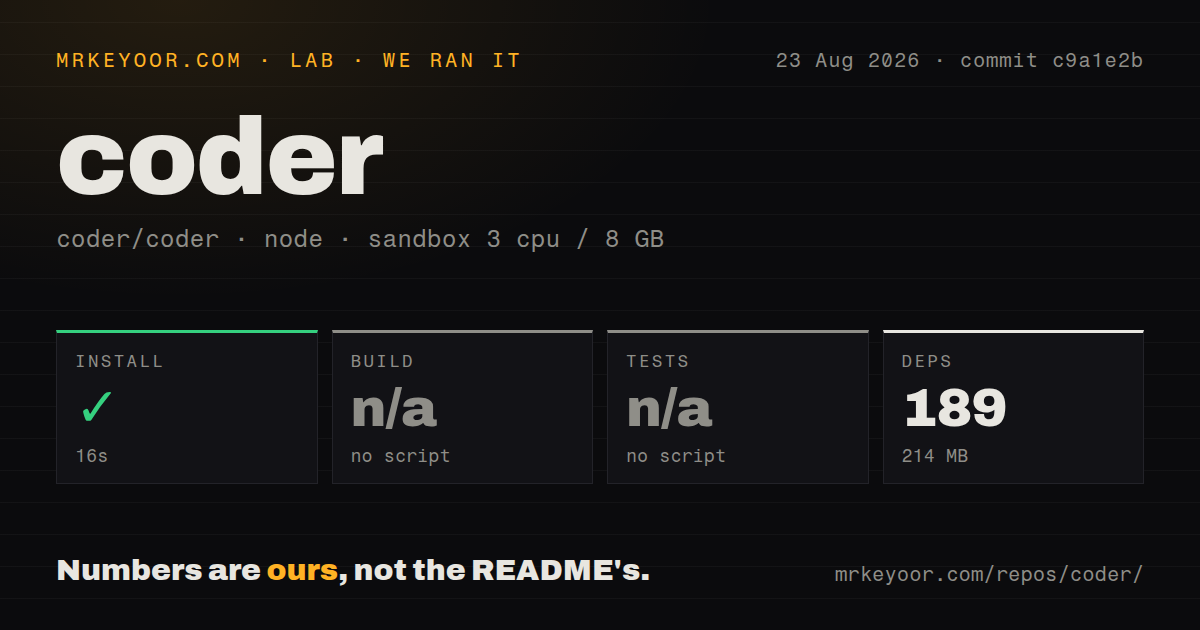
Our sandbox installed 189 pnpm packages in 16 seconds, leaving 214 MB on disk. The repository checkout was much larger at 187 MB, with 12,403 files and roughly 1,474,922 lines of source. The harness detected a Node workspace and completed dependency installation. It found 31 CI workflow files, a Compose file, no Dockerfile, and no tests directory under its scan rules.
There was no detected build script or target, so the build step was skipped. The same was true for tests. This means our run produced no compiler result and no test count for commit c9a1e2b. Coder's repository is primarily identified by GitHub as Go, so a pnpm-only harness result covers one slice of the monorepo rather than the server a buyer would deploy. We do not treat a skipped target as a passing check.
The run used an unprivileged Debian container with 3 CPUs, 8 GB of RAM, and no secrets. We did not start coder server, provision a workspace, apply Terraform, connect an IDE, or exercise Coder Agents. The 16-second install only shows that the detected pnpm dependency step worked. A serious trial should use the published release or documented source build, then provision and destroy a representative workspace on the intended provider.
Evaluation starts locally, while production starts at PostgreSQL 13
The quickstart installs a binary, runs coder server, and opens port 3000 to create the first user and Docker template. Without production flags, Coder uses a built-in database and obtains a *.try.coder.app access URL. That route is useful for learning the interface and template flow. It is not the architecture the README recommends for a durable multi-user deployment.
Production adds PostgreSQL version 13 or later and an external access URL. From there, operators still need TLS termination, backups, identity, monitoring, upgrade procedures, and enough compute for simultaneous workspaces. Kubernetes deployments also need ingress, persistent storage, and cluster policies. Coder publishes validated architectures and administration guides, which is reassuring, but following them is platform work rather than application installation.
WireGuard connects the control plane and workspaces. That can simplify direct access to environments spread across networks, provided firewalls, proxies, DNS, and egress rules are designed for it. Test the path from each developer location, not only from inside the data center. Workspace startup time, image pulls, provider quotas, and idle shutdown behavior will matter more to users than how quickly the Coder binary itself launches.
Issue 28656 blocks one current Codex AI Bridge path
Open issue 28656 reports that Premium AI Bridge in Coder 2.35.6 rejects OpenAI Responses requests containing Codex's namespace tool type. The bridge returns HTTP 400 before forwarding the request, while the same payload reportedly succeeds against the upstream endpoint. The reporter says Codex CLI 0.149.1 includes that tool for its multi-agent feature and that disabling the feature is a working workaround.
This is a narrowly described compatibility bug, not evidence that workspace access or other agents fail. It still matters to teams buying Coder partly for centralized Codex governance. Reproduce a complete Codex run through the intended AI Bridge version, including streaming, tool calls, usage recording, and any multi-agent features you allow. Provider and client schemas change faster than infrastructure platforms, so gateway compatibility deserves its own release check.
Release 2.35.6 and same-day pushes show active maintenance
GitHub recorded 14,259 stars, 986 combined issues and pull requests, and a last push on August 26, 2026. The open count includes pull requests, so it is not a defect count. Release v2.35.6 shipped August 25 with a switch to disable workspace-agent context sync and release-pipeline maintenance. The repository and tracker were active the next day, including issue 28656.
Coder is mature enough to shortlist for a real platform program, and large enough that a local dependency install says almost nothing about operational success. Its value rises with team size, infrastructure variety, security requirements, and the number of coding agents that need consistent policy. Run a provider-specific pilot with several templates, identity integration, recovery drills, and a current Codex compatibility check before making it the default development environment.