Short answer
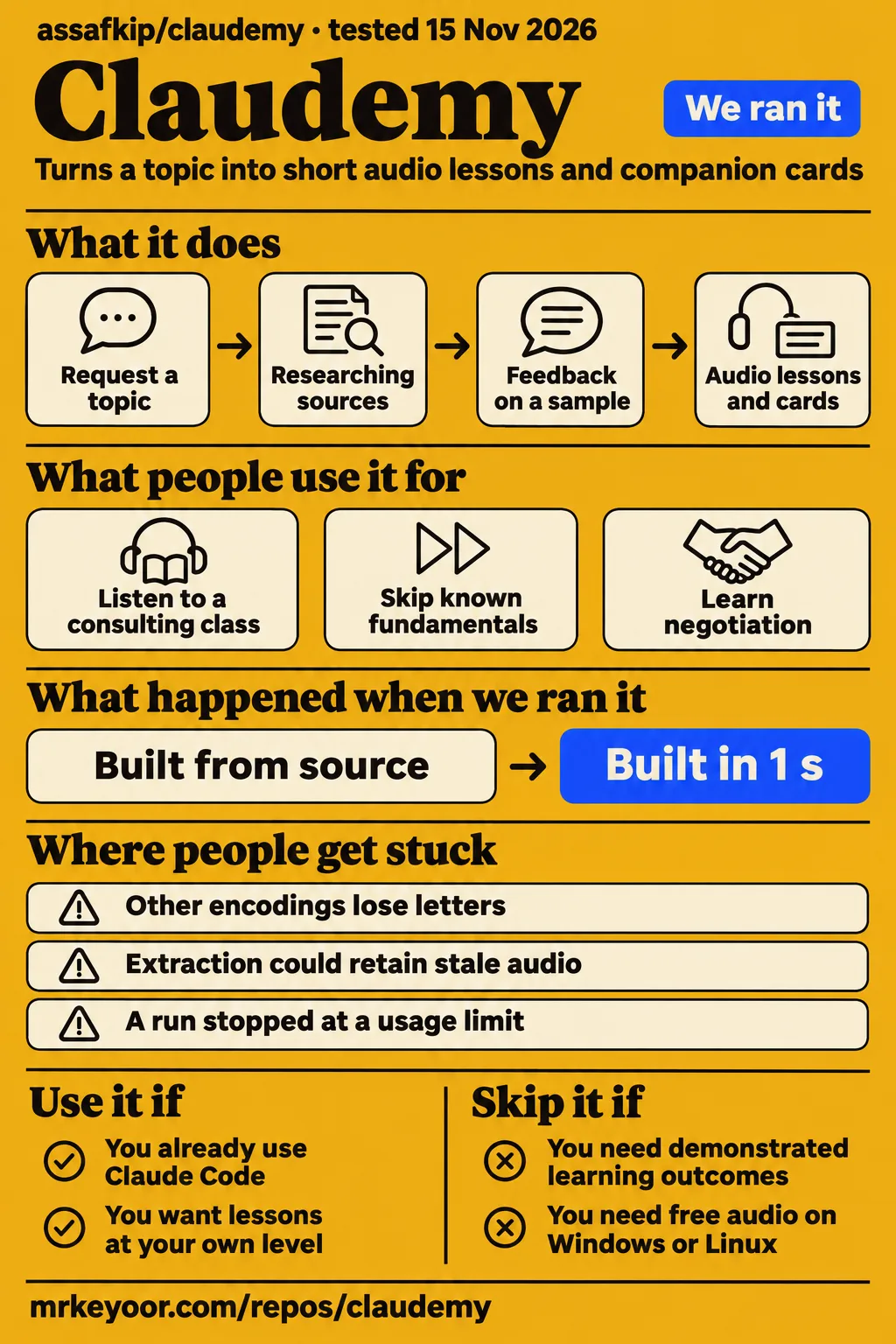
Our sandbox installed Claudemy in 6 seconds and built it in 1 second, but pytest stopped before running any tests. Use it if you already work in Claude Code and want a short, personally scoped audio course with source links. Skip it if you need a finished curriculum with demonstrated learning outcomes, or free audio on Windows or Linux. The documented free voice fallback uses macOS.
Claudemy is an MIT-licensed Claude Code skill that researches a topic and produces short audio lessons, companion cards and a playbook. Its strongest selling point is control over what you learn: XDA's Dhruv Bhutani requested two reinforcement-learning lessons that skipped fundamentals he already understood. That is a more convincing reason to try it than the README's promise of a course you will finish. README, Bhutani's account.
What you can do with Claudemy
Claudemy normally plans about 12 lessons of around 2 minutes, with a sample for your feedback before it generates the rest. The README describes mapping the topic, researching sources, comparing their positions and arranging the material into lessons. You can also ask for a course drawn from one expert's blog or Substack. That changes the reading list from several perspectives to one person's body of work. Documented workflow.
The companion card is useful because audio alone is awkward to revisit. In the README's negotiation demo, the first lesson concerns deciding what you will do if an ask fails. Its card pairs the idea with a practice, source links and a rule to keep. The playbook collects those rules in one file. If you expect to return to an idea during work, keep the cards alongside the MP3s rather than treating the audio as the entire course. Negotiation example.
The best request names both a topic and a boundary. Bhutani's reinforcement-learning experiment supplied his existing knowledge and a smaller lesson count. That gives the system a clearer job than asking it to teach an entire field. It also gives you something concrete to judge in the sample: did it start at the right level, and does the proposed practice fit what you actually wanted to learn? XDA's customization example.
What people use claudemy for
Reported uses include a consulting course heard during a car ride and two reinforcement-learning lessons tailored to existing knowledge. The accounts below have different evidential weight: an author's own success story, an outside writer's experiment and a demonstration supplied by the project are separate kinds of evidence.
| Who used it | What they did | Reported outcome |
|---|---|---|
| Project author ColdPlankton9273 on r/artificial | Generated a consulting class and listened during a car ride | Said they heard the whole class and found it easy to consume. They also described a personal knowledge-base customization. Author's thread |
| XDA writer Dhruv Bhutani | Requested two reinforcement-learning lessons, skipping known fundamentals | Described useful control over scope and usable Mac system voices, with cards to review alongside the audio. XDA experiment |
| Assaf Kipnis, in the repository demo | Generated a negotiation course | Presented a two-host first lesson called Your Walk-Away with a companion card. Project demo |
| note.com writer ゆいまる | Tried running the tool while exploring alternative assistant tooling | Reported hitting a free usage limit halfway through, and separately exhausting their Claude Code weekly allowance. Translated account |
The consulting account makes the intended use easy to picture: listen on a drive, then connect an idea to work you already do. The knowledge-base connection belongs to the author's personal customization. The README documents voice overrides, but that anecdote is not a reason to expect an included knowledge-base integration. Author's customization report, voice configuration.
The outside accounts also need reading closely. The note.com extract carries an automatic-translation warning and discusses OpenCode as well as Claude Code, so its interrupted attempt is not a clean compatibility test. Meanwhile, 0exp.com says it installed the plugin on a clean machine and reviewed the repository, but did not exercise its main account-dependent features. That is setup documentation, not another completed-course result. note.com account, 0exp's test boundary.
What happened when we ran it
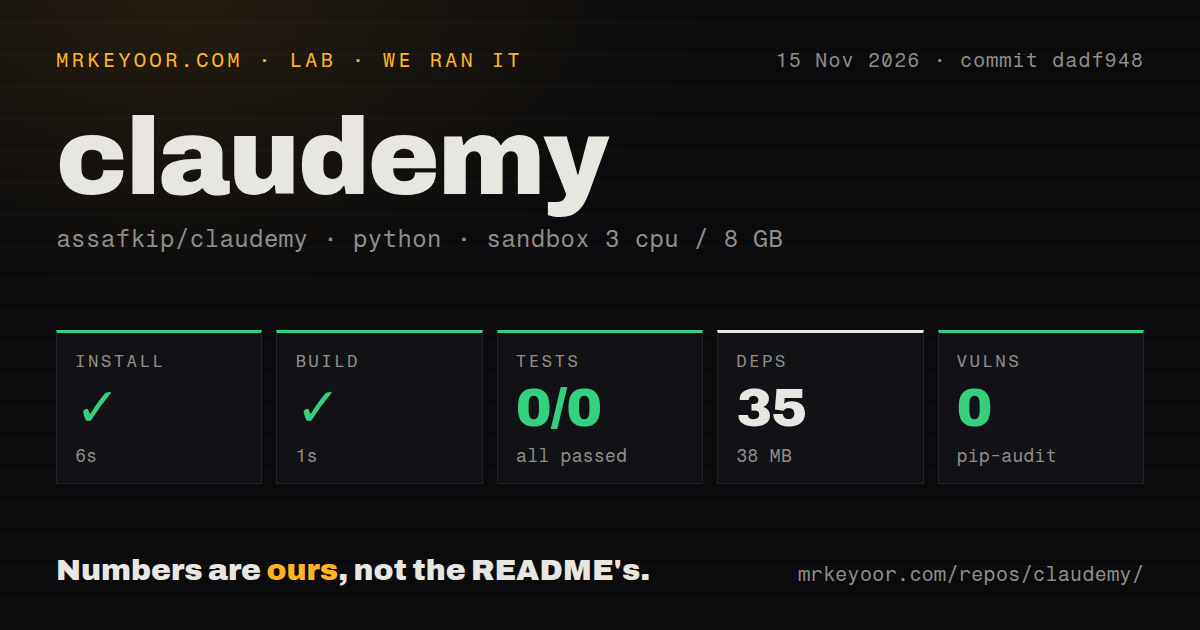
In our November 15, 2026 sandbox run at commit dadf948, installation succeeded in 6 seconds, the build succeeded in 1 second, and pytest exited 3 after 2 seconds with no tests run. These are repository checks, separate from the course reports above.
| Recorded check | Our result | What it tells you |
|---|---|---|
| Install | Succeeded in 6 seconds | The recorded dependency step completed |
| Dependencies | 35 recorded, 38 MB on disk | The installed environment was small in this run |
| Build | Succeeded in 1 second | The recorded build step completed |
| Tests | Failed, exit 3, after 2 seconds | Pytest recorded 0 passed and 0 failed out of 0 |
| pip-audit | 0 known vulnerabilities | The audit reported no known advisories |
| Repository signals | 0 CI workflows, no Dockerfile, tests directory present | The scan found tests, but no CI workflow files |
The failure happened while pytest imported tests/test_scripts.py, which imported scrape.py. That script then raised SystemExit with the message missing dependency: pip install beautifulsoup4. Pytest reported an internal error and stopped. Calling that zero failed tests would conceal the result: the command failed before any test executed. The log identifies the dependency message, but gives no basis for blaming a particular package version or explaining why the dependency was unavailable.
The configured sandbox had 3 CPUs and 8 GB of RAM, using image label ghcr.io/astral-sh/uv:python3.12-bookworm. That label records the configured image, not an independently established runtime or operating-system version. The checkout contained 29 files, approximately 1,488 source lines and 4.1 MB on disk. Those measurements describe this checkout, not the storage a collection of generated courses will eventually use.
A separate hands-on record says its safety step failed because none of compose.yaml, compose.yml, docker-compose.yaml or docker-compose.yml existed. Its rule required a Compose file. A generic run summary nevertheless says the project was deployed with its own Docker Compose, with ports bound to 127.0.0.1. Those records conflict. We count the explicit safety failure, not the summary's deployment assertion, as the supported outcome. The teardown record says teardown: ok. A Compose requirement in that runner is a poor fit for a Claude Code skill and is not evidence that Claudemy needs a server.
Where people get stuck: scraping, cards and packaged audio
The maintainer reports fixes for four script bugs in v0.3.1, while issue #6 describes an open encoding failure reproduced on v0.3.2. The distinction matters if you are searching old error reports: the closed bugs have specific fixes, whereas the encoding report still needs an answer.
| Report | What went wrong | Resolution in the supplied thread |
|---|---|---|
| Issue #2: Atom links | The scraper picked the first link, which could lead to comments, an API or media | Maintainer says v0.3.1 prefers an alternate or unqualified link, with a first-link fallback and a regression test |
| Issue #3: sitemap indexes | Person mode could silently find zero posts when the sitemap was an index | Maintainer says v0.3.1 follows child sitemaps two levels deep, guards self-reference and reports unmatched URL counts |
| Issue #4: hidden card content | HTML comments could satisfy required sections or trigger a false rejection | Maintainer says v0.3.1 strips all comments before every card check and adds regression cases |
| Issue #5: duplicate audio names | Several MP3s in a lesson folder shared a ZIP member name, allowing stale audio to survive extraction | Maintainer says v0.3.1 uses unique names for multiple MP3s, lists them on stderr and includes a regression test |
| Issue #6: non-UTF-8 input | Other encodings lose letters, and a Shift_JIS feed stops the run before later authors are scraped | Open report reproduced on v0.3.2 |
Issue #2 explains why a citation checker can give you false confidence. A saved post could contain the correct article text but carry a comment-feed URL. The lesson's citation would then match the saved research while still sending the learner to the wrong destination. The reported fix improves link selection. It does not turn matching a stored URL into proof that a lesson's explanation is correct. Open the actual source when an idea will affect a decision. Atom report and maintainer response.
Issue #6 is especially relevant when learning from international experts. Its reproduction describes a Latin-1 page losing accented letters and a Shift_JIS feed raising a ValueError that stops the whole scrape. Later authors then receive no turn. An English topic name does not guarantee that every useful source uses the encoding the script expects. For a course built around one expert, inspect whether their writing actually made it into the saved research. Encoding reproduction.
Claude allowance and your audio platform shape the cost
The skill is free, Claude usage still counts, and ElevenLabs voices consume credits. The README requires Claude Code with web search, Python 3 with beautifulsoup4, and ffmpeg. It offers free built-in voices on macOS, while the cards and playbook can work without audio. Optional pandoc support produces a Word copy of the cards. These are separate setup decisions: installing the plugin does not supply the assistant allowance or a cloud speech balance. Requirements and cost model.
For repeated use, research and regeneration are the work to budget. The README describes a full course as a long-running Claude Code session. The note.com writer's allowance interruption gives that warning a practical consequence: you may be waiting for renewal before finishing the material. Requesting a smaller scope and reviewing the sample before generating the rest is a sensible starting point, particularly when you already spend most of your Claude allowance on coding. README workflow, interrupted attempt.
For Windows and Linux audio, the documented route is an ElevenLabs key. 0exp's guide specifically says the free fallback is macOS only. That makes a Mac a cheaper place to try the audio workflow if you already own one. On another platform, decide whether text cards are enough before adding a paid voice service. Platform guidance.
Security: local files still feed external services
With an ElevenLabs key configured, Claudemy sends each lesson's text to ElevenLabs for speech generation. The README says researched public pages are saved locally and that the skill has no server or analytics. Local storage and external processing coexist here: keeping the course directory on your machine does not make cloud speech local. Choose macOS voices or text-only output if sending lesson scripts to that provider is unsuitable. Documented data flow.
0exp's repository inspection adds a credential detail: the SessionStart hook exports a configured key into the session environment, where shell commands in that session can read it. That is a concrete access boundary to understand when sharing a Claude Code workspace or adding other tools. The same guide says downloaded research copies are for personal study and should not be republished or committed to a public repository. Keep that in mind when generating a course inside a working checkout. Hook and research-storage inspection.
Claudemy vs NotebookLM, Udemy, Coursera and MIT OpenCourseWare
Pick Claudemy when your first requirement is a course scoped to a question and your existing knowledge. The comparisons in the supplied accounts concern inputs, structure and time commitment. They are useful for choosing a workflow, but offer no common learning-outcome test.
| Alternative | Reason to choose it instead | Where Claudemy fits |
|---|---|---|
| NotebookLM | You want audio overviews from documents you upload, as described by 0exp's guide | Claudemy's documented starting point is public-web research on a named topic. Input comparison |
| Udemy or Coursera | You want to follow an existing recorded curriculum | Claudemy lets you request a topic and level instead of finding a matching course. This is the repository's stated distinction. README comparison |
| MIT OpenCourseWare | You want the substantial university-course commitment Bhutani describes | Bhutani preferred Claudemy for initial exploration and explicitly kept deep research and experimentation separate. XDA comparison |
| Asking an LLM directly | You already know the question and can judge its answer | Bhutani valued Claudemy's structured learning plan when he did not know where to begin. His stated reason |
For me, the deciding question is whether you want help choosing a reading path or help completing a curriculum you already trust. Claudemy's source comparison and sample lesson address the former. If an existing course covers the subject at the right depth, its length alone is a weak reason to replace it. Bhutani's account is persuasive precisely because he asked for a bounded piece of reinforcement learning rather than claiming to replace university study.
What the other reviews get wrong
SkillsLLM incorrectly says Claudemy lacks a SKILL.md file. Its comparison with ECC makes that claim about both projects, but Claudemy's documented skill path is skills/claudemy/SKILL.md, and issue #3 discusses instructions in it. The correction applies to Claudemy. There is no need to make an additional claim about ECC to fix that error. SkillsLLM comparison, documented skill path, issue discussing the file.
The note.com overview also labels dropout as extremely low, yet its author's attempted run stopped at a usage limit. The README promises a course you will finish. Those statements describe a hope for the format, not measured completion or retention. The concrete positive evidence is smaller and more useful: an author listened to a consulting class, and an outside writer liked a narrowly tailored reinforcement-learning experiment. note.com claims and attempt, author's listening report, XDA experiment.
Questions people ask
The Claudemy GitHub repository is assafkip/claudemy, and its README documents installation as a Claude Code plugin. Official repository instructions.
Where is the Claudemy GitHub repository, and is 'claudemythos' referring to the same project?
Use github.com/assafkip/claudemy. The supplied autocomplete includes both “claudemythos” and “claudemy github”, but autocomplete is no evidence of a shared identity. Claudemy's own README identifies the audio-course skill. Use that owner and repository name when searching for its issues. Search terms, project identity.
How does Claudemy turn a topic into a personalized microcourse?
Claudemy researches a topic into roughly 12 lessons of around 2 minutes each by default, comparing web sources and asking for feedback on a sample before making the rest. Cards retain source links and a small practice, while the playbook collects a rule from each lesson. README workflow.
How do I install Claudemy in Claude Code?
Run /plugin marketplace add assafkip/claudemy, followed by /plugin install claudemy@claudemy, in Claude Code. The README also permits copying skills/claudemy/ into your Claude skills directory. Have Python 3, beautifulsoup4 and ffmpeg available, and enable web search. Install and requirements.
Is Claudemy free once Claude usage and audio credits are included?
The MIT-licensed skill is free, but its work uses your Claude plan and ElevenLabs credits if you choose that voice service. Mac system voices cost nothing. Budget against your actual assistant allowance rather than treating the license as a promise of unlimited course generation. README cost explanation.
Can I use Claudemy without ElevenLabs?
Yes. On macOS it falls back to built-in voices, and the cards and playbook work without audio. Bhutani specifically reported using his Mac's system voices, which he considered adequate for the task. README fallback, XDA listening account.
Can I use free audio voices on Windows or Linux?
The documented free voice fallback is macOS only. 0exp's guide directs non-Mac users to configure an ElevenLabs key for audio. Cards and the playbook remain an option if you want to avoid that service. Platform instructions, text-only output.
Can Claudemy assess my skill level with a pre-training quiz?
Manual level setting is the supported example: Bhutani told it he knew the fundamentals and requested two lessons. On X, fwlkit asked for an included pre-training quiz. That post is a feature request, not evidence of a shipped assessment. Tell Claudemy what you already know. X request, manual customization.
Can I change the lesson count and skip basics I already know?
Yes. Bhutani requested two reinforcement-learning lessons and explicitly excluded fundamentals he already understood. His account also says you can choose the lesson count and identify yourself as a beginner or someone who knows the basics. XDA's scope experiment.
Can I learn from one specific expert's writing?
Yes. The README documents naming an expert in the request so Claudemy builds from their Substack or blog. This is the person-mode path affected by the sitemap and encoding reports discussed above, so the saved source list matters as much as the resulting lesson titles. Person-mode instructions.
Can I customize voices and connect lessons to my own knowledge base?
Voice changes are documented through CLAUDEMY_VOICE_A and CLAUDEMY_VOICE_B for ElevenLabs, or CLAUDEMY_SAY_A and CLAUDEMY_SAY_B for macOS. The knowledge-base connection was the Reddit author's personal customization. It should not be read as a documented stock connector. Voice settings, personal customization.
How long does a course take to generate, and can it exhaust my Claude allowance?
The README calls a full course a long-running Claude Code session, without supplying a measured generation duration. The note.com author reports an interrupted attempt and an exhausted weekly Claude Code allowance. Treat generation time and allowance as constraints to check with your own topic, rather than assuming short lessons mean a short session. README warning, allowance account.
What does Claudemy send to ElevenLabs?
When you configure an ElevenLabs key, the text of each lesson goes to ElevenLabs for audio rendering. Without a key, the README documents local rendering through Mac voices. The researched pages remain in the local workspace according to the project's data description. README data flow.
What we have not tested yet
Our repository checks did not generate or listen to a course, reproduce the reported fixes, or measure learning outcomes. The conflicting Compose records supply no reliable deployment result. We have no measured course-generation duration, cost per topic, retention rate, repeated-course reliability or production workload result. The image label also supplies no substitute for raw toolchain logs. The absence of known advisories in pip-audit is not a security review.
The macOS math-audio concern also remains unresolved in the supplied evidence. On r/SideProject, Natethegreat9999 warned that the fallback would drop bracketed content such as '[0,1]' and suggested stripping only recognized audio tags. That is a commenter's warning, not our reproduced finding or a documented shipped fix. A course containing equations needs a listening check against its script. Speech warning.
The video titled “Claudemy GitHub Explained” reaches a request for a microcourse about organizing digital files in a fictitious project. Its supplied transcript ends there, before a result, and provides no channel name. Another Claudemy video record has no transcript. Neither adds a completed-course outcome to this review. Likewise, the X request for a diagnostic quiz supplies no implementation, and the note.com discussion of OpenCode supplies no successful alternative workflow. Video excerpt, empty video record, quiz request, OpenCode attempt.
For a first course, choose a subject whose basics you can already judge, request a small scope and listen to the sample with its card open. Check that a cited page opens to the intended article and supports the explanation. That single lesson is the useful adoption decision: whether Claudemy's reading choices and audio help you understand this topic well enough to continue.