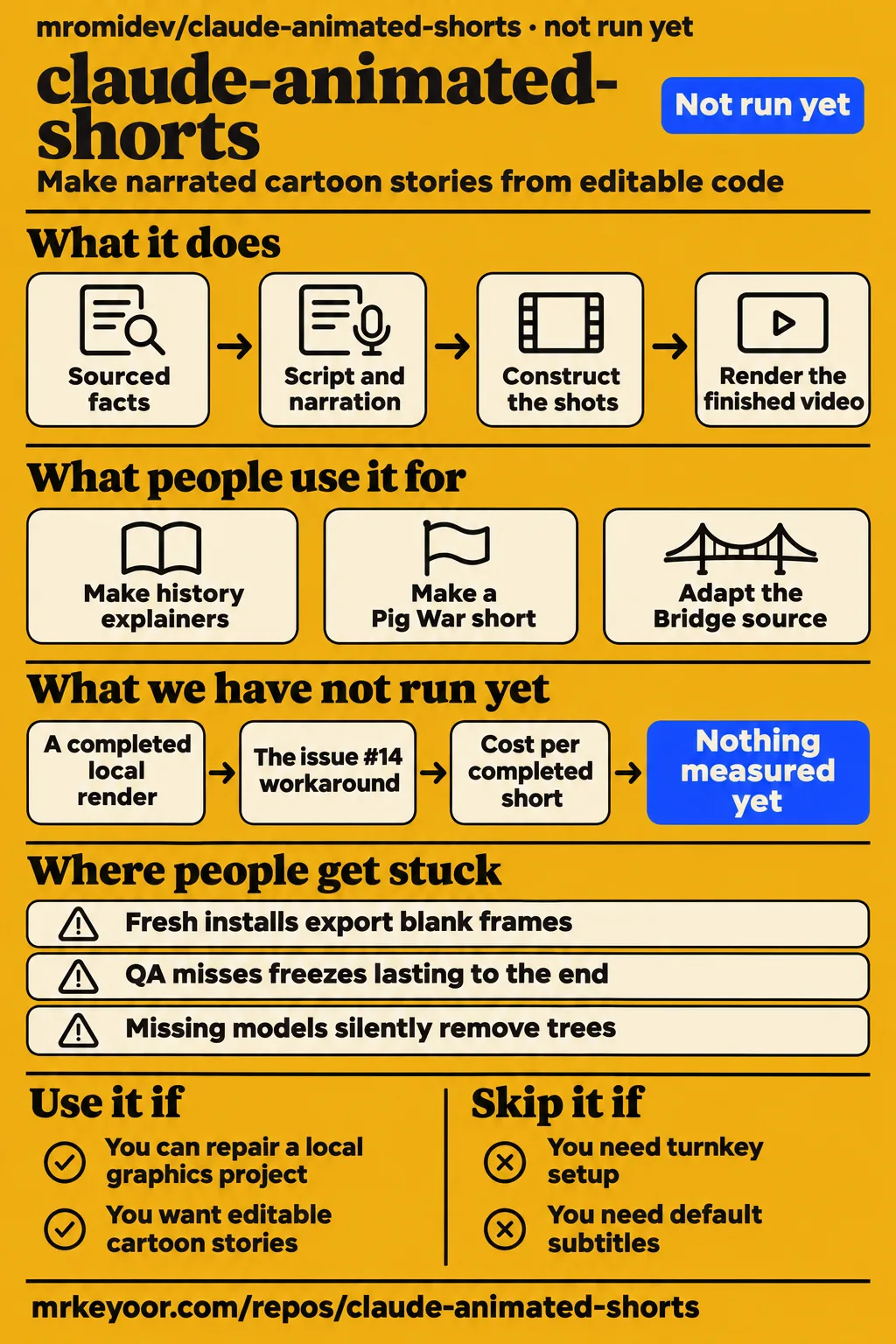
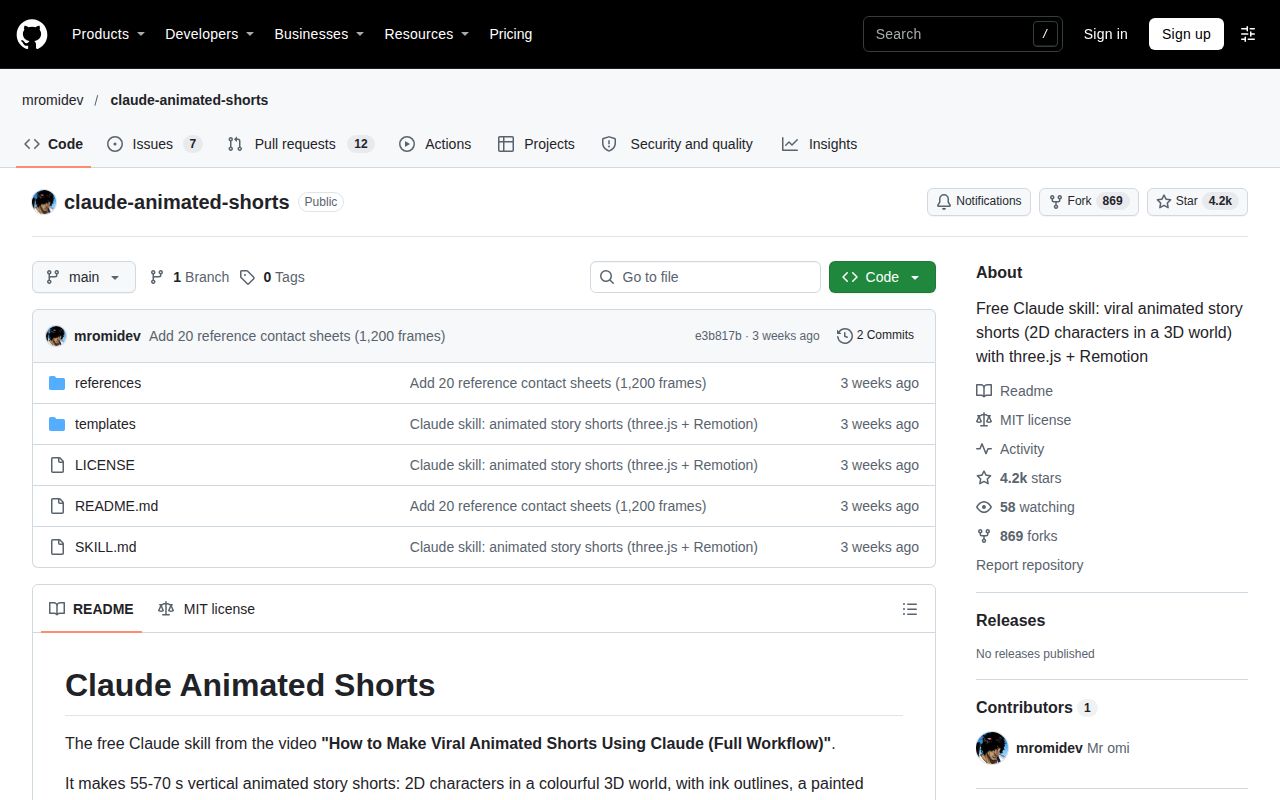
Claude Animated Shorts includes the source of a 67-second Bridge film, but fresh-install reports show why a finished example is different from a reproducible setup. Use it if you want editable cartoon history or science stories and can repair a local graphics project. Skip it if you need a turnkey renderer or want automated checks to approve the finished video for you. Our sandbox stopped before execution. Upstream README; fresh-install report.
What people use claude-animated-shorts for
The strongest concrete example is mromidev's The Bridge That Fell for a Song, a narrated animation about the 1831 Broughton bridge. The source covers the world, characters and camera, alongside synthesized sound and inspection scripts. That gives another creator something specific to adapt: a scene system with an existing story, rather than instructions to invent every component. Bridge source inventory.
| Who used it | What they did | What the record supports |
|---|---|---|
| Project author mromidev | Published The Bridge That Fell for a Song | The README identifies a 67-second example and supplies its source. Author example |
| An unnamed builder described by Morelime2 | Made a Pig War short | Morelime2 reports a 66-second film passing automated checks across 1,976 frames. This is that page's account, not a result from our lab. Pig War account |
| The reporter of issue #14 | Tried BridgeShort on Apple Silicon | The reporter got blank frames, then restored the visual chain using a dependency pin and a fragment around composer children. Fresh-install experience |
| Fork author EssouliAnas | Added a runnable project around the templates | The fork author reports project scaffolding, setup scripts and model downloads. Setup fork |
| Fork author thuann-vn | Replaced the flat characters with rigged models | The fork includes office/home scenes, an office skit and a chase test. 3D-character fork |
The actual workflow starts with sourced facts, then a script, narration and word timings. Shots follow those timings. Three.js constructs the illustrated world, while Remotion renders the composition as video. The skill then asks for still comparisons, sound assembly, a final export and frame inspection. Picture timing needs to settle before the sound mix: changing it later means generating sound again. Production instructions.
In the author's linked YouTube walkthrough, How to Make Viral Animated Shorts Using Claude (Full Workflow), the creator describes flat characters in a three-dimensional world and says Claude built the example in code. He also describes extracting visual rules from reference videos. This is an account of the creator's method, rather than a separate customer's reproduction. It helps explain why the repository contains detailed visual reports instead of just a sample prompt. Creator walkthrough.
What happened when we ran it
Our 2026-11-19 sandbox did not run commit e3b817b: the harness had no supported ecosystem for this TypeScript repository, and the repository had no Dockerfile. The recorded sandbox configuration was 3 CPUs and 8 GB RAM, with image listed as n/a. Those are configuration facts, not measured hardware requirements.
| Check | Recorded outcome | What it tells a reader |
|---|---|---|
| Source execution | Not run: unsupported ecosystem, TypeScript; no Dockerfile | No local animation result came from this attempt |
| Sandbox configuration | 3 CPUs, 8 GB RAM, image n/a; commit e3b817b | A recorded configuration, without actual runtime versions |
| Hands-on safety step | FAILED: no compose.yaml, compose.yml, docker-compose.yaml or docker-compose.yml | The deployment path required a Compose file and stopped before deployment |
| Teardown | ok | The teardown record reports completion |
The safety log uses the label "unsafe repo" because its rule requires a Compose file. That label describes the deployment harness's eligibility decision. It supplies no evidence of malicious code. The exact failure is the missing Compose configuration.
There is also a generic run record saying the repository was deployed with its own Docker Compose. That statement conflicts with the failed safety step and the explicit not-run result. We treat it as contradictory bookkeeping, not a successful deployment. No render, playback or question-answer exercise follows from that record. The blank-frame account below belongs to another user's installation.
Where people get stuck: blank frames can look like success
Issue #14 reports BridgeShort exporting only its background while the process exits successfully and logs no warning. The reporter's fresh installation was on macOS with Apple Silicon. A completed command therefore did not mean the scene appeared in the exported frames. For this workflow, opening a rendered still is a more useful first checkpoint than trusting the exit status. Issue #14.
The reporter traced the failure to the interaction between the postprocessing composer and Remotion's frame advancement. In their account, newer composer initialization happens after the frame needs it, and its render subscription also prevents the ordinary scene render. They restored the full visual chain by pinning @react-three/postprocessing to 3.0.4 and wrapping composer children in one fragment. Their suggested delayRender approach for newer versions was explicitly untried. These are a reported workaround and a proposed direction, respectively. Diagnosis and workaround.
| Symptom or setup assumption | What to inspect | Evidence and status |
|---|---|---|
| Flat background instead of the scene | Postprocessing initialization and selected dependency version | Issue #14 reports the 3.0.4 pin plus fragment restoring the post chain; the issue is open |
| Stills script cannot find Chrome | Hardcoded Windows browser path | Issue #14 identifies the path; EssouliAnas reports using Remotion's browser with a CHROME override |
| Temp files ignore the intended location on macOS/Linux | TEMP and TMP versus TMPDIR | Issue #14 identifies the platform mismatch; its record supplies no upstream correction |
| Renamed project renders the wrong composition | Hardcoded BridgeShort ID | Issue #14 points out that the skill asks you to register and rename a composition |
| Merge helper points nowhere useful | Placeholder project root | Issue #14 shows a root that must be set for the actual Remotion project |
| Trees or stalls disappear | Missing model inventory and town texture | Issue #14 reports 26 expected Kenney models and Textures/colormap.png |
Sources for the fix map: issue #14 and EssouliAnas fork README.
The missing-model behavior deserves its own check. The reporter says the loader silently skips absent models, so an incomplete town can still produce an image. Inspect the scenery as well as the characters. Before the first full render, render the supplied example as stills, confirm that the expected props and texture appear, and check the browser path and composition ID. That sequence tests the assumptions documented in the report without spending effort on a new story first. Asset and script findings.
The QA script can miss a frozen ending
Issue #13 reports that short_qa drops a frozen span when motion never resumes before the video ends. The report identifies the same e3b817b revision used for our attempted sandbox check. Its explanation is concrete: the loop writes down a freeze only when it encounters a later moving frame. At the end of the file, that trigger never arrives. Issue #13.
The reporter demonstrates the difference with synthetic frame differences. A still span followed by movement is recorded, while a still span running to the end is dropped. Imagine a scene that animates normally and then repeats its last frame until the export finishes. The report says that final freeze can escape this particular check, even though a similar freeze in the middle gets noticed. That is a reason to play the ending, not a reason to discard all of the inspection helpers. Reproduction in issue #13.
The supplied pull-request listing contains an open proposal, #21, to flush a freeze still in progress when the difference array ends. Its merged_at field is null in that snapshot. Treat the proposed correction as a contribution awaiting acceptance, not an upstream fix that every clone contains. After generating a short, inspect the closing shot and its transition into the end of the file yourself. Pull-request snapshot.
Revisions repeat sound work and temporary asset copies
The upstream instructions say each Remotion bundle copies roughly 1.3 GB of public assets into the temporary folder. They tell you to put REMOTION_TMP on a large drive. That is an upstream storage warning, not disk usage measured on our sandbox. Moving the temporary folder changes where those copies go, so choose the destination before repeated visual revisions begin. README storage note.
The skill also says later picture-timing changes require regenerating sound. A late script edit can therefore affect the word timings, shot plan and audio cues that already agree with one another. For a series, I would approve narration and its timing before polishing individual effects. Keep the sourced script with the project so a factual correction can be traced through the same sequence. The ordering follows the repository's production instructions. Timing and sound workflow.
Local rendering still needs permissions, original material and English narration
The README licenses code and documentation under MIT while limiting reference frames to style study. It tells creators to make their own story, characters and voice. Keep that distinction when preparing something for publication: an open code license is not a blanket permission to redistribute the study images. The 3D-character fork likewise says third-party assets retain their own licenses. Upstream license note; fork asset credits.
The skill's instructions specify English narration and no captions or labels in the video. English documentation is available, and the template's delivery rules are explicitly English-first. A creator needing subtitles or another narration language should expect to change those instructions and inspect the resulting timing, rather than assuming the default workflow already targets that output. Language and delivery rules.
The setup fork documents an ElevenLabs key as one voice option and a recorded voice as another. An agent following these instructions also runs local rendering and audio commands. Review the scripts and the files it can access before granting execution permissions. That is practical advice about this workflow's execution boundary, not a claim that the missing-Compose safety label identifies a security flaw. Fork voice and setup instructions.
claude-animated-shorts vs setup forks and motion-graphics skills
Choose the EssouliAnas fork for its documented project scaffolding, or the thuann-vn fork when orbitable characters are the requirement. Keep the original when you want to study and adapt mromidev's Bridge sources. Those choices concern different starting materials, rather than a measured ranking of render quality or speed. Setup fork; 3D fork; Original inventory.
| Option | What its source describes | Choose it when |
|---|---|---|
| mromidev/claude-animated-shorts | Bridge source, sound scripts and measured style references | You want this illustrated story format and can integrate the source into your project |
| EssouliAnas/claude-animated-shorts | A complete Remotion project, setup scripts and automatic model downloads, according to its author | Scaffolding and asset acquisition are your immediate obstacles |
| thuann-vn/claude-3d-animated-shorts | Rigged, orbitable 3D characters with office/home scenes | You need poses and camera angles beyond flat billboard characters |
| Simpler Remotion motion graphics | FuturPulse recommends this route for charts, captions and product interfaces | The subject can be explained without building a cartoon town |
Comparison sources: original README, EssouliAnas README, thuann-vn README and FuturPulse comparison.
How does it compare with motion-graphics skills? Its instructions prescribe a particular story rhythm and illustrated world, while a simpler graphics composition can concentrate on text, charts or interface elements. That specificity is useful when the recurring world is part of the channel's appeal. It is extra construction when the viewer mainly needs to read a diagram. FuturPulse draws that same task-based distinction. Motion-graphics comparison.
What the other reviews get wrong
WaveWeaver describes the Bridge source as a complete working Remotion project, but EssouliAnas explicitly says the original ships source files only. Those statements describe different levels of completeness: the original has the example's source, while the fork adds a project entry, composition and configuration. Issue #14 adds concrete fresh-install failures to the comparison. A reader deciding what to clone needs that distinction before following a short install recipe. WaveWeaver guide; fork explanation; fresh-install report.
WaveWeaver also puts 60 sampled frames per reference short under references/frames/. The upstream README instead lists 38 full-size frames there, with the 20 contact sheets under references/sheets/, each containing 60 frames. These are separate collections with different uses: individual comparison images and overviews of each reference short. WaveWeaver reference claim; Upstream reference inventory.
WaveWeaver's promotional appearance in the tracker is itself documented in issue #5. The thread was closed after aronezhang described the linked page as static documentation and said the tracker should stay focused on bugs and feature requests. That closure concerns a promotional thread. It does not resolve the rendering or QA reports, and neither the promotion nor a reply alleging malware supplies a security assessment. Issue #5 discussion and closure.
Questions people ask
Install cartoon-3d-short by copying the repository into ~/.claude/skills/cartoon-3d-short/ and providing Remotion with @remotion/three, Node, Python 3 and FFmpeg, as the README directs. The project integration and asset checks above matter after that copy. Installation instructions.
How do I install the cartoon-3d-short skill in Claude Code?
Copy or clone the folder to ~/.claude/skills/cartoon-3d-short/, then supply the rendering tools listed above. In Claude Code, ask it to use the cartoon short skill with your chosen subject. The upstream README describes skill discovery separately from the local rendering dependencies. README install steps.
What is the actual workflow behind these animated shorts?
Research facts, write the script, make narration with word timings, construct the shots, review stills, create sound and render the finished video. The skill requires fixing word timings by hand and checking the final frames and audio. Treat script approval as a production decision because later timing edits carry into sound generation. Full workflow.
How do you teach Claude to reproduce this animation style?
The repository supplies a style bible, visual reports and reference images, then asks agents to compare stills against them. The creator's walkthrough describes turning reference analysis into a rule book. This is instruction and comparison during production, not evidence of a newly trained animation model. Reference inventory; creator explanation.
How can I make 2D animation videos with Claude for free?
The code and documentation are free under MIT, and the supplied template uses flat characters in a 3D scene. That describes the repository's license and visual approach. A recorded voice is an option in the setup fork, while an ElevenLabs integration is another. Choose the voice route deliberately instead of treating the word free as an account of every production expense. License and format; voice choices.
Why does BridgeShort render blank frames on a fresh install?
Issue #14 attributes the blank render to composer initialization with @react-three/postprocessing versions from 3.0.5 onward. The reporter restored rendering with 3.0.4 and a fragment around composer children. Follow that report's environment and reproduction when diagnosing the same symptom rather than assuming every empty render has that cause. Blank-frame report.
Why does short_qa miss a frozen ending?
The loop described in issue #13 records a freeze when motion resumes, so it drops a freeze that lasts until the file ends. The proposed #21 change flushes the remaining span after the loop. The supplied snapshot shows the proposal open. QA report; proposed change.
Can Claude generate animated videos with this skill?
Claude writes and revises production code and files that render locally through Three.js inside Remotion. The repository explicitly says it uses no AI video generator. You still need a working project, the required assets and a review of what the exported frames actually show. README format and rendering.
How much local hardware and storage does it need?
The README warns about roughly 1.3 GB of asset copying per Remotion bundle and recommends REMOTION_TMP on a large drive. That is the actionable storage warning in the original documentation. Our configured sandbox memory is not a minimum requirement, because no render ran there. Hardware and cost evidence gaps are collected below. Storage instructions.
What we have not tested yet
We have no completed local render, reproduced installation, build result or test-suite result for this repository. The unsupported-ecosystem outcome and missing Compose file explain the stopped lab attempt. Actual runtime versions require raw toolchain logs, and image n/a establishes no operating-system version. The contradictory deployment boilerplate cannot supply the missing execution evidence.
Our review has not reproduced the issue #14 workaround, the setup fork or the rigged-character fork. We also have no visual-quality comparison across those paths. The Pig War account comes from Morelime2, and the creator walkthrough explains the author's own process. Neither supplies independent validation of repeatable creator output. The supplied evidence does not establish creator revenue, sustained adoption or a business outcome attributable to this repository. Pig War account; creator walkthrough.
How much does Claude work cost for this workflow? The supplied records provide no measured all-in cost per completed short. FuturPulse explicitly labels its token-price arithmetic as a hypothetical workload calculation rather than a finished-short quote. We also lack a reproducible render-time benchmark tied to specified hardware, minimum RAM evidence and a demonstrated supported GPU list. The setup fork's qualitative duration estimate cannot fill those gaps. Cost and hardware boundaries; fork estimate.
We have not audited command permissions, outgoing network traffic or rights for reusing reference material beyond the README's stated style-study condition. Search hits for other Claude animation tutorials and claims about faceless-channel income are not demonstrated uses of this repository. Start with the included Bridge stills, inspect the missing-model and browser assumptions, and play the final seconds of any export before trusting its QA report. Reference restrictions; fresh-install checks; ending-freeze report.