Version 0.12.1 automates the first decoding pass
Ciphey v0.12.1 takes text or a file and searches for a path to plausible plaintext. The Rust source has handlers for Base32, Base58 variants, Base64, Base91, Base65536, binary, hexadecimal, URL encoding, Morse, Braille, Caesar, Vigenere, Atbash, ROT47, rail fence, and Brainfuck. That mix suits CTF challenges, suspicious snippets, and nested encodings where the analyst does not know which operation came first.
The program uses A* search, decoder costs, pruning, and cached results. Its plaintext checkers draw on English statistics, regular expressions, wordlists, password data, and LemmeKnow classifications. Ciphey can return several candidates, accept a regex crib, or ask whether a candidate is meaningful. A readable result still needs confirmation against the source, expected format, and problem context.
A 5-second cutoff favors quick answers over exhaustive work
The CLI defaults to a 5-second cracking timeout, which users can change. --top-results keeps several possible plaintexts and turns off the human checker. --disable-human-checker matters for scripts, while --regex supplies known plaintext and --wordlist loads exact candidates. The timeout keeps an uncertain search bounded, though difficult or poorly classified input may stop without the answer an analyst hoped to see.
The library accepts text plus a Config and returns decoded text with the decoder sequence. An analyst can replay that path in another tool. Ciphey also stores successful results in SQLite. The cache records encoded text, decoded text, decoder path, and execution time, so sensitive inputs persist on disk unless the operator manages ~/.ciphey/database.sqlite.
What happened when we ran it
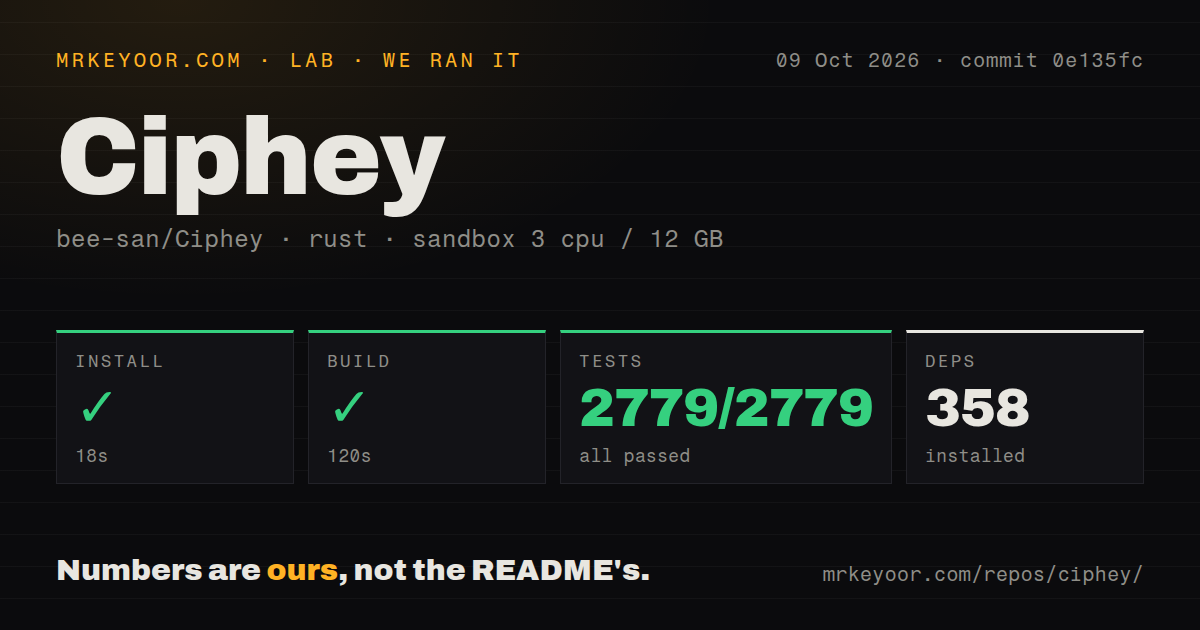
Our sandbox installed 335 packages in 31 seconds. The build completed in 89 seconds in an unprivileged container with 3 CPUs and 12 GB of RAM. The checked-out commit was e426bca, and the repository occupied 1.1 MB before the installed Rust packages. Nothing in the supplied install or build result failed.
cargo test ran for 150 seconds and reported 612 passed with 0 failed out of 612. The result establishes that the checked-out suite passed in the stated container. The lab did not measure decoding throughput, compare Ciphey with another tool, or test first-candidate quality on an outside corpus.
The checkout contained 152 files and about 13,945 lines of source. It had 8 CI workflow files, a Dockerfile, and a tests directory. Those signals match the passing suite. The quickstart workflow still declares a 3-OS matrix while setting its runner to Ubuntu for every matrix entry, so that file does not provide three-platform test coverage.
A 500 MB detector is optional, while local caching is standard
Enhanced plaintext detection uses a BERT-based model that the README sizes at 500 MB. Enabling it requires a one-time download and a free Hugging Face account. The security documentation says the token is used for download and is not written to disk. Isolated networks can leave the feature off and use the built-in checkers, accepting a different candidate-ranking path.
Ciphey creates ~/.ciphey/config.toml and ~/.ciphey/database.sqlite; optional models live under ~/.ciphey/models/. Its first-run wizard asks about display, result handling, timeout, wordlists, and enhanced detection. A service wrapper should create a known configuration, disable human prompts, decide whether cached plaintext may persist, and restrict file permissions on that directory.
Version 0.12.1 fixed an untrusted-input hang
The v0.12.1 release caps Brainfuck interpretation at 1,000,000 executed instructions. A non-terminating program now reaches the decoder's error path instead of hanging Ciphey. The release also restored exact rand 0.8 and half 2.3.1 pins after newer dependencies broke cross-platform builds. Both fixes matter for a tool that accepts strange input and publishes binaries for several operating systems.
Eight workflows do not repair the broken docs index
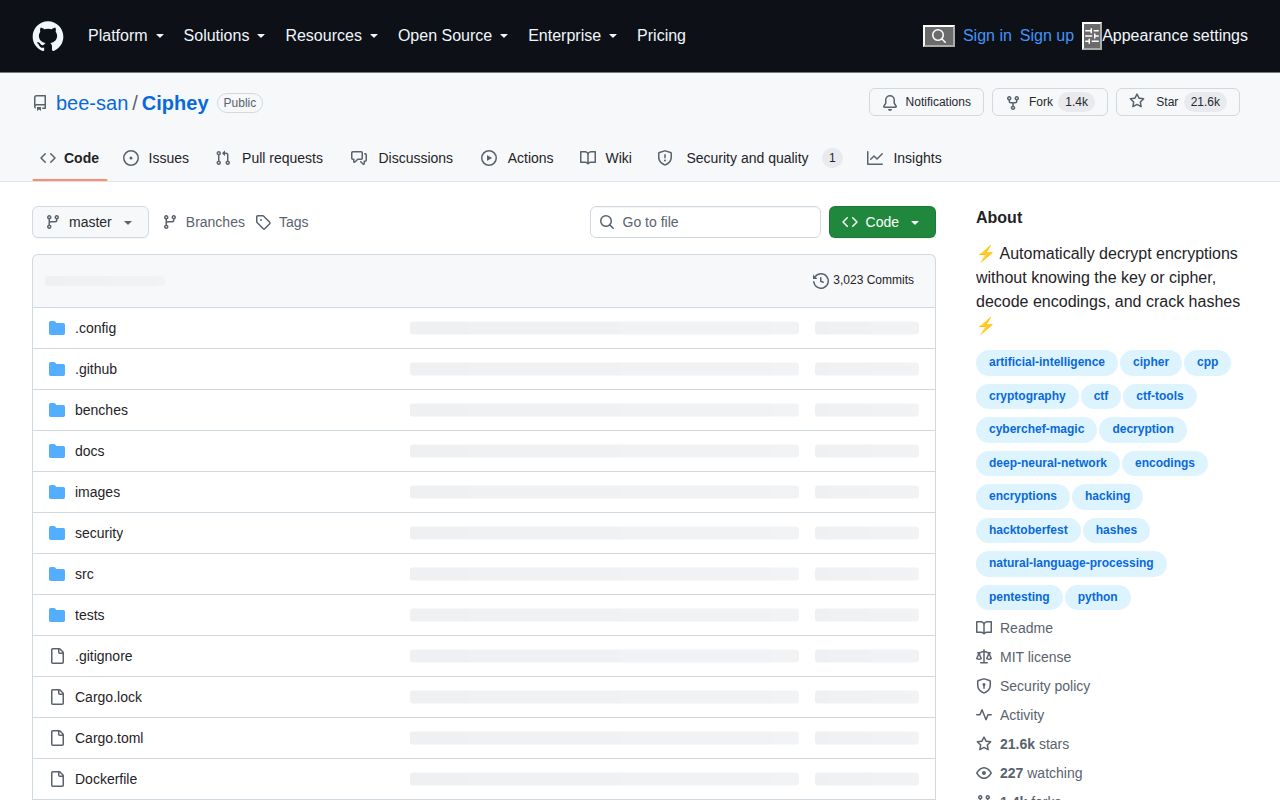
GitHub showed 21,588 stars, a last push on September 1, 2026, and 0 open issues and pull requests. Release v0.12.1 arrived one day earlier, followed by fixes to release runners and the Windows checksum. That is current maintenance backed by closed pull requests. The empty queue says little about future response, and the Rust package remains below 1.0.
Documentation quality is mixed. The README gives a Cargo command, Docker route, features, timeout, and optional-model requirements. Deeper notes cover A* search, plaintext detection, storage, and security. Yet the docs index links to ciphey_overview.md, using_ciphey.md, and ciphey_architecture.md, and all 3 paths return 404 at commit e426bca. The Dockerfile also pins its runtime stage to Alpine 3.12.
The 612-test result earns a trial, not blind trust
Ciphey belongs before a specialist tool. Give the 5-second search an unfamiliar string, inspect the proposed transformations, and confirm the output. Reach for CyberChef when you want to build the recipe by hand, Hashcat for a known password-hash mode, or RsaCtfTool for weak RSA. That division avoids asking one automatic decoder to solve every cryptographic problem implied by the repository tagline.
The 612-test suite, recent security fix, MIT license, and library interface make Ciphey a sound CTF and exploratory-decoding choice. Its pre-1.0 version, local cache, first-run interaction, optional account-backed model, broken documentation links, and Alpine 3.12 image need explicit handling in repeatable workflows. Record the decoder path and verify the plaintext outside Ciphey before acting on it.