mrkeyoor.com_
Fri 04 Sept 06:42 UTC
Dataevaluationupdated 04 Sept 2026

chinese-independent-developer review

Chinese Independent Developer is a Chinese-language directory of products made by independent developers in China. Its catalog and contribution instructions are written primarily in Chinese, and the repository has no dedicated English README. It helps readers discover working websites, apps, games, and developer products while giving makers a simple submission route.

Verdict

Our sandbox installed the repository in 11 seconds, built it in 5 seconds, and passed all 4 tests, so the maintenance code is unusually cheap to inspect and try. Use the catalog for discovering products from Chinese independent developers or as a dataset that you expect to clean yourself. Do not treat its status icons as product testing, and settle the missing license before redistributing the repository or building a commercial dataset from it.

We ran it

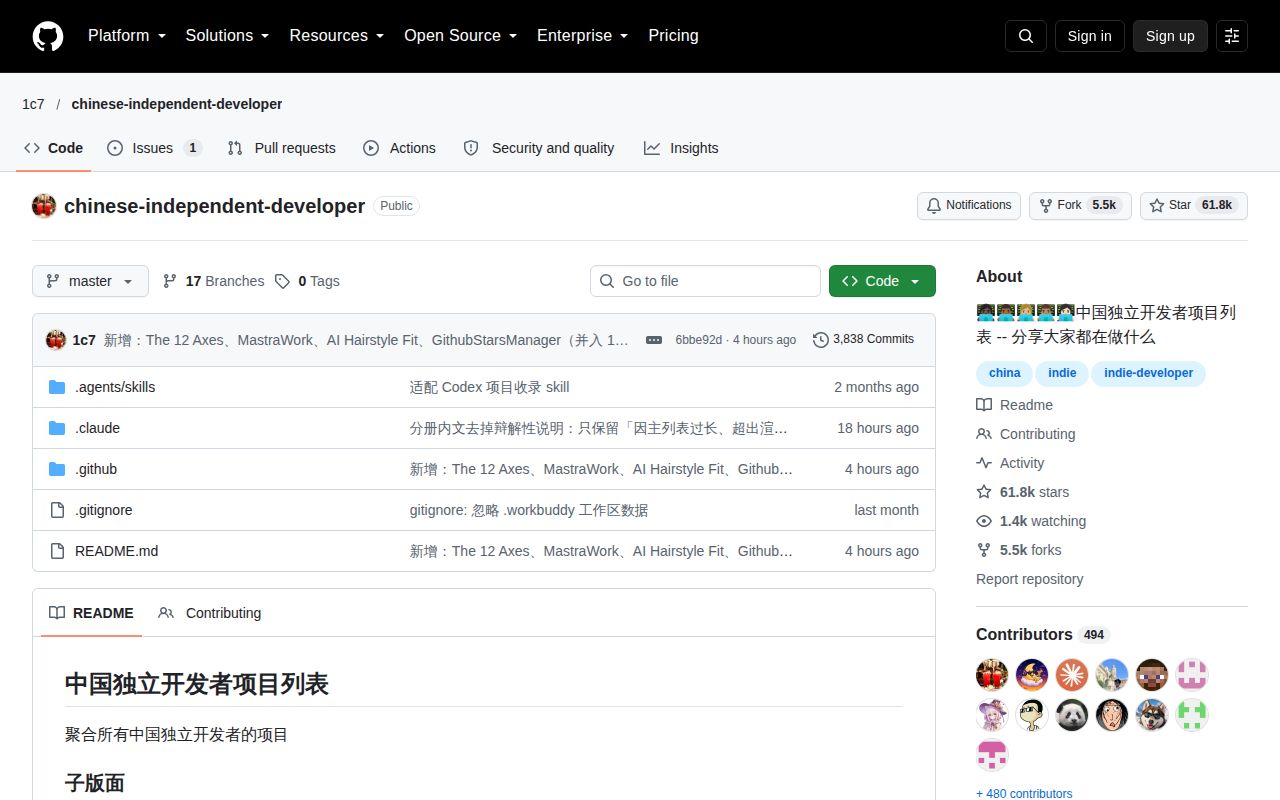
Lab card: what happened when we ran chinese-independent-developerScreenshot of chinese-independent-developer (github.com/1c7/chinese-independent-developer)
Install✓ · 11s35 packages · 37 MB
Build✓ · 5s
Tests✓ · 5s4 passed · 0 failed of 4 (pytest)
Known vulns0(pip-audit)
Repo15 files~405 lines of source · 0.8 MB · 2 CI workflows · tests dir

Answers from our run

Does chinese-independent-developer build from source?

Dependencies installed in 11 seconds (35 packages), and the build succeeded in 5 seconds. We cloned commit e3b2995 into a clean Debian container with 3 CPUs and no project-specific setup.

Do chinese-independent-developer's tests pass?

Yes: 4 of 4 passed when we ran the project's own test command (pytest). Some failures need services or credentials a bare container does not have.

Does chinese-independent-developer have known vulnerabilities in its dependencies?

pip-audit found none in the dependency tree at the time of our run.

Who should not use chinese-independent-developer?

Organizations that require an explicit open-source license: GitHub reported no detected license for a repository with 61,236 stars.

What are the alternatives to chinese-independent-developer?

Awesome Indie, Awesome Selfhosted, Product Hunt. Our sandbox installed the repository in 11 seconds, built it in 5 seconds, and passed all 4 tests, so the maintenance code is unusually cheap to inspect and try.

Setup5/511-second install and all 4 tests passed
Docs4/5Clear Chinese rules and maintainer flow; no English guide
Community5/561,236 stars and submissions handled through September 2026
Maturity3/5Long-running catalog with tests, but no detected license

Who it’s for

Chinese readers looking for small products in a catalog whose measured checkout was only 0.8 MB.
Independent developers in China who want a listing and can supply a working product URL plus a specific description.
Researchers who want a dated, human-maintained record of Chinese indie products.
Maintainers who want a tested example of turning GitHub submissions into reviewed Markdown entries.

Who it’s NOT for

Organizations that require an explicit open-source license: GitHub reported no detected license for a repository with 61,236 stars.
English-only readers who need full documentation: the main catalog, contribution guide, maintainer notes, and Claude Code skill are primarily Chinese, with no dedicated English README.
Buyers seeking independent product testing or ranked recommendations: entries are short maker submissions with status markers, not hands-on reviews.
Developer-tool authors expecting placement on the main page: the README sends command-line and code-based products to a separate programmer edition.
Makers outside China who want to submit: the documented scope and maintenance skill restrict acceptance to Chinese independent developers.

Setup reality

Our sandbox installed 35 packages in 11 seconds and used 37 MB. The build succeeded in 5 seconds, then all 4 pytest cases passed in another 5 seconds. Pip-audit found 0 known vulnerabilities at commit e3b2995.

Reading the catalog needs no account or local service. Running its submission automation needs a GitHub personal access token and an LLM API key; the scheduled Claude Code route also depends on a Claude Routine token.

The 0.8 MB checkout had 15 files and about 405 source lines, so the code is easy to inspect. Maintenance still depends on GitHub issues, reactions, pull requests, external product links, and Chinese editorial judgment. There is no Dockerfile or declared license.

Three status markers keep a sprawling Chinese catalog readable

The measured 0.8 MB checkout uses 3 symbols to label projects as in development, live, or closed and poorly maintained. The root README is a dated directory of products made by independent developers in China, with a name, link, short description, and often a maker profile. Its first question is practical: what are people shipping? That makes it useful for discovery, trend research, and finding small tools that may never reach an English launch site.

The catalog separates products by the effort required to use them. The main page is for websites and apps that open directly, while 3 linked pages cover programmer products, games, and the 2018 to 2020 archive. That division is more useful than a long tag cloud. A reader looking for an ordinary consumer app does not have to wade through command-line tools, while developers still get a dedicated list rather than being excluded entirely.

Issue 160 is the front door, with a maintainer making the call

GitHub listed 3 issues, all open on September 4, 2026, including issue 160, the standing submission thread. Contributors can also open an issue or pull request. The rules ask for a product name, working URL, short concrete description, and optional maker details. The main list accepts websites and apps for ordinary users; community sites are excluded. The contribution guide asks writers to explain the job and distinguishing limit, such as local processing or no registration, instead of submitting a string of flattering adjectives.

The repository has 2 automation routes around that editorial decision. A Python script scans maintainer-approved submissions, asks an LLM to format entries, creates a branch and pull request, then replies to contributors. A separate Claude Code skill documents a 72-hour scan of comments, issues, and pull requests, plus checks for duplicates, placement, product URLs, and contributor scope. Human approval remains central because the maintainer marks submissions and merges the resulting changes.

What happened when we ran it

Our sandbox installed 35 Python packages in 11 seconds and left 37 MB on disk. The build completed in 5 seconds. That is a light maintenance environment for a repository whose visible product is mostly Markdown, and the fresh Debian container needed no privileged access or secrets for those setup checks. The result applies to commit e3b2995 on 3 CPUs and 8 GB of RAM.

Pytest finished in 5 seconds with 4 passed and 0 failed out of 4. Those cases cover reaction ownership and the scanner's treatment of issues and pull requests. They do not visit every listed product, check descriptions against product pages, or exercise live GitHub and LLM credentials. Pip-audit reported 0 known vulnerabilities in the installed packages, which is reassuring for the tested environment without proving the linked products are safe.

The measured checkout contained 15 files, about 405 source lines, and occupied 0.8 MB. We found a tests directory and 2 CI workflow files, with no Dockerfile. One workflow installs Python 3.13 dependencies and runs the processing script manually; the other sends a scheduled request to a Claude Code routine. The repository build passing says the small automation is intact. It says nothing about whether hundreds of outside URLs still work.

The 15-file codebase belongs behind editorial review

The 15-file checkout is small enough to inspect before granting any write token. Most users should consume the list on GitHub and skip local installation. Maintainers need more machinery: PAT_TOKEN authorizes GitHub work, LLM_API_KEY feeds the formatter, and LLM_BASE_URL can point at a compatible provider. The second workflow needs its own Claude Routine token. Those secrets allow changes and contributor replies, so the repository account should give them narrow permissions.

The maintenance skill shows why a short script is only part of the system. Its 72-hour window, duplicate URL checks, page selection rules, identity checks, merge handling, and comment cleanup encode decisions that are hard to infer from the public README. A team reusing this project as a catalog engine would need to replace those China-specific rules and audit the write permissions. There is no documented generic configuration layer for turning it into a directory for another community.

Chinese coverage is the reason to visit and the access limit

The 0.8 MB checkout has a main README, a 2018 to 2020 archive, and current submission material written chiefly in Chinese. Product names and some descriptions are English, but the repository has no dedicated English README. Browser translation can make entries searchable for an English reader. It cannot supply the cultural and geographic context used when maintainers decide whether a maker belongs in this particular list.

The 3 status markers also deserve a modest reading. They distinguish development, live, and closed or poorly maintained entries, yet each row remains a short directory record. The repository does not document recurring uptime checks, security reviews, price tracking, or hands-on product tests. Use a listing as a lead, then open the product, inspect its own terms, and verify that it still does the job described before recommending or buying anything.

A September 2026 push shows activity, while the missing license limits reuse

GitHub recorded 61,236 stars and a last push on September 3, 2026. It also showed 3 open issues and pull requests; the open list contained 3 issues, including the long-running submission thread updated that day. Recent commits added new products, so the absence of a tagged release is not evidence that the catalog has stopped. A Markdown directory can stay current through small commits without packaging versions.

GitHub reported no detected license for the repository. That matters if you plan to copy the dataset, publish a derivative directory, or put its automation into a product. For reading and submitting Chinese indie projects, the list has clear scope and current maintainer activity. For reuse, ask the owner for licensing terms first, then decide whether brief self-submitted records are enough for your application.

Alternatives

ProjectWhat it isPick it when
Awesome IndieA curated resource collection, compared with this directory's measured 15-file checkout.pick this instead when you need maker guides and business resources rather than a directory of Chinese products.
Awesome SelfhostedA large catalog of software that readers can host on their own servers.pick this instead when deployable free software matters more than the identity or location of its maker.
Product HuntA global product-launch directory with voting, comments, and daily rankings.pick this instead when you want worldwide launches and popularity signals in an English interface.
Indie HackersA founder community built around product discussions, progress, and business stories.pick this instead when conversation and founder experience matter more than a compact product index.

What people are saying

  1. [velocity-scout] 1c7/chinese-independent-developer

Sources

  1. Chinese Independent Developer repository
  2. Contribution guide
  3. Standing project submission issue
  4. Maintainer workflow notes
  5. Submission processing script
  6. Claude Code maintenance skill
  7. Submission processor tests

More data reviews

dataease · tidb · anki · Summer2027-Internships · postgres · VictoriaMetrics · the whole board →