A Digital Library for a Nation's Curriculum
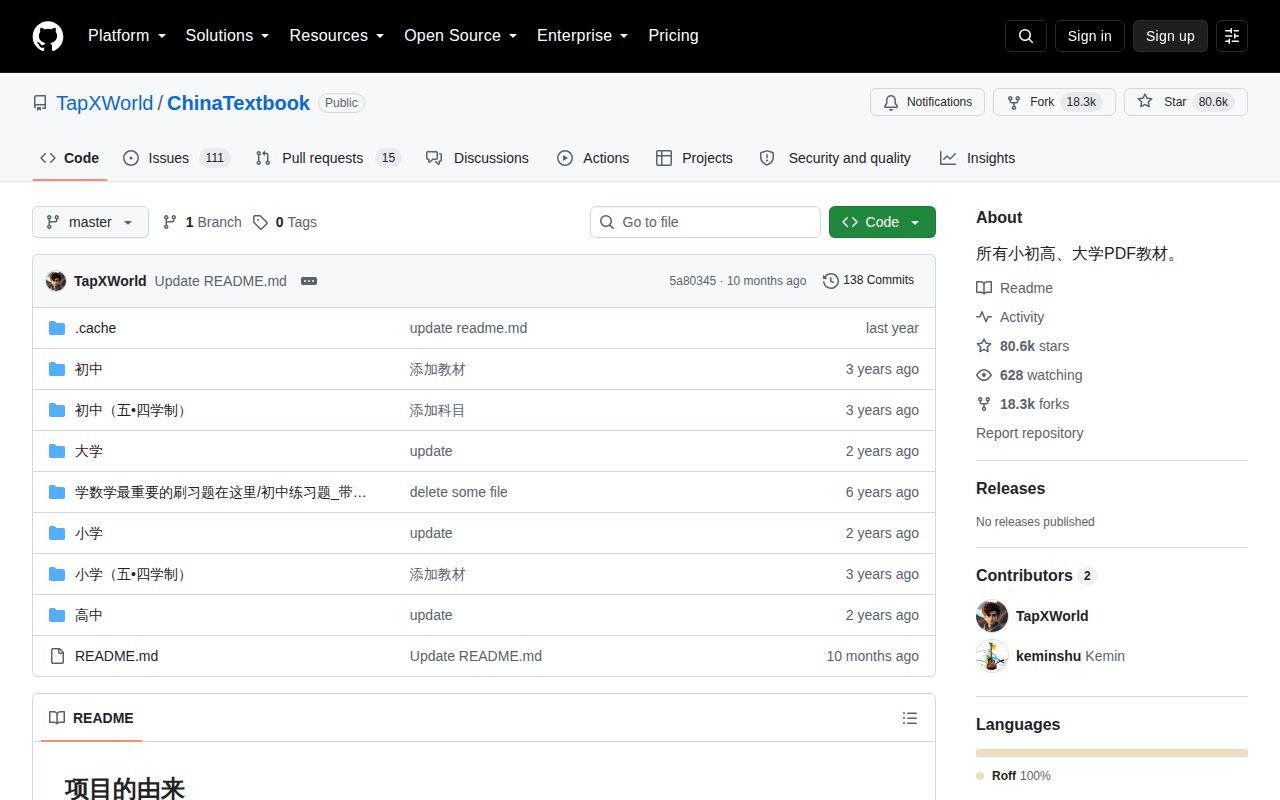
The internet promised to democratize information, but sometimes the most fundamental knowledge, the kind found in a school textbook, remains surprisingly hard to access. TapXWorld/ChinaTextbook is a direct response to this problem. It's not a piece of software or a complex platform, but something far simpler and arguably more essential: a massive, centralized repository of Chinese educational textbooks, available for free on GitHub. The project’s creator states two clear goals: to combat the practice of people selling these publicly available resources online, and to provide a way for overseas Chinese families to keep their children connected with the mainland curriculum. With over 77,000 stars, it has clearly struck a chord.
What It Offers: A Comprehensive Math Curriculum
The core strength of ChinaTextbook is its content. The repository is a treasure trove of PDF textbooks, meticulously organized by educational level. While it contains materials for various subjects, the collection is most robust in mathematics. It covers the entire educational journey, from first-grade arithmetic to university-level topics like calculus, linear algebra, discrete mathematics, and probability theory.
The structure is intuitive. You'll find folders for elementary school (小学), middle school (初中), high school (高中), and university (大学). Within these, materials are further broken down by grade and semester (e.g., "一年级上册" for first grade, first semester). This makes it incredibly easy for a parent, student, or teacher to find exactly what they need without navigating confusing government websites or third-party platforms cluttered with ads.
For its primary audience, this is a huge convenience. A family living abroad can download an entire grade's worth of math books in minutes. A university student who left a textbook at home can quickly pull up a digital copy. The project's existence serves as a powerful public utility, centralizing resources that, while technically free, are often scattered or locked behind inaccessible portals.
A notable point of thoughtful design is how the project handles GitHub's file size limitations. Because GitHub warns about files over 50MB and rejects those over 100MB, the maintainer has split larger textbooks into smaller, 35MB chunks. The README provides clear, step-by-step instructions for merging them back together, even offering a pre-compiled Windows executable (mergePDFs-windows-amd64.exe) to automate the process. This foresight prevents download failures and makes the repository more reliable.
The Cracks in the Foundation
Despite its noble goals and immense popularity, ChinaTextbook is not without serious flaws. The most significant issue is that it appears to be an abandoned project. The last code push was in October 2025, nearly a year ago. For a project of this scale, a year of inactivity is a lifetime. The 118 open issues, with no apparent responses from the maintainer, reinforce this conclusion. This means the content is static; there will be no new editions, no corrections to errors in the PDFs, and no additions of missing subjects or grade levels. Users are getting a snapshot of the curriculum from 2025, which may become increasingly outdated.
The second major concern is the ambiguous legal standing of the materials. The repository has no license file, and it hosts direct copies of textbooks published by commercial entities like the People's Education Press (人民教育出版社). While the project’s goal is to provide free access, it's operating in a copyright gray area at best. For individual students using this for personal study, the risk is likely low. However, for educators, institutions, or anyone looking to redistribute these materials, the lack of a clear license is a significant legal hazard.
Furthermore, while the solution for merging split files is helpful, it's incomplete. The provided tool is only for Windows. The README casually mentions that the process is similar for "other operating systems," but offers no guidance. A Linux or macOS user would need to know to use a command-line tool like cat to combine the files (e.g., cat file.pdf.1 file.pdf.2 > file.pdf). This isn't difficult for a technical user, but it presents a barrier for the average parent or student the project aims to serve.
Finally, the project is exclusively in Chinese. The README, the file names, and the content of every single textbook are in Mandarin. This isn't a criticism so much as a hard boundary for its audience. If you don't read Chinese, this repository has nothing to offer you.
Community: Popular but Dormant
ChinaTextbook is a classic example of a project that is wildly popular but has a non-existent development community. The 77,000+ stars represent a massive user base that finds the resource valuable. It has been featured on GitHub's trending page, indicating strong organic interest. A Telegram group is linked for discussion, which may be a hub of activity.
However, on GitHub itself, the project is a ghost town. The lack of recent commits and the pile of unanswered issues show that there is no active maintenance. This is not a project you can contribute to or expect support from. It should be treated as a static archive, not a living open-source effort. You take what's there, and if something is missing or broken, you're on your own.
The Verdict
So, should you use ChinaTextbook? If you are a student, parent, or educator who needs digital copies of Chinese textbooks, particularly in math, and you can read Mandarin, the answer is a qualified yes. It is an incredibly convenient and comprehensive source of these specific materials, solving a real access problem, especially for those outside mainland China.
However, you must use it with your eyes open. Understand that the project is unmaintained and the content may become dated. Be aware of the potential copyright issues and the risks associated with using unlicensed materials. And if you're not on Windows, be prepared to figure out how to merge the larger textbook files yourself. It's a valuable but flawed resource, a digital library whose doors are open but whose librarian has long since gone home.