It downloads from one Chinese education platform
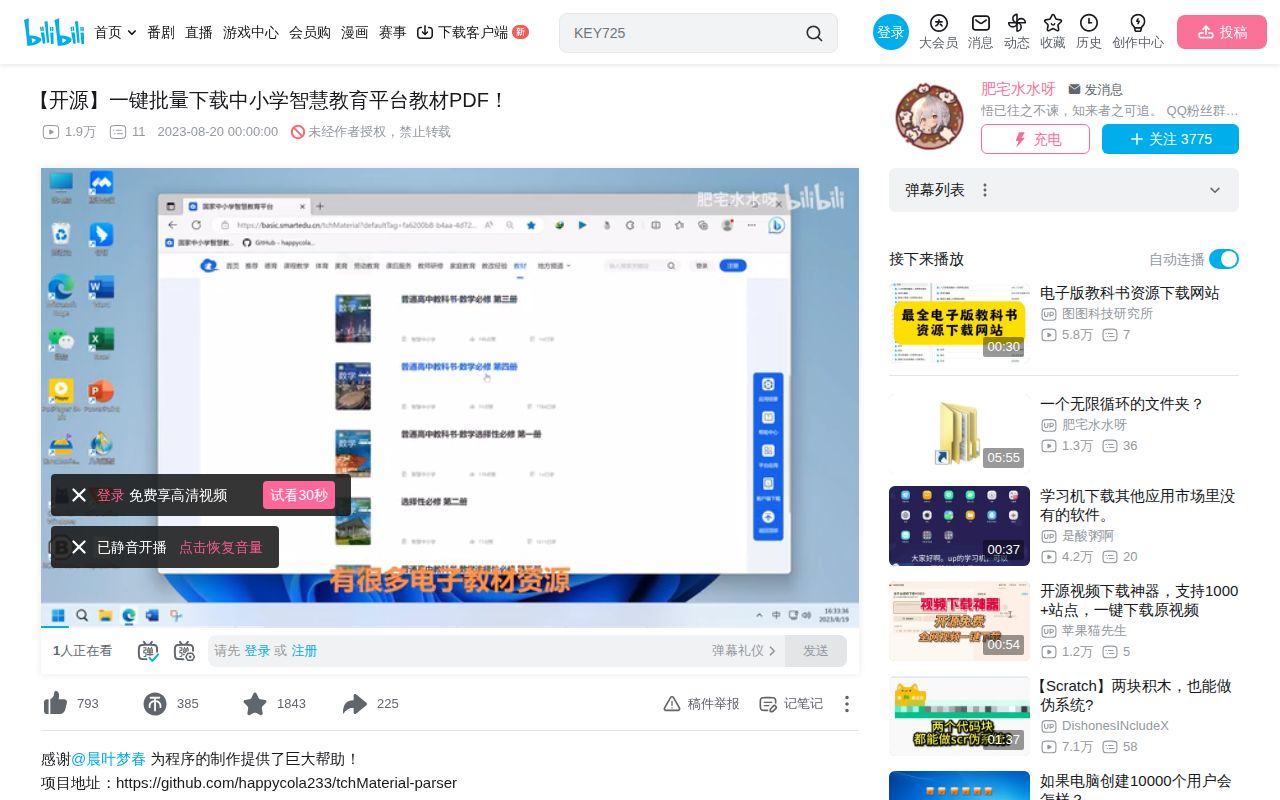
tchMaterial-parser is a focused desktop client for the National Smart Education Platform's textbook area. Users can paste one or several preview-page URLs, search resources by school stage, subject, or grade, then save files under textbook names. An optional post-processing step adds PDF bookmarks. The interface follows light or dark mode and targets Windows, Linux, and macOS, but both the application guidance and support conversation assume a Chinese-speaking user.
The repository is small: 60 files, about 3,376 lines of source, and 2.1 MB checked out. That narrow scope is an advantage for a utility tied to one site. It also concentrates platform risk. If the upstream catalog, authorization flow, or private download hosts change, there is no second provider to fall back on. The tool's value depends on maintainers tracking those changes quickly.
The graphical interface blocks server automation
This is a Tkinter desktop application. The contribution guide starts it through Python and warns that some Linux distributions need a separate python3-tk package. Minimal Linux desktops may also lack Chinese and emoji fonts, producing square placeholders. Prebuilt releases cover x86_64 and Arm64 on the three supported desktop operating systems, while unsigned macOS builds require the quarantine-removal command documented in the README.
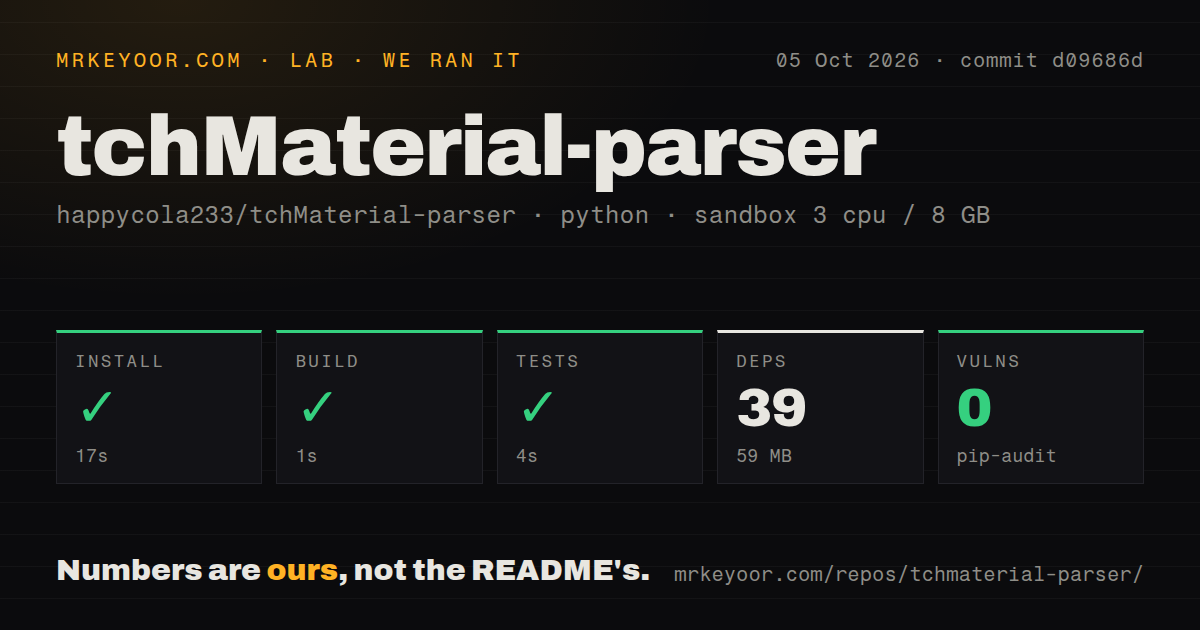
Our source install took 23 seconds, added 39 packages, and occupied 59 MB. The project requires Python 3.10 or newer and declares Pillow, psutil, pypdf, requests, and sv-ttk, plus pywin32 on Windows. Open issue 74 states that there are no command-line arguments and no CLI for headless use. A project.scripts entry launches the app, but it does not turn the GUI workflow into an automation interface.
What happened when we ran it
We cloned commit 3e200c1 and ran it in a fresh unprivileged Debian container with 3 CPUs and 8 GB of RAM. Installation succeeded in 23 seconds. The build passed in 4 seconds, and the test step passed in 5 seconds. Unlike the larger projects in this set, the complete lab sequence finished in well under a minute.
Pip-audit found 0 known vulnerabilities in the 39-package, 59 MB environment. The repository had a tests directory and 2 CI workflow files, with no Dockerfile. The clean run verifies the supplied source checks; it does not prove that every current textbook URL downloads or that the graphical interface renders correctly on each desktop. Those behaviors depend on a live third-party platform and OS UI packages outside this sandbox result.
Private downloads can require three local credentials
The README calls the Access Token optional because another download method exists when none is saved. It also warns that this anonymous path may not keep working. For authenticated access, users log into the education platform, open browser developer tools, and run a script that reads saved login data. Version 4.2 expects one JSON object containing access_token, mac_key, and diff, rather than the older single token string.
Release 4.2 shipped on August 18, 2026 after private resources returned HTTP 400 for some users. Its notes say the app now computes the site's private download signature from the current URL and spaces concurrent requests. Saved credentials may expire, commonly after about 7 days according to the FAQ. The app stores them in the Windows registry or an OS-specific local data file, and says it does not upload them. Never paste that JSON into a public issue.
Catalog accuracy is a more serious risk than installation
The app can search by resource name and educational categories, which is more convenient than collecting preview URLs manually. Yet an open July report, issue 70, says several publishers had duplicate entries and that one entry could retrieve content that did not match the official textbook, especially the vocabulary list in English books. That report has not been resolved in the issue state we fetched. Check the title, publisher, grade, and sample pages before relying on a downloaded file.
The 5-second passing test step is reassuring for code changes but cannot certify a changing remote catalog. August work shows maintainers responding to concrete breakage: version 4.2 addressed private-download authorization, while pull request 80 handled overly long filenames and collisions between same-named books from different publishers. Video download is still requested in open issues 25 and 82, so buyers should treat the tool as a textbook and related-resource downloader, not a general platform scraper.
The MIT code license does not grant textbook rights
The source code uses the MIT license, and included Microsoft Fluent Emoji assets carry their own MIT notice. Downloaded textbooks are a separate matter. The README says copyright remains with the official platform and other rights holders, limits use to personal learning and teaching reference, and tells users not to use the files commercially or redistribute them. A permissive software license does not change those content restrictions.
GitHub recorded the last push on August 29, 2026, eleven days after version 4.2. The repository had 6,419 stars and 6 open issues and pull requests when fetched. Current issue updates and recent authentication fixes indicate active maintenance. Combined with our 23-second install, 4-second build, and 5-second tests, that makes the app worth trying for its narrow audience, with the official platform kept as the authority for access and catalog identity.