mrkeyoor.com_
Wed 30 Sept 03:04 UTC
Dataevaluationupdated 30 Sept 2026

ccf-deadlines review

CCF-Deadlines is a community-maintained catalog and website for computer science conference deadlines. It turns conference YAML records into countdowns, calendars, feeds, a Python CLI, and several companion interfaces, helping researchers follow submission dates without keeping a private spreadsheet.

Verdict

Our run installed 65 packages and built in 4 seconds, but it had no detected test target, so CCF-Deadlines is easy to assemble and still needs independent data checks. Use it as a shared calendar and discovery layer, especially if CCF rankings matter to your lab. Verify the final deadline on the conference's own site, and expect the 248-pull-request queue to delay some changes.

We ran it

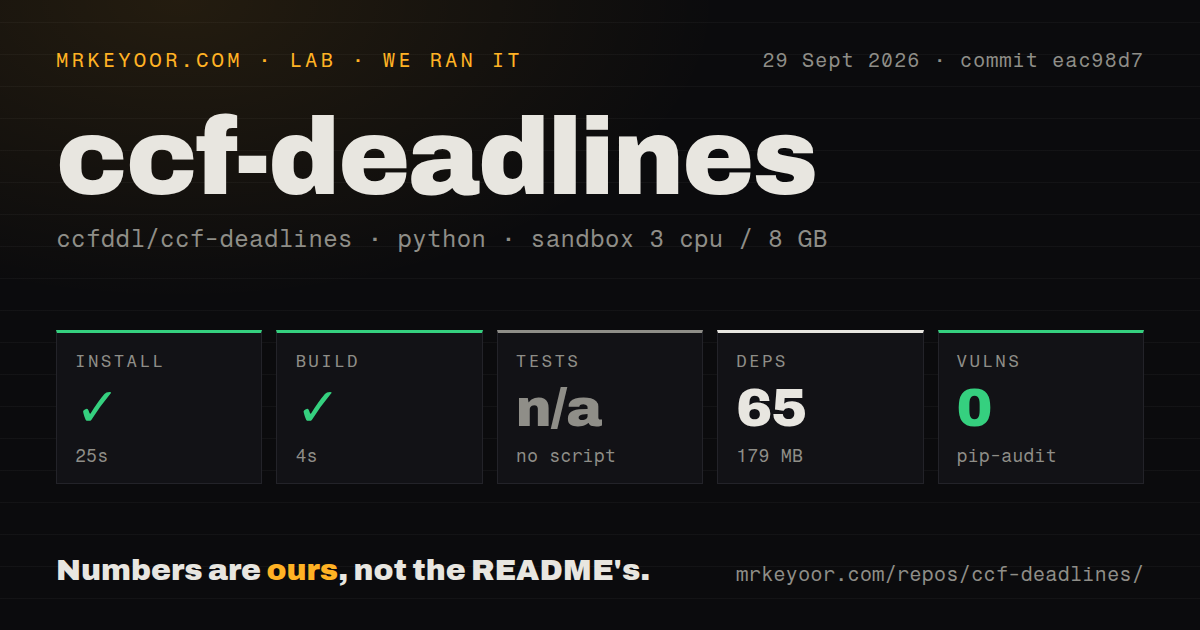
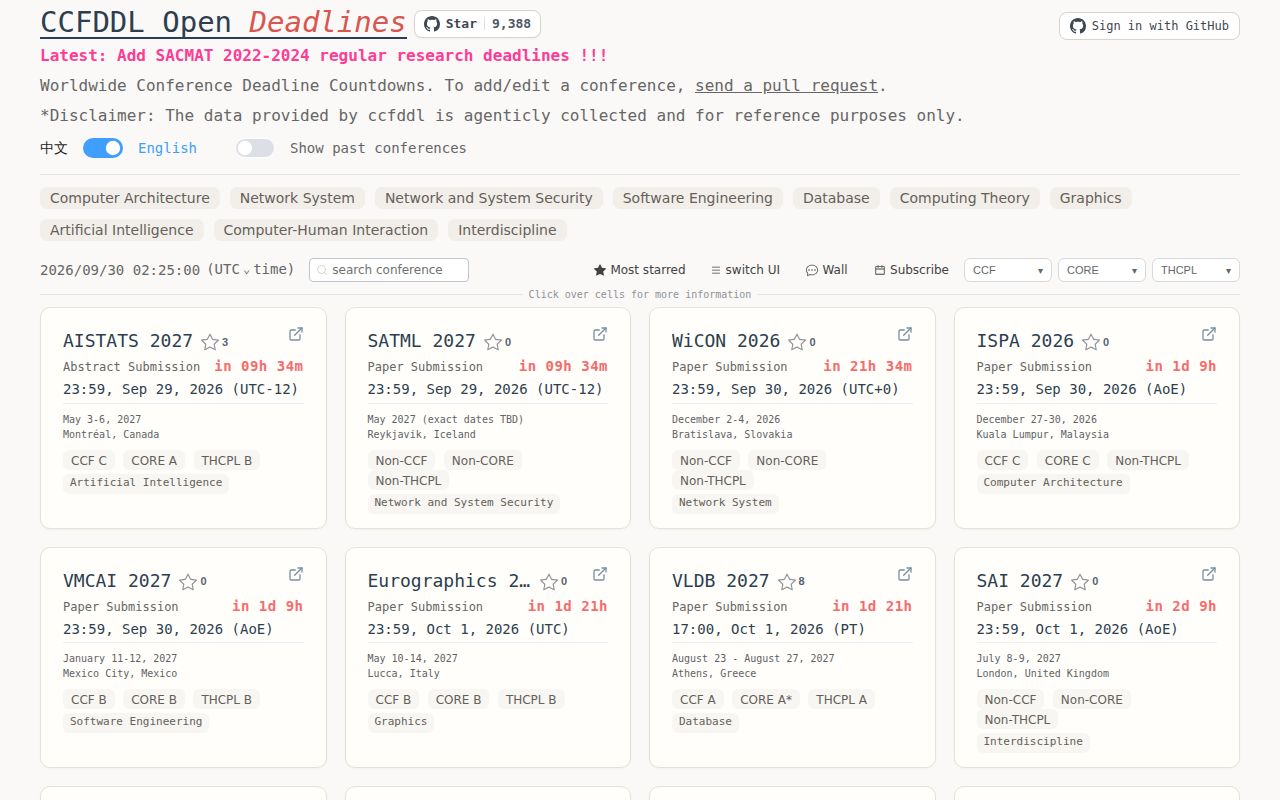
Lab card: what happened when we ran ccf-deadlinesScreenshot of ccf-deadlines (ccfddl.com)
Install✓ · 25s65 packages · 179 MB
Build✓ · 4s
Testsn/ano test script
Known vulns0(pip-audit)
Repo632 files~13,350 lines of source · 10.4 MB · 3 CI workflows

Answers from our run

Does ccf-deadlines build from source?

Dependencies installed in 25 seconds (65 packages), and the build succeeded in 4 seconds. We cloned commit eac98d7 into a clean Debian container with 3 CPUs and no project-specific setup.

Does ccf-deadlines have tests you can run?

Not through a standard command: the project exposes no test script or target that our harness could run.

Does ccf-deadlines have known vulnerabilities in its dependencies?

pip-audit found none in the dependency tree at the time of our run.

Who should not use ccf-deadlines?

Researchers who will submit from the countdown alone: the catalog is community-edited, and open issue 239 says some conferences can go without updates.

What are the alternatives to ccf-deadlines?

Hugging Face AI Deadlines, AI Deadlines, SecDeadlines. Our run installed 65 packages and built in 4 seconds, but it had no detected test target, so CCF-Deadlines is easy to assemble and still needs independent data checks.

Setup4/525-second install and 4-second build, with no test target
Docs4/5Clear YAML schema, contribution steps, and CLI examples
Community4/59,388 stars and September 30 activity, but 248 PRs await review
Maturity3/5Useful outputs, while the data backfill remains incomplete

Who it’s for

Computer science researchers who follow CCF, CORE, or TH-CPL ranked conferences.
Labs that want shared deadline data in YAML, JSON, iCal, RSS, a website, or a Python CLI.
Contributors willing to verify a conference page and submit corrections through pull requests.
Self-hosters comfortable with a Python data build followed by a Rust and WebAssembly front end.

Who it’s NOT for

Researchers who will submit from the countdown alone: the catalog is community-edited, and open issue 239 says some conferences can go without updates.
Teams that need a small review queue before trusting new records: GitHub showed 248 open pull requests on September 30, 2026.
Maintainers seeking a one-command container deployment: our scan found no Dockerfile, while the workflow installs Python, Rust nightly, a WebAssembly target, and Trunk.
Buyers requiring a test result from our sandbox: the harness found no test script or target, so it skipped that step.
Edge users depending on the browser extension: open issue 2485 reports that its popup can stop opening.

Setup reality

Our fresh Debian sandbox installed commit eac98d7 in 25 seconds, adding 65 packages and using 179 MB on disk. The build succeeded in 4 seconds. The harness found no test script or target, so tests were skipped. Pip-audit reported 0 known vulnerabilities.

The production workflow uses Python 3.12 to assemble conference data and create iCal and RSS files, then Rust nightly, the wasm32-unknown-unknown target, and Trunk to build the browser app. Contributors edit YAML; CLI users can install the separate Python package.

The 10.4 MB checkout held 632 files and about 13,350 lines of source. There is no Dockerfile and no top-level tests directory. The repository does contain CI checks, but our measured run did not execute them, so the successful build is the only runtime gate we can report.

The shared deadline data is the reason to use it

Each record can hold 3 ranking systems, multiple deadline stages, and a precise timezone. CCF-Deadlines puts those fields into one catalog, then publishes them as countdowns, tables, iCal files, RSS feeds, and command-line output. The repository is most useful as a common source for a research group, with the website acting as one view over the data.

A conference record also carries a short name, subject code, DBLP identifier, event date, and location. A deadline may include abstract, rebuttal, and decision dates as well as submission time. Rankings can cover CCF, CORE, and TH-CPL. That is enough structure to answer a practical question such as which A-ranked AI venues close next month.

Ten subject codes define the catalog's center of gravity

The schema divides venues among 10 CCF subject codes, including AI, databases, security, software engineering, graphics, and theory. Non-CCF entries can use an N rank, and optional ranking fields widen the lens. Still, the organizing system comes from computer science conference lists. It is a poor fit for journals, grant calls, workshops outside the catalog, or a field that does not use these ranking systems.

The README makes contribution straightforward: edit a conference YAML file and open a pull request. Required fields force contributors to specify the timezone and exact deadline format instead of leaving readers to interpret a date. The format supports UTC offsets, Anywhere on Earth, and Pacific Time with daylight-saving adjustment. That precision is useful, provided the source date itself is current.

What happened when we ran it

Our sandbox installed commit eac98d7 in 25 seconds, pulling 65 packages and using 179 MB on disk. The build passed in 4 seconds. This ran inside an unprivileged Debian container with 3 CPUs, 8 GB of RAM, Python 3.12, and no secrets. Pip-audit found 0 known vulnerabilities.

The harness did not find a tests script or target, so it skipped tests. That is not a passing suite. The repository signals also showed no top-level tests directory, though its workflow and subdirectories contain their own check commands. We report the path our sandbox executed: dependency installation and build worked, while no test result was produced.

The checkout was modest at 10.4 MB, 632 files, and about 13,350 lines of source. Its deployment path has more moving parts than those numbers suggest. Python assembles YAML into JSON and creates iCal and RSS output. The browser front end uses Rust, WebAssembly, and Trunk. GitHub Actions installs Rust nightly and the WebAssembly target after the Python stage.

Calendars and the CLI make the catalog reusable

The Python CLI filters on 3 axes, conference, subject, and rank, and can return JSON. Generated iCal and RSS files put dates into tools researchers already check. The README also points to a WeChat applet, Raycast extension, SwiftBar plugin, Chrome extension, and a separate terminal interface.

Those options remove the need to scrape the visual site. A lab can subscribe to a calendar, query JSON in a script, or keep a filtered terminal view. Generated data is split so the front end can load current deadlines before historical records. If a split file is missing during deployment, the documented loader falls back to the original full JSON file.

A 248-pull-request queue slows human review

GitHub showed 9,388 stars, 8 open issues, and 248 open pull requests on September 30, 2026. The repository was pushed that same day. Many recent proposals add or correct acceptance statistics, while issue 1888 says the 2021 through 2026 backfill remains in progress and that an open pull request does not mean a conference has been fully checked.

That is active work, but the queue is also review debt. A date or acceptance figure can sit outside the main branch while maintainers inspect its evidence. Open issue 239 raises the older problem directly: conferences that attract little attention may go without updates. Community maintenance spreads the workload; it does not guarantee equal coverage.

Final submission dates still belong to the conference

Our 4-second build says nothing about whether tomorrow's submission date is correct. Check the linked conference site for the current call, timezone, track, and extension, then use CCF-Deadlines for reminders. Issue 2485, which reports an unreliable extension popup in Edge, is another reason to keep a calendar export or the main site available.

The trade is fair for most computer science labs. The data format is readable, and the outputs cover browsers, calendars, feeds, and terminals. Adopt it as shared plumbing if its rankings match your field. Keep the official conference page in the submission checklist, because a missed deadline costs far more than one extra verification.

Alternatives

ProjectWhat it isPick it when
Hugging Face AI DeadlinesA focused countdown site for artificial intelligence conference deadlines.pick this instead when AI conferences are your whole scope and CCF categories add noise.
AI DeadlinesThe established AI conference deadline tracker now maintained under Papers with Code.pick this instead when you want a familiar AI-only calendar with a narrower dataset.
SecDeadlinesA deadline countdown site limited to security and privacy conferences.pick this instead when security and privacy venues are the only dates you need.

What people are saying

  1. [github-trending] ccfddl/ccf-deadlines

Sources

  1. CCF-Deadlines repository
  2. CCF-Deadlines deployment workflow
  3. Issue 1888: acceptance-rate backfill
  4. Issue 239: automatically update conference times
  5. Issue 2485: Chrome extension sometimes not working

More data reviews

instagram-private-graph · OpenBB · polyledger · timeseries-atlas · opendataloader-pdf · data-formulator · the whole board →