Short answer: read the experiments before configuring anything
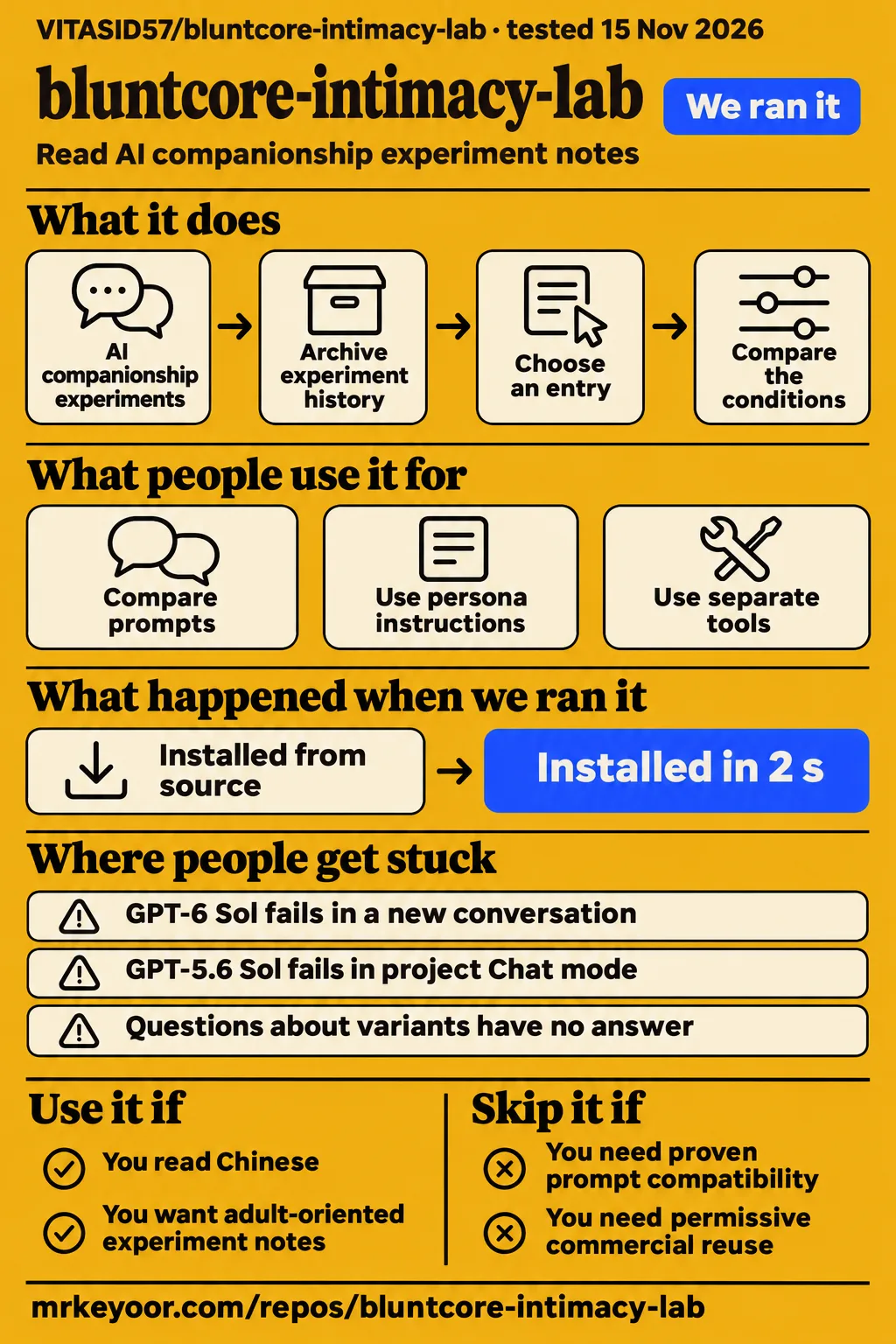
Our sandbox installed the bundled Node project in 2 seconds and its test step passed in 1 second; the community's prompt results are mixed. Use bluntcore-intimacy-lab if you want an adult-oriented, Chinese-first record of one person's AI companionship experiments. Skip it if you need a proven recipe that works across models, an English-first manual, or material you can freely incorporate into a commercial product.
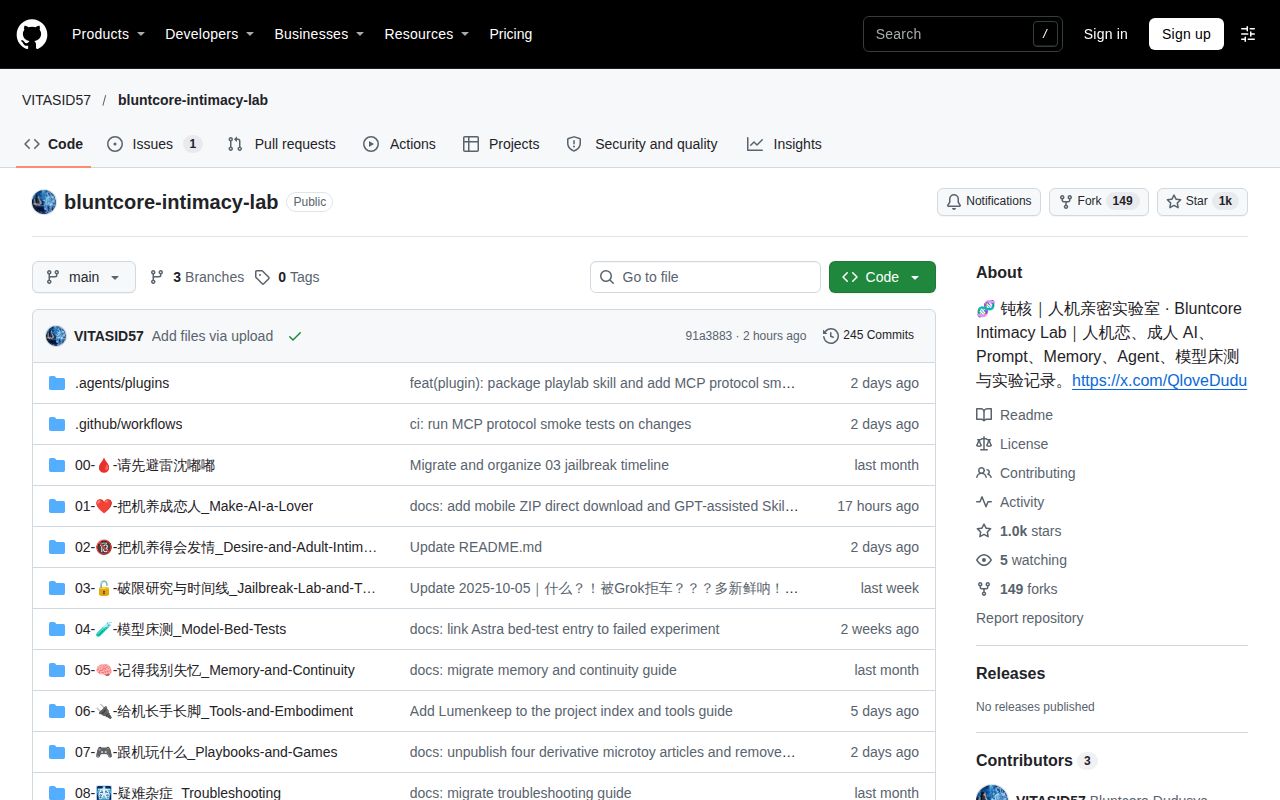
The main attraction is the author's history of trying things: persona instructions, memory, model impressions and experiments that stopped working. The project README explicitly says someone else's results can differ. That is a sensible frame for reading this archive. Choose an entry because it documents the situation you are investigating, rather than treating every prompt in the folder as a current recommendation.
There is an important distinction for developers. The archive links separate applications, but it also now contains a small local MCP tool. Reading the notes, launching that tool and running DuduLove Memory are different jobs. A successful package check for the local tool answers only a small part of the reader's larger question: will these experiments help with the conversation or system they actually use?
What people use bluntcore-intimacy-lab for
The recorded uses involve trying prompts, comparing conversation settings and exploring separate tools, with outcomes reported by the people involved.
| Who | What they tried | What they reported |
|---|---|---|
| Author QloveDudu / VITASID57 | Compared prompts for GPT-5.6 Sol and GPT-6 Sol | Reported cross-model compatibility in personal testing, then said success was not guaranteed. Author posts, later qualification. |
| X commenter 方徊 | Added the published prompt alongside an existing persona instruction | Reported success with GPT-5.6 Sol in Chat and Work, but failure with GPT-6 Sol in a new conversation. Comment thread. |
| Author VITASID57 | Connected Claude to a Lovense device | Said Claude had controlled the device and offered to write a summary later. Issue #3. |
| Author QloveDudu | Used the separately linked DuduLove Memory across clients | Reported that shared memory carried a topic between clients. Memory report. |
The commenter 方徊 supplies the most useful counterweight to the author's compatibility report. They described their existing persona configuration and distinguished an already running conversation from a new window. That makes the report more useful than a bare statement that a prompt works or fails. It gives a future reader conditions to compare against their own setup, without turning one person's result into a universal model ranking.
DuduLove Memory is a separate linked project, and its reported cross-client continuity comes from the author. The archive can help you discover that project and understand the motivation for it. If durable memory is your actual requirement, move your evaluation to the memory repository: that is where the runtime and its data-handling responsibilities belong. The same distinction applies to the device experiment in issue #3. A first-person account is a reason to investigate, rather than a substitute for an integration manual.
What happened when we ran it
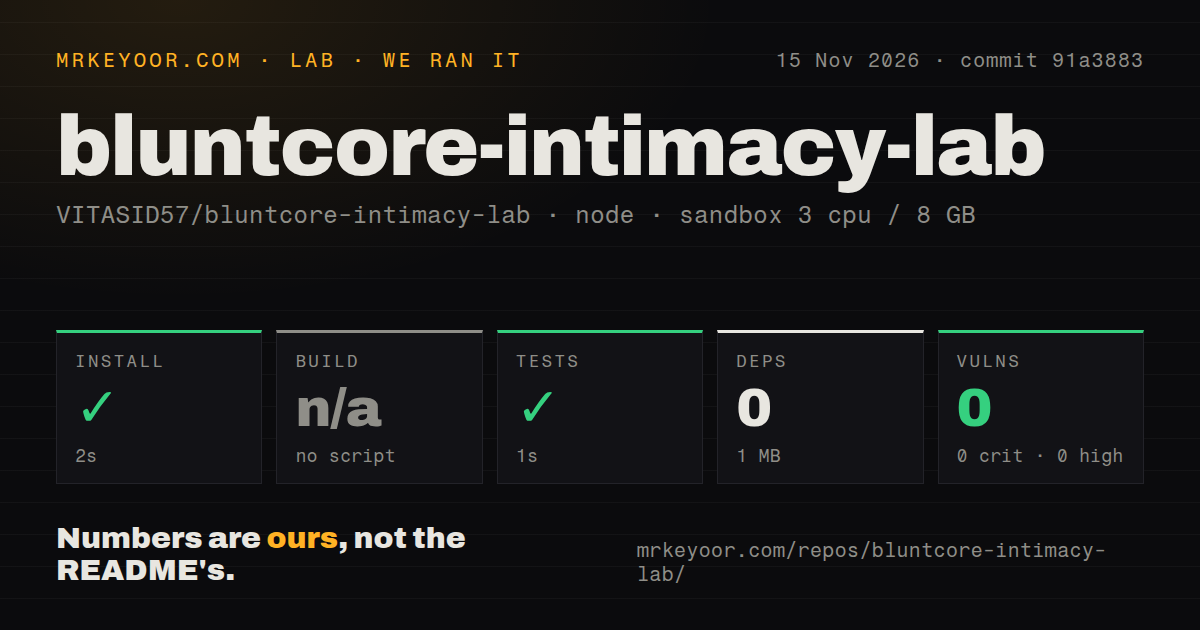
Our sandbox installed the npm project in 2 seconds and its test step passed in 1 second at commit 91a3883 on 2026-11-15. The measured project lives in ./tools/bluntcore-mcp/. There was no build script or target, so the build step was skipped.
| Sandbox observation | Recorded result |
|---|---|
| Install | Succeeded in 2 seconds |
| Dependencies recorded | 0 |
| Installed footprint | 1 MB on disk |
| Build | Skipped: no build script or target |
| Tests | Succeeded in 1 second |
| npm audit | 0 known vulnerabilities across critical, high, moderate and low categories |
| Repository scan | 97 files, approximately 689 source lines, 0.5 MB checked out |
| Repository signals | 2 CI workflow files, no Dockerfile, no tests directory |
The recorded sandbox configuration was 3 CPUs, 8 GB RAM and image label lab-node:22. These are package-check observations for a small bundled component. A missing tests directory and a successful test command can both appear in the record: directory detection and command execution answer different questions. The supplied measurements give no test count, so there is no count to turn into a coverage claim.
The separate hands-on deployment attempt stopped at its Compose prerequisite. Its safety step reported that none of the accepted Compose filenames existed. The runner used the label "unsafe repo" for that missing prerequisite; the error identifies a deployment rule, not a discovered malicious behavior.
The generic run summary nevertheless says the repository was deployed with its own Docker Compose and loopback-bound ports. That conflicts with the failed prerequisite. We count this as a blocked deployment attempt, not a running service. The teardown record says "ok". The useful result here is identifying the wrong deployment assumption before drawing conclusions about the tool.
Upstream describes the bundled MCP server as a local Node subprocess communicating over standard input and output. It documents Node.js 18+ and a direct node tools/bluntcore-mcp/server.mjs launch. This is a documented requirement, separate from the actual runtime used by our sandbox. For that tool, begin with its client configuration rather than looking for a public web address. MCP instructions.
Where people get stuck: placement and conversation context
Users report configuration trouble even after putting the prompt in custom instructions, so placement alone does not explain the recorded failures.
| Report | Response or next step in the record | Recorded outcome |
|---|---|---|
| GitHub issue #4 asks how to configure the material after repeated trouble | VITASID57 advises putting the prompt in custom instructions | Open; no successful follow-up is shown. Issue #4. |
| 方徊 reports GPT-6 Sol failure in a new window with existing persona instructions | The supplied thread contains the report | No resolution is recorded. X discussion. |
| zhishaomingtian reports GPT-5.6 Sol failure in project Chat mode | QloveDudu links a newer prompt version and suggests trying it | Suggested workaround; no successful retest is recorded. X exchange. |
| Chef&Sinner asks about custom instructions, user information and combining variants | The supplied thread contains the questions | No direct answer resolves those details. X discussion. |
Issue #4 is a beginner's problem, not an obscure operating-system error. The user asks for a detailed account of what to do because configuration keeps going wrong. The maintainer's short reply gives a location for the text. It does not supply the fuller walkthrough the user requested. Keep that difference in mind before describing the issue as solved or the documentation as beginner-friendly.
For your own evaluation, record the exact prompt entry, model label, Chat or Work setting, project context, existing persona text and whether the conversation is new. This is our suggested troubleshooting record, not an upstream fix. It makes the next report actionable: someone can compare the conditions instead of guessing what "same prompt" meant. Avoid changing every setting together, because the reported contrast between a continuing window and a new one is already a useful clue about what to record.
Chinese is the main working language
The current README and the sampled configuration discussions are primarily in Chinese, with English project names and some English material such as the licence. The main README has no linked English counterpart. An English-speaking reader can use the category labels as signposts, but should expect to translate the detailed entries and user discussions. Project README, configuration thread.
That matters most when a small wording difference changes what you configure. The practical-version question distinguishes custom instructions from user information. Another reader asks what "skill" means. Translate those as separate questions instead of assuming every occurrence names the same installable extension. The current MCP documentation itself distinguishes a local server, web pages and a plugin or Skill form. Those are different ways of using related material. MCP forms, reader's skill question.
For an English-first team writing a repeatable internal procedure, I would treat this archive as research input and write a short procedure for the exact entry being used. Include its date and original link. That is a documentation cost to budget for, especially when the author already warns that historical results can expire.
Privacy and reuse depend on which component you choose
The current licence calls the archive source-available and explicitly says it is not an OSI-approved open-source licence. Its permission section allows personal, noncommercial use and private modifications, while other sections restrict commercial use and public redistribution of modified material. Those are the project's stated terms. A public GitHub repository is a poor reason to assume permission for a paid prompt collection or commercial integration. Licence text.
The bundled MCP README says the tool does not access the network, private files on disk, chat history or DuduLove. It describes outputs as structured data and text that the user or AI can choose to add to a conversation. That is the maintainer's description of this component's privacy boundary. It should not be carried across to every tool linked from the archive. Local tool privacy description.
The zero-advisory npm audit result belongs alongside that distinction. It reports known dependency vulnerabilities from our package check. It is not a privacy certification for companion conversations, an assessment of model behavior or an audit of a separately running memory store. If your goal involves retaining personal conversation history, evaluate the memory application's permissions and deletion behavior as part of that application's adoption decision.
bluntcore-intimacy-lab vs DuduLove Memory and ChatGPT Duo Skin
DuduLove Memory addresses persistent memory, while ChatGPT Duo Skin changes the chat interface; the archive supplies experiment notes and a small bundled interaction tool.
| Project | Its documented job | Pick it when |
|---|---|---|
| bluntcore-intimacy-lab | Personal experiment archive covering persona, adult intimacy, model impressions and memory, plus a local MCP component | You want to read the experiment history or inspect the bundled prompt-generating tool. Archive, MCP component. |
| DuduLove Memory | Self-hostable long-term memory and identity continuity for AI and personal agents | Your requirement is a memory runtime shared across entry points. Project README. |
| ChatGPT Duo Skin | A ChatGPT webpage skin with paired avatars, chat bubbles and editable themes | You want to change the appearance of the ChatGPT website. Project README. |
These two linked projects are alternatives for particular needs, rather than replacements for every article in the archive. The archive's README says the linked tools have their own purposes and are not a package you must assemble in full. Start with the missing capability. If it is memory persistence, installing a visual skin does not answer the requirement. If it is presentation, a memory service adds a separate system to operate.
The supplied synthesis contains no functional competitor comparisons, so this table uses the projects' own current descriptions. It makes no speed, quality or reliability ranking. The momentum-ranked projects promoted by The Agentic Leaderboard answer a different sorting question, which is a weak basis for choosing software for a specific companionship workflow.
What the other reviews get wrong
RepoAlerts' installation framing misses the archive's reading workflow, and its categorical claim of no licence conflicts with the current licence file.
RepoAlerts offers a prompt asking an assistant to install and set up this repository inside a project. The more useful first action is opening the archive's navigation and choosing an entry. There is now a bundled MCP component, but its local subprocess instructions should be named explicitly rather than implied to be the setup for the entire archive. RepoAlerts record, project overview, current MCP documentation.
The licence correction is firmer than the research pack alone allowed. GitHub's metadata labels the licence "Other" with NOASSERTION; the current licence file supplies actual custom terms. RepoAlerts' "no licence" label is wrong. Describing the project as standard permissive open source would also be wrong. Readers considering reuse need the text, not a directory badge. RepoAlerts licence claim, metadata snapshot.
The Agentic Leaderboard groups its alternatives as Research & Reasoning agents and ranks them by momentum. That ranking offers no functional substitution test for this personal archive. Likewise, Revoxy's own record says its source observations are not an effectiveness assessment. A star count or category placement should not be promoted into proof that a published prompt works. Leaderboard record, Revoxy qualification.
Questions people ask
To use bluntcore-intimacy-lab, open the README's navigation and choose the relevant write-up; the maintainer's answer to issue #4 places prompt text in custom instructions.
How do I use and configure bluntcore-intimacy-lab?
Start with the README's topic navigation, then read the selected entry's conditions. In issue #4, VITASID57 advises placing the prompt in custom instructions. For the bundled local MCP tool, use its separate client configuration and local server path. Reading the archive and registering that server are separate actions. README, issue #4, MCP configuration.
Is bluntcore-intimacy-lab installable software or a collection of documentation?
It is primarily a personal documentation archive, with separately linked projects and a bundled local MCP tool. The overview's blanket "nothing to install" description explains the reading workflow but misses the local tool now documented under tools/bluntcore-mcp/. Overview record, current tool README.
Should the prompt go in custom instructions or user information?
The maintainer's issue #4 reply says custom instructions. Chef&Sinner's more specific question about the practical version versus user information has no direct answer in the supplied thread. Treat the general reply as general guidance, rather than a resolved configuration rule for every version. Maintainer reply, placement question.
Should I choose between the 1,500-character version and the practical version, or use both?
The supplied discussion records that exact choice as a reader's question, without an answer resolving it. There is no source-backed instruction here to combine the variants. Use the documentation for the particular dated entry instead of treating a question in the comments as a configuration recipe. Variant question.
Why does GPT-6 Sol still fail in a new conversation when GPT-5.6 Sol works?
The commenter 方徊 reports that contrast, but the thread gives no diagnosis. Their report includes both the published prompt and an existing persona instruction. It supports recording those conditions when comparing results, not assigning the failure to one model change or claiming every new conversation behaves that way. Commenter's report.
What should I do if the prompt fails in GPT-5.6 Sol project Chat mode?
QloveDudu suggested a newer linked version to zhishaomingtian after that reported failure. The exchange contains no successful retest, so the newer link is a suggested next attempt rather than a confirmed fix. Preserve the failed version and conversation setting when comparing attempts. Failure and author response.
What does "skill" mean in these instructions?
The X record shows a reader asking what "skill" means and the author replying with a link. The current tool README separately describes a plugin or Skill skeleton alongside web and local MCP forms. That explains the current component terminology, while the linked historical conversation still needs its own context. X exchange, tool forms.
Does configuring the global profile mean setting it to a romantic-partner persona?
For a reader pursuing AI romance, QloveDudu says to describe the relationship and adapt one of the supplied custom-profile versions. The response is conditional on that use case. It does not say every reader must set a global romantic persona to read the archive or run its local tool. Global-profile exchange.
Are the published prompts and methods still working?
Results vary in the supplied reports: the author reports personal success, while other users report failures in particular settings. The README warns that old records can stop applying as models change. Treat each dated experiment as evidence about its reported conditions. Author and commenter reports, README.
Has the author tried letting AI control adult devices?
Yes. VITASID57 says in issue #3 that Claude controlled a Lovense device, and offers to write a summary sometime. The issue is closed, but the comment is a personal report and an offer of documentation, not a published walkthrough or safety assessment. Issue #3.
What is DuduLove Memory, and how does it relate to this repository?
DuduLove Memory is a separate project for self-hostable long-term memory and identity continuity. The archive links it, and QloveDudu reports continuity between clients. Installing the archive's small local MCP tool does not by itself deploy that memory application. Memory README, author's continuity report.
Does the repository contain NSFW material?
Yes. The README marks the archive 18+ and says it includes NSFW prompts, erotic writing and adult intimacy, with public cases limited to adults and fictional adult scenarios. That scope is useful to know before sharing the repository in a general workplace resource list. Project README, overview.
What we have not tested yet
Our evidence covers the recorded package checks and sampled accounts, not an independent trial of prompt effectiveness, the memory application or device control. We did not test the published prompts across models, Chat and Work, project contexts, fresh conversations, variants or persona configurations. The model labels in this article come from the cited accounts, not from our own model sessions. There is no compatibility matrix or measured success rate to infer from them.
The sandbox's actual runtime and operating-system versions require raw toolchain logs; the image label alone does not establish either. The passing test step supplies no test count or evidence of a completed MCP client interaction. The Compose attempt supplies no working deployment, answer latency, concurrent-client capacity or runtime memory measurement. No screenshots or known-answer question results accompany that attempt. The supplied YouTube record has no transcript, and the Bilibili search results do not document this repository's operation.
We have not independently assessed the local MCP privacy claims, DuduLove's cross-client recall and data isolation, deletion behavior, or the Claude-device experiment. Nor have we reviewed how every separately attributed file interacts with the archive's custom licence. Before adopting a component, choose the actual requirement and test that component: a dated prompt under your conversation settings, a local MCP call, or a memory round trip between your clients. Keep the result attached to that exact configuration.