One framework replaces a crowded network-security toolbox
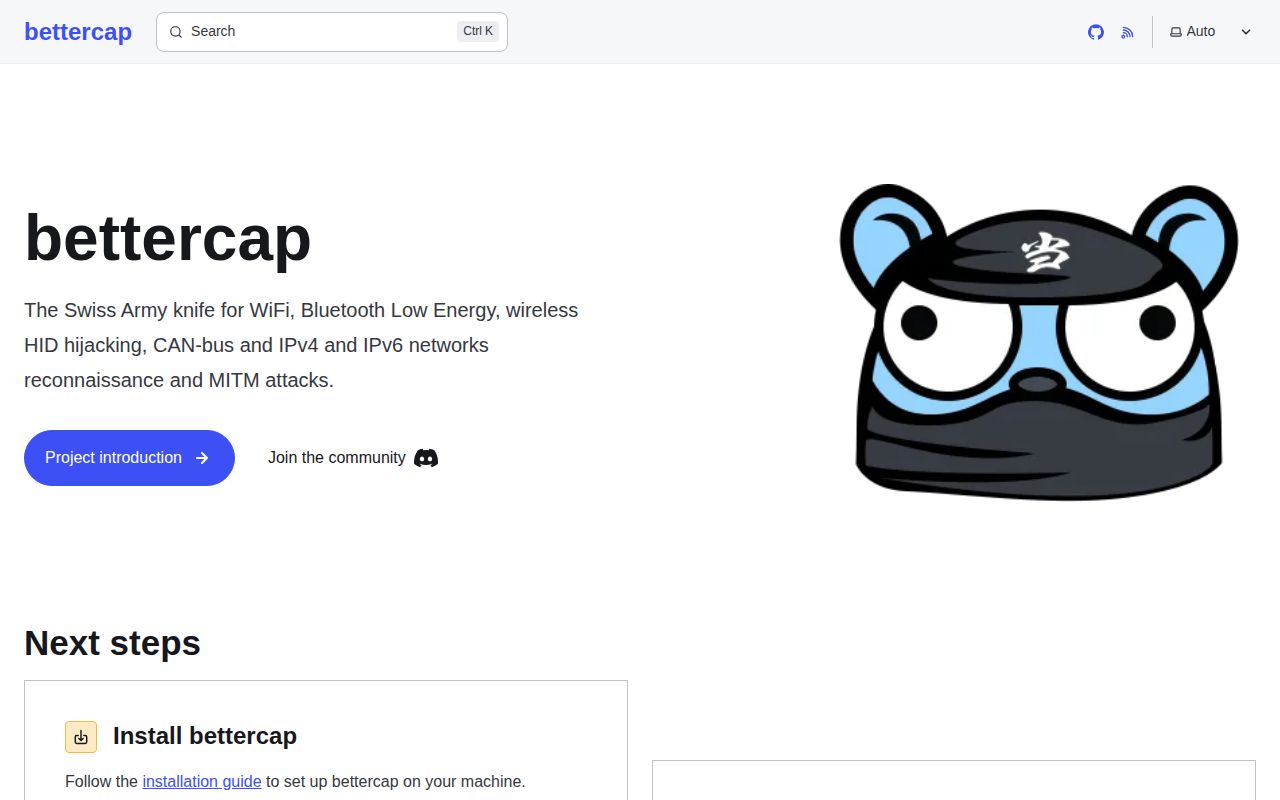
bettercap is an operator's framework, not a friendly desktop scanner. Written in Go, it brings reconnaissance and active network techniques into one environment. Its scope crosses WiFi, Bluetooth Low Energy, 2.4 GHz HID devices, CAN-bus, and IPv4 and IPv6 networks. That breadth is the attraction: a researcher can move from discovering hosts to observing traffic, controlling a proxy, or orchestrating a test without constantly changing tools. It is also the warning, because many of those actions can disrupt real devices and networks.
The project has 19,914 GitHub stars and describes itself as an all-in-one answer for security researchers, red teams, and reverse engineers. That is fairer than calling it a packet sniffer. The README lists WiFi scanning, deauthentication, PMKID association attacks, WPA/WPA2/WPA3 handshake capture, BLE enumeration and read/write operations, MouseJacking with HID injection, and CAN frame decoding, injection, and fuzzing. This broad offensive toolkit belongs in an authorized engagement or isolated lab, not casual troubleshooting on a shared office network.
Our build passed, but the test run did not
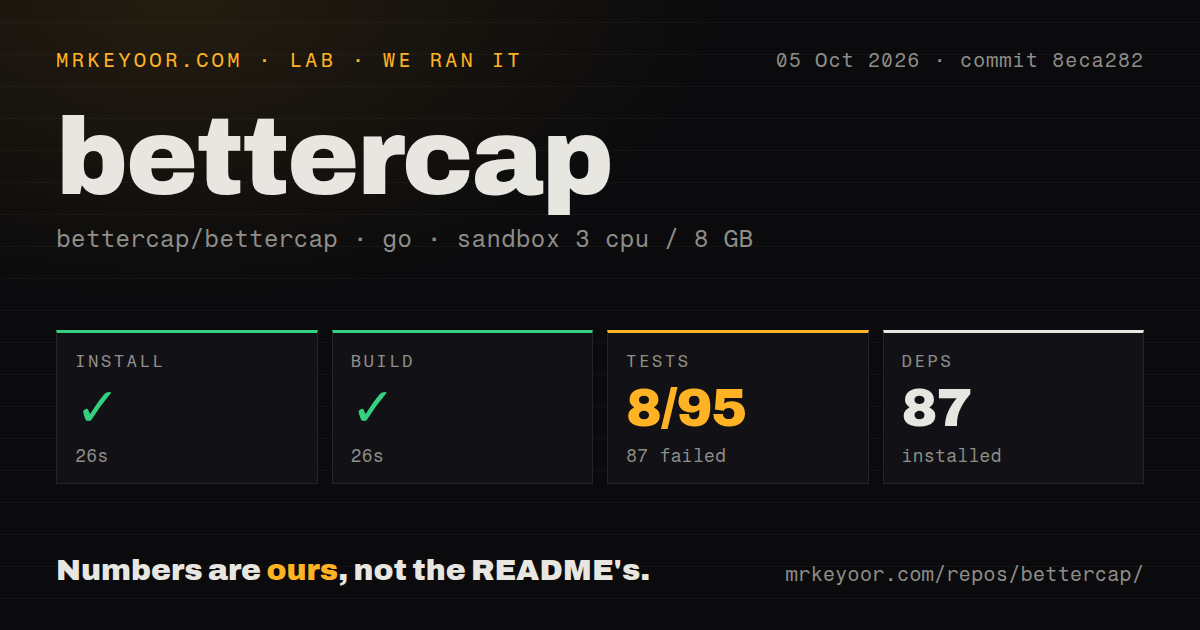
We cloned commit 8eca282 and ran it on 2026-08-30 in an unprivileged golang:1.24-bookworm container with 3 CPUs and 8 GB of RAM. The checkout contained 2,032 files, about 89,706 lines of source, and occupied 45 MB. Installation succeeded in 48 seconds and installed 87 packages. The build succeeded in 36 seconds. Those results show that the source could be fetched, dependencies resolved, and a binary compiled in our clean Debian environment.
The test stage was worse. It failed after 14 seconds: 8 packages passed and 87 of 95 failed. The log tail reports build failures in modules including UI, update, utils, WiFi, wake-on-LAN, network, packets, session, and TLS, while routing passed in 0.396 seconds. The excerpt lacks the underlying compiler messages, so we cannot responsibly assign a cause. Our run did not establish a clean repository baseline.
There are 5 CI workflow files, a Dockerfile, and no dedicated tests directory detected by our measurement. That does not mean the project lacks tests, because Go tests commonly live beside source packages. Operators should reproduce the suite on the intended host and inspect the full failure output before trusting a sensitive workflow. Wireless interfaces, Bluetooth adapters, CAN hardware, kernel capabilities, and elevated network permissions can matter here, but our shortened log does not prove which, if any, explain these failures.
Its strength is breadth with useful control surfaces
The strongest part of bettercap is how its pieces support a complete assessment. It can probe hosts actively or passively, scan ports, run ARP, DNS, NDP, and DHCPv6 spoofers, and inspect traffic with a network sniffer. Packet-level, TCP-level, and HTTP/HTTPS proxies can be scripted through JavaScript plugins. Experienced users get more room than a fixed-purpose scanner: observations can feed actions, and repeated procedures can become scripts instead of manual command sequences.
Automation is not an afterthought. The README documents a REST API and asynchronous event notifications over WebSocket, plus a web UI for operators who do not want to live entirely in a terminal. In a real stack, bettercap can act as a controlled assessment engine behind runbooks, evidence capture, and authorization checks. Version v2.41.7 was released on 2026-05-11, so teams can pin an identifiable release instead of following the development branch blindly.
Hardware range is another differentiator. Many tools stop at Ethernet or 802.11, while bettercap reaches BLE characteristics, wireless HID injection with DuckyScript support, and CAN/DBC workflows. A consultancy evaluating connected products may avoid assembling 4 unrelated consoles for discovery and protocol work. The tradeoff is complexity: several radio and bus families make setup more dependent on adapters, drivers, host permissions, and the module being used.
The rough edges matter before an engagement
The README communicates capability well, but does not prove that every path works on a plain machine. Our 87 failing packages are the clearest caution. A successful build does not validate the UI, updater, WiFi path, network layer, packet handling, session logic, or TLS modules named in the log. Before an engagement, define the modules you need, run their relevant checks, confirm hardware access, and record a known-good configuration.
There are presentation and metadata wrinkles. The community invitation contains a duplicated Discord URL in its link target. Repository metadata supplied to us reports the license as NOASSERTION, while the README badge and license section say GPL 3. Anyone redistributing a modified build should inspect LICENSE.md directly rather than relying on summary metadata. These issues do not erase the tool's value, but argue against treating the landing page as the whole deployment guide.
Activity looks healthy, but adoption is not verification
Project health looks good from the dates and issue count together. The latest release, v2.41.7, arrived on 2026-05-11, and the repository was pushed on 2026-08-13, only 18 days before this review. There are 44 open issues, a manageable-looking queue for a project of this reach, although the supplied data does not show response times or closure speed. The star count signals awareness and adoption, not correctness on your hardware.
For a real security stack, place bettercap in a segregated lab or authorized assessment environment, alongside evidence storage and reporting. Use Wireshark for passive protocol analysis, mitmproxy for focused HTTP interception, Aircrack-ng for a narrower WiFi audit, and Nmap for discovery. Choose bettercap when crossing several boundaries in one controlled session is worth the setup cost. With 8 passing packages against 87 failures in our container, promotion to a shared team tool should follow a host-specific validation run.