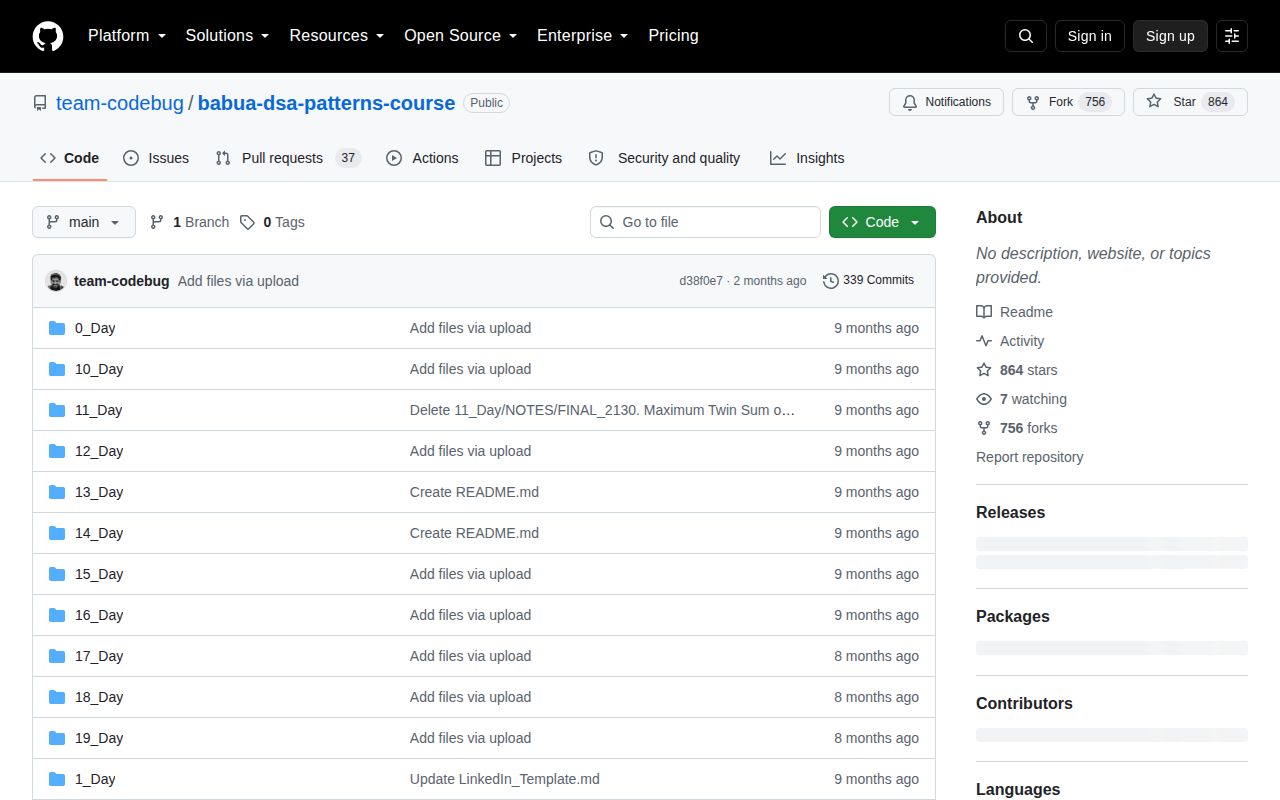
A video course with a repository attached
Babua DSA Patterns Course teaches coding-interview questions through recurring solution shapes. Recognizing two pointers, fast and slow pointers, sliding windows, and related patterns is more useful than attacking a random list. The README frames it as a 90-day challenge covering 30 patterns, with Java as the main language, optional Python, and Hindi explanations. The main written pages are in English.
The repository is a companion to the CTO Bhaiya YouTube course. Its root page links early lessons to videos and note folders. Google Sheets hold the main question list and revision tracker. Learners are asked to fork the repository, mark daily progress, copy the revision sheet, and revisit each topic several times. This can work well for someone who wants a teacher and a visible streak.
Much of the teaching is outside GitHub. YouTube carries the explanations, Google Sheets carries tracking, and LeetCode supplies the exercises. The repo stores diagrams, PDFs, Excalidraw sources, short day pages, and a small amount of solution code. A broken external link would take part of the course with it.
What the curriculum gets right
The onboarding sheet gives beginners a concrete runway before the main sequence. It links 43 lessons covering arrays, linked lists, queues, hash structures, trees, binary search, sorting, recursion, stacks, and dynamic programming. Students can see the assumed topics and close gaps before starting the challenge.
The main README makes revision explicit. It asks learners to copy a separate sheet and revisit material at least four times. Recognizing a pattern after a week matters more than following one solution during a video. The daily sequence also removes the repeated decision about what to study next.
Visual learners get many diagrams. Day 1 centers on two-pointer theory and includes editable Excalidraw material plus a PDF export. Later folders name specific LeetCode problems, so learners can usually identify the topic before opening a large asset.
Where the repository gets in your way
The index is inconsistent with the archive. The README's progress table stops at Day 11, yet commit d38f0e7 contains folders reaching Day 93. Several numbers are absent, including Day 30, Days 49 through 51, and Day 76. A learner following the root page cannot see the later course order, while someone browsing folders must infer whether a missing number was skipped, renamed, or never added. For a schedule-driven course, that is a serious documentation defect.
Many folder-level README files are too thin to stand alone. Day 1's folder has a 29-byte README beside multi-megabyte visual files. Other day pages are similarly small. There may be useful notes in an SVG or PDF, but the page often lacks a concept explanation, prerequisites, a solution summary, or searchable text. People who learn from written explanations will spend most of their time elsewhere.
GitHub calls JavaScript the primary language, while the course README says Java is primary and Python optional. At the measured commit, the tree contained little source code compared with hundreds of documentation and visual assets. Treat this as a language-flexible learning archive with Java-led instruction, not as a JavaScript codebase you can clone and execute.
Licensing is the sharper concern. GitHub reports no license, so the repository does not grant the standard reuse permissions developers expect from an open-source project. Pull request 64 proposes adding one, but it was still open on 2026-08-23. Reading a public repository is easy; copying its notes into training material or another project needs clearer permission.
What happened when we ran it
We cloned commit d38f0e7 into a fresh Debian container with 3 CPUs and 8 GB RAM. We did not run it. The lab found no supported ecosystem and no Dockerfile, so there was no legitimate install, build, or test step to attempt. That result fits its role as a collection of study material and links.
A learner can open the README and start watching without local tooling. Our lab provides no evidence that an individual solution compiles because the repo has no supported project-level check. Setup means forking the repo if you want editable progress marks, copying the revision sheet, choosing Java or Python, and keeping access to YouTube and LeetCode.
Activity without a finished release process
The last push was 2026-06-29, less than two months before this review. GitHub showed 37 open issues and pull requests on 2026-08-23, while an issue-only search returned zero. The queue therefore consists of pull requests, many from learners marking onboarding videos complete in their own copies or proposing small tracking edits. Recent submissions show interest, but they also show that personal progress changes are reaching the upstream queue.
There is no GitHub release, and recent commits use generic messages such as Add files via upload and Create README.md. That makes changes hard to audit and gives learners no stable course edition to reference. Together with the missing license and incomplete root index, the repository feels actively used rather than carefully packaged.
Babua DSA Patterns Course is worth trying for a Hindi-speaking learner who responds well to daily video instruction. Use the repo as a map and notebook, then do the practice on LeetCode. If you need searchable English lessons, automated exercise checks, or material you can safely reuse, Coding Interview University or a maintained algorithm collection is a better starting point.