mrkeyoor.com_
Tue 01 Sept 17:27 UTC
Dataevaluationupdated 31 Aug 2026

awesome-zhuiju-free review

Awesome Zhuiju Free is a Chinese-language directory of free streaming sites, media apps, cloud-drive search, BitTorrent indexes, subtitles, TVBox configurations, IPTV sources, and related open-source projects. The repository has no English README, so English-only readers need translation to use its ratings, risk notes, and contribution process.

+193 / 1dstars / 7d
Verdict

Our Awesome Zhuiju Free run installed 35 packages in 37 seconds and built in 8 seconds, but the repository supplied no test target. Use its 114-entry Chinese directory as a lead sheet, then check every destination's rights, ads, privacy, and playback yourself. The open data and daily reachability record are useful; the lack of English docs and the narrow meaning of 'available' rule it out as a trusted catalog for most English readers.

We ran it

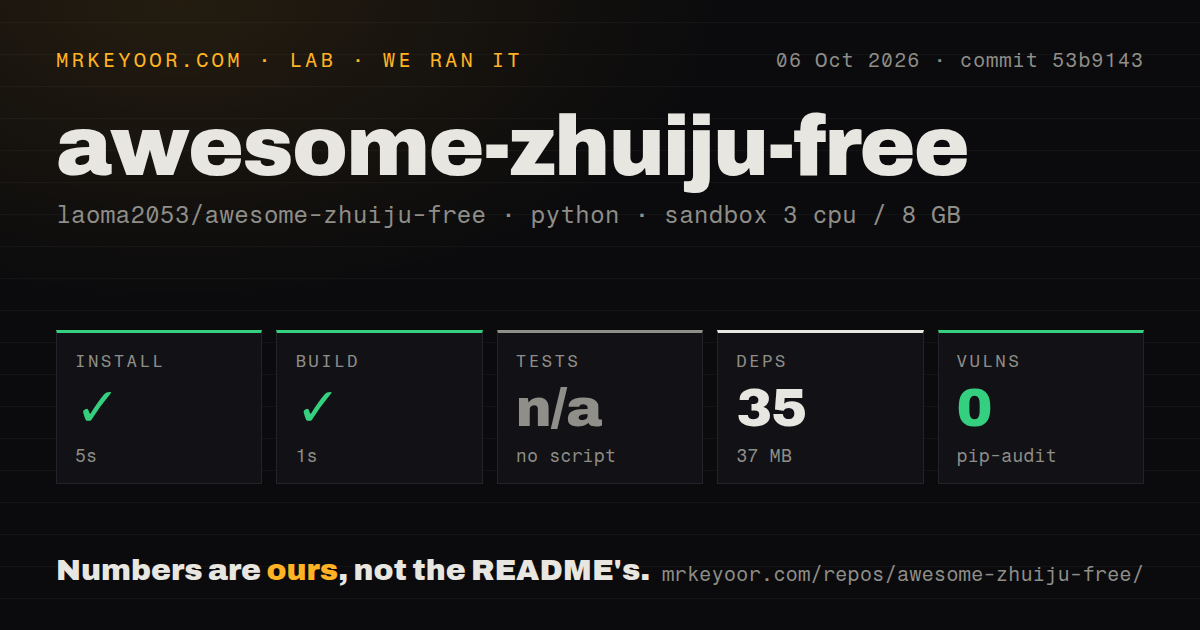
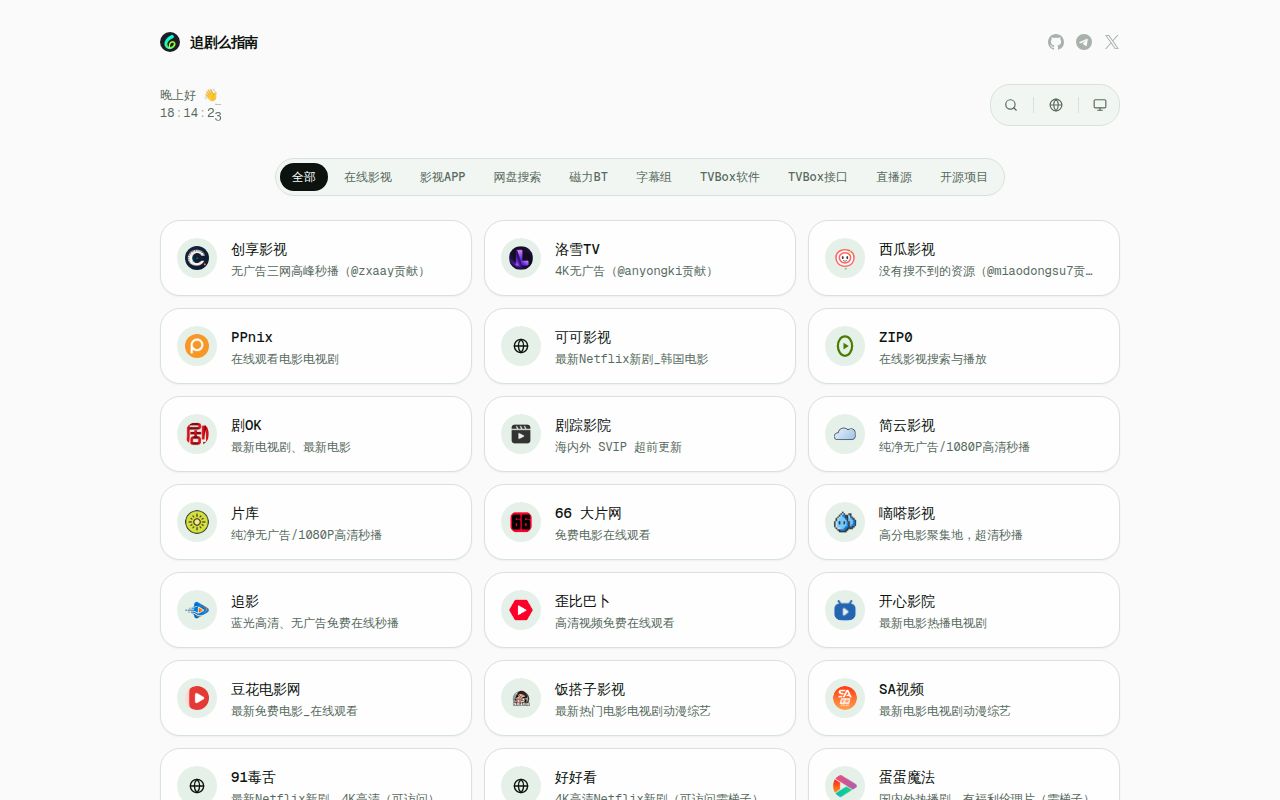
Lab card: what happened when we ran awesome-zhuiju-freeScreenshot of awesome-zhuiju-free (zhuiju.me)
Install✓ · 37s35 packages · 37 MB
Build✓ · 8s
Testsn/ano test script
Known vulns0(pip-audit)
Repo71 files~2,024 lines of source · 0.9 MB · 5 CI workflows

Answers from our run

Does awesome-zhuiju-free build from source?

Dependencies installed in 37 seconds (35 packages), and the build succeeded in 8 seconds. We cloned commit 48e3cfb into a clean Debian container with 3 CPUs and no project-specific setup.

Does awesome-zhuiju-free have tests you can run?

Not through a standard command: the project exposes no test script or target that our harness could run.

Does awesome-zhuiju-free have known vulnerabilities in its dependencies?

pip-audit found none in the dependency tree at the time of our run.

Who should not use awesome-zhuiju-free?

English-only readers who need usable documentation without translation: the repository has no English README or parallel English guide.

What are the alternatives to awesome-zhuiju-free?

IPTV-org, Awesome Selfhosted, Bangumi. Our Awesome Zhuiju Free run installed 35 packages in 37 seconds and built in 8 seconds, but the repository supplied no test target.

Setup4/537-second install and 8-second build; no test target exists
Docs4/5Detailed Chinese data and maintainer docs, with no English guide
Community4/57,388 stars and current submissions in a three-month-old repo
Maturity3/5Daily checks and weekly records exist, but the project is young

Who it’s for

Chinese-reading viewers who want one current starting list for several kinds of film and television resources.
TVBox and media-app users who understand configuration URLs and will verify each source themselves.
Maintainers who want structured JSON, public verification records, and issue templates for a community directory.
Researchers studying the availability and churn of Chinese-language media sites without asking the project to host the media.

Who it’s NOT for

English-only readers who need usable documentation without translation: the repository has no English README or parallel English guide.
Anyone treating a green availability mark as a safety or quality approval: the README says it only records whether the homepage responded from a GitHub Actions node.
Users who need guaranteed legal sources: the dataset records copyright risk, and the disclaimer gives no guarantee of third-party legality.
People looking for a player or hosted catalog: the project says it does not host films, cracked apps, accounts, credentials, or links to individual titles.
Operators who require a test suite before consuming generated data: our checkout had 5 workflows and schema checks, but no test target or tests directory.

Setup reality

Our sandbox installed commit 48e3cfb in 37 seconds, adding 35 packages and using 37 MB. The build passed in 8 seconds. There was no test script or target, so tests were skipped. Pip-audit found 0 known vulnerabilities.

Most readers do not need a local runtime because the README and zhuiju.me expose the directory. Maintainers work with resources/resources.json, its schema, JavaScript maintenance scripts, GitHub issue templates, and verification reports. Publishing the optional blog integration needs separate site configuration that casual users can ignore.

The 0.9 MB checkout had 71 files, about 2,024 source lines, and 5 CI workflows. It had no Dockerfile and no tests directory. Daily availability comes from GitHub Actions network checks, whose location can disagree with the reader's country, ISP, or browser.

The 114-entry directory is written for Chinese readers

Awesome Zhuiju Free collects 114 media resources under one Chinese README and a companion site. Its categories include 49 online-video sites, 16 magnet or BitTorrent indexes, 15 TVBox configuration sources, several search and subtitle tools, and 16 open-source projects. The repository has no English README in its 71-file tree. An English reader can translate the page, though labels such as access restrictions and copyright risk need more care than a browser's one-click translation gives them.

This is a directory rather than a media application. It sends readers to third-party sites and keeps the main records in resources/resources.json. The project says it does not host films, accounts, credentials, cracked software, or links to individual titles. That boundary makes the repository useful for discovery and easier to inspect, while leaving playback, registration, downloads, and any payment interaction on sites that the maintainer does not control.

A green mark means one homepage answered, not that a film played

The weekly release for 2026-W35 counted 71 accessible resources, 19 with restricted access, 8 unreachable, and 0 untested. A scheduled workflow updates those states each day around 09:00 Beijing time. New or changed records also trigger a check. This is more useful than an abandoned bookmark list because each row carries a date and the full result is preserved in reports/availability.json.

The README defines the limit clearly: the job checks whether a homepage responds from a GitHub Actions node. It does not watch a film, inspect every advertising redirect, test a download, or reproduce a reader's network. One row can be green in Actions and blocked by an ISP; another can open normally while exposing intrusive ads after the first click. Treat the status as a quick reachability signal and read the separate risk fields before visiting.

What happened when we ran it

Our sandbox installed commit 48e3cfb in 37 seconds, adding 35 packages and occupying 37 MB. The build completed in 8 seconds. Pip-audit found 0 known vulnerabilities in the installed Python environment. The 0.9 MB checkout contained about 2,024 lines of source across 71 files, which is small enough for a maintainer to review alongside the JSON data and generated README.

There was no test script or target, so our lab skipped tests. The repository also had no tests directory and no Dockerfile. It did have 5 CI workflow files covering availability, data validation, open-source statistics, issue conversion, and weekly releases. Those workflows are useful operational checks, but our supplied measurement does not report test cases or passed assertions. A downstream consumer should run the schema validator on every imported snapshot.

The JSON tracks 4 kinds of risk without deciding them for you

Each resource has a stable ID, category, URL, source, verification summary, and optional GitHub metadata. The schema separates capability scores from 4 risk areas: copyright, safety, privacy, and payment. A maintainer can sort or render the records without scraping the README table. Historical verification and notice files record changes and complaints, while a rights-holder issue template gives removal requests a defined path.

The ratings still involve judgment. The README scores breadth, speed, cleanliness, and stability, then marks each risk low, medium, high, or unknown. Issue 17 shows why the distinction matters: its submitter disclosed Google advertising, analytics, optional login, user-supplied M3U data, and uncertain channel rights. The directory can preserve that disclosure. It cannot audit every playlist or promise that a third-party operator will behave the same tomorrow.

Open submissions expose both useful detail and uneven evidence

GitHub listed 11 open issues and 2 pull requests on August 31, 2026. Most open issues are resource nominations. Some include a region, test date, ad behavior, and an explicit relationship disclosure. Others say little more than 'no risk.' That difference is visible instead of being hidden behind a staff rating, but readers must judge how much evidence supports each proposed entry. Inclusion should not turn a submitter's unchecked statement into a safety claim.

The contribution process helps. Templates ask for the URL, category, known risks, location, date, and relationship. Maintainers can validate the JSON before merging and retain a record of later complaints. CC BY 4.0 also permits reuse with attribution. For teams building another guide, the structured record and provenance fields are more useful than copying 114 rendered table rows.

Daily pushes show maintenance; three months do not prove durability

The repository was created on June 5, 2026 and last pushed on August 31, 2026. GitHub showed 7,388 stars, 418 forks, and 13 open issues and pull requests combined. The latest weekly release was published on August 30 and recorded additions, removals, adjustments, and availability changes. Current issue submissions show that readers are still feeding the list.

That activity earns the directory a place in a Chinese-speaking research workflow. Its age still matters because streaming domains change quickly and community ratings take time to earn trust. Use the JSON as a dated discovery dataset, preserve the verification timestamp, and follow local law plus each service's terms. The 5 workflows can tell you that a page answered; they cannot tell you whether using what lies behind it is a sound decision.

Alternatives

ProjectWhat it isPick it when
IPTV-org gh↗A worldwide collection of publicly available IPTV channels maintained as playlists.pick this instead when live television playlists across many countries are the requirement and Chinese streaming directories are outside scope.
Awesome SelfhostedA large catalog of free software that can run on infrastructure you control.pick this instead when you want to host a media server or application rather than follow third-party viewing links.
BangumiAn open-source mobile client for tracking anime and other ACG interests through bgm.tv.pick this instead when tracking watched series on Android or iOS matters more than finding streaming and download sources.

What people are saying

  1. [github-trending] laoma2053/awesome-zhuiju-free

Sources

  1. Awesome Zhuiju Free README
  2. Resource data field guide
  3. Weekly release 2026-W35
  4. Issue 17: Free IPTV Player submission
  5. Repository facts
  6. IPTV-org repository
  7. Awesome Selfhosted repository
  8. Bangumi repository

More data reviews

turso · TrackersListCollection · dash · getcontact-cli · iggy · ddia · the whole board →