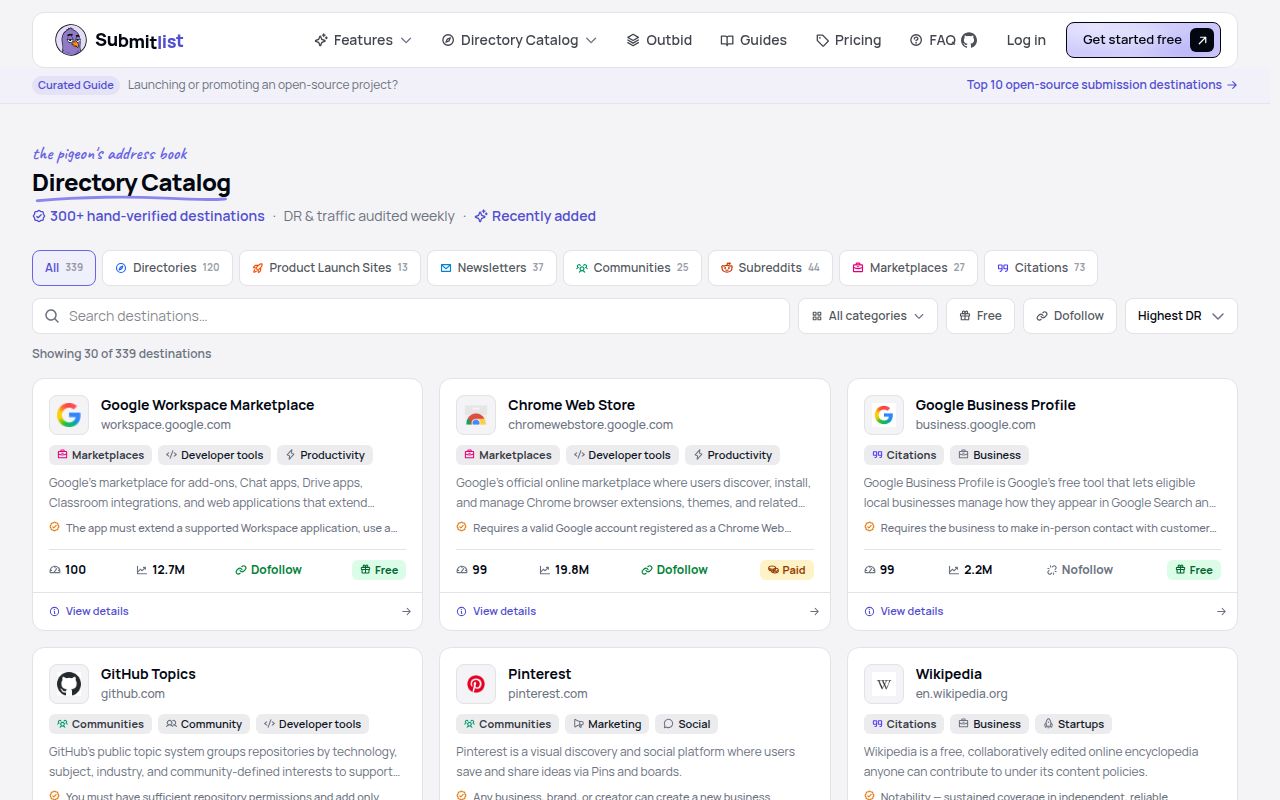
A directory list becomes useless one dead form at a time. Awesome Submitlist attacks that decay by generating its README from a live catalog every Monday, instead of asking maintainers to keep 339 rows fresh by hand. The result is an unusually detailed public list for founders deciding where to launch, seek a listing, pitch a newsletter, or approach a publication.
This is still a research aid, not a distribution engine. It gives you a destination, an eligibility summary, pricing, and a submission URL when one exists. You decide whether the audience fits, check the current rules, write the pitch, and submit it. That division of labor is sensible because a high Domain Rating says little about whether a particular listing will send buyers.
The 339 rows are useful filters, not 339 recommendations
The September 28, 2026 snapshot contains 120 directories, 73 citation targets, 44 subreddits, 37 newsletters, 27 marketplaces, 25 communities, and 13 product launch sites. Those categories prevent a common planning error. A founder should approach a subreddit according to its promotion rules, while a citation target may require a story or editorial pitch rather than a listing form.
Of the 339 entries, 203 are marked free and 46 paid, while 90 have unknown pricing. The data marks 158 links dofollow, 96 nofollow, and leaves 85 unknown. Domain Rating and monthly traffic appear on 258 records. Missing values are presented as unknown instead of zero, which keeps an incomplete check from masquerading as a bad score.
The detail is good enough to build a shortlist. Each JSON record can carry an audience, eligibility text, pricing note, categories, link type, and separate website and submission URLs. Newsletter entries add readership fields, while subreddit entries can describe size, recent growth, and permitted promotion routes. The README turns those fields into compact chips, but the JSON is the more useful artifact for sorting or importing into your own board.
What happened when we ran it
We did not run Awesome Submitlist in our sandbox. The lab harness classified the repository as JavaScript but found no supported ecosystem, and the repository had no Dockerfile to supply an alternative runnable path. That means we have no install, build, test, dependency, or audit result to report for commit 9e15ceb.
The source does include scripts/build-readme.js, and the contribution guide says it can run with Bun or Node. It reads the public Submitlist catalog endpoint, removes archived and paused destinations, then writes both README.md and data/destinations.json. No token is required according to the guide. We inspected that design, but our lab result did not execute or verify it.
This distinction matters because the repository is mostly a published dataset. Reading the 163,026-byte README and parsing the 339-row JSON tell us what the snapshot contains. They do not prove that every outbound form works today, that the Ahrefs values are current, or that the generator will reproduce the files on a fresh machine.
Monday syncs reduce decay but keep Submitlist in control
A GitHub Actions workflow runs at 06:17 UTC each Monday, installs Bun, calls the build script, and commits changes to the two generated files. The README says people manually open each candidate, confirm that it accepts submissions, record eligibility and price, and archive sites that die or stop taking listings. That is a stronger maintenance claim than the usual anonymous spreadsheet offers.
There is a tradeoff. The repository is a downstream view of api.submitlist.io, so the public catalog remains the editorial source. Pull requests that alter a destination row are overwritten at the next sync. Corrections must go through a GitHub issue or the Submitlist contact route, while code, assets, and documentation can be changed by pull request. The JSON has a catalog-wide synced_on date, but no per-entry verification date.
The data is released under CC0 1.0, with a separate note that Ahrefs supplies the Domain Rating figures under its own license. That makes the list easy to reuse, yet reuse does not make the traffic estimates independent. If DR drives an important decision, check what the number measures: it describes the destination domain’s backlink profile, not the traffic or ranking your eventual listing will receive.
Automation permission is the missing field
The repository’s one open issue, filed September 22, asks for a field covering automated-submission permission. Its author reports checking 84 free directory hosts and finding several whose robots rules or terms restricted automation. Those figures are a contributor’s unmerged research, so we would not treat them as catalog facts. The underlying question is valid: an open form is not permission to script it.
That omission barely affects a founder submitting by hand. It matters a great deal to an agent or bulk outreach service. The dataset tells such a tool where a form lives, but not whether automation is welcome, which terms govern it, or how recently that permission was checked. Use the 302 records with submission URLs as leads, not as an unattended job queue.
Current activity is stronger than release history
The repository had 162 stars, 5 forks, 1 open issue, and a last push on September 28, 2026. It was created on September 6, so the small community numbers describe a young project rather than a long-running list in decline. The scheduled sync and same-day data stamp are better health signals here than a release tag.
There are no tagged releases. For a CC0 snapshot, cloning a commit or saving the JSON is the practical way to pin a version. Start with the free entries that fit your audience, verify their rules, and record the outcome. The list earns its keep when it narrows a launch plan from 339 possibilities to the few places where your product actually belongs.