Alphabetical entries leave the final choice to you
Open awesome-rust's web programming section and you'll find Actix Web, Rocket and Axum alongside less familiar frameworks. Each gets a short description and a link. That helps when you know you need a web framework but haven't settled on candidates. It leaves the consequential question unanswered: which one fits your application? I'd use this directory to make a shortlist, then move to the projects' own documentation before choosing.
The 0.5 MB checkout in our lab reflects a resource you can keep locally and browse as Markdown. The README separates complete applications from development tools and reusable libraries, so a database server and a database client needn't compete in the same mental bucket. You can jump to the relevant heading rather than search Rust's entire package registry. Reading the list requires only a browser or text viewer.
Popularity gets projects listed without ranking them
The contribution guide asks for at least 50 GitHub stars, 2,000 crates.io downloads, or equivalent popularity evidence. Entries follow an alphabetical template with repository links, optional crate links and descriptions. Maintainers explicitly avoid choosing favourites. That is a reasonable way to manage submissions, but popularity answers whether people have noticed a project. It doesn't establish whether its API or maintenance commitments match your job.
Our cargo test step passed with 0 tests, so it supplies no evidence that a listed framework behaves correctly. The short descriptions also lack the comparative argument you'd want before adopting a dependency. A CI badge beside an entry links to that project's checks, where provided. Follow it. Neither the badge nor the alphabetical position tells you whether that project handles your particular workload.
Projects stay listed until they're broken or deprecated
The removal policy keeps projects unless they're outright broken or explicitly deprecated by another project or their author. That matters if you're treating the README as a list of currently recommended choices. Its machine-learning section even labels Leaf abandoned and points readers toward Juice. The warning is useful, but the entry's presence shows why inclusion alone cannot establish that a project is a sensible new dependency.
Our scan found 4 CI workflow files and no tests directory. Those are signals about the directory's own upkeep, with a limited bearing on the projects it links to. For a production shortlist, inspect each candidate's recent changes and unresolved issues yourself. The contribution policy explains why this work remains necessary even when the surrounding list is active: removal has a narrower standard than suitability for a new application.
What happened when we ran it
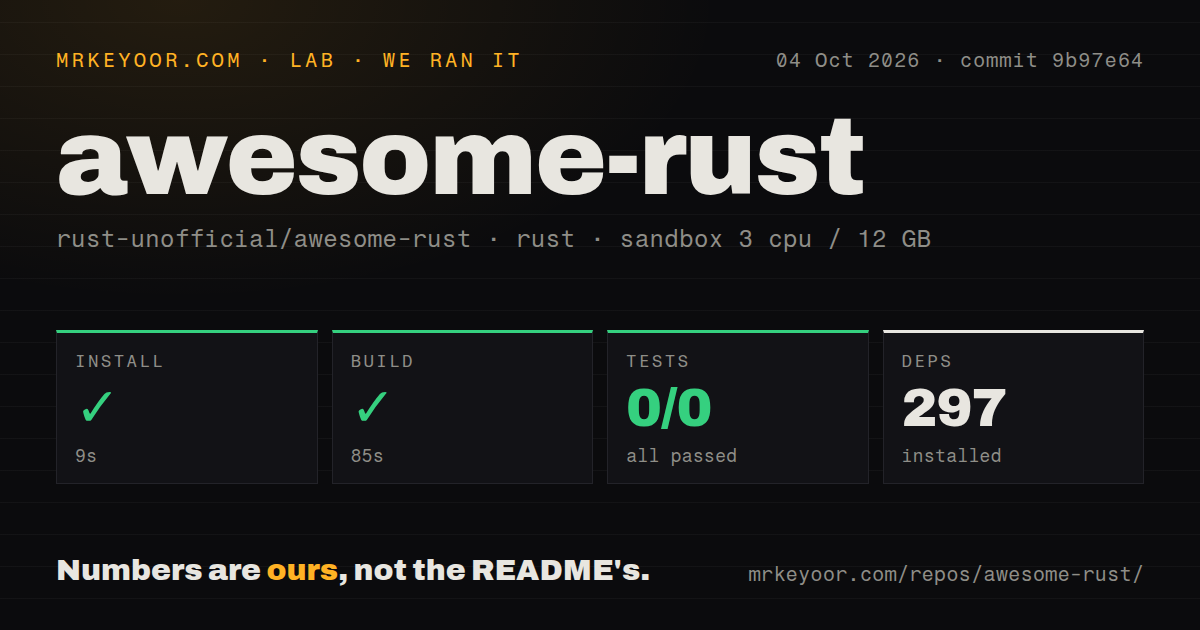
Our run installed 297 packages in 9 seconds, built successfully in 85 seconds, and completed cargo test successfully in 5 seconds. The test result was 0 passed, 0 failed out of 0. We cloned commit 9b97e64 on 2026-10-04 into a fresh Debian sandbox with 3 CPUs and 12 GB of RAM, using image lab-rust:1. The container was unprivileged and held no secrets. None of the measured steps failed.
The checkout contained 22 files, roughly 1,372 lines of source and 0.5 MB of checked-out content. The scan found 4 CI workflow files, no Dockerfile and no tests directory. These measurements cover this repository's setup and build path. A successful command with 0 tests provides no behavioral coverage. The supplied run also contains no workload measurement for any of the projects listed in the README.
The Rust executable maintains the directory
The repository's Rust source reads README.md, processes links and popularity data, and writes YAML results under results/. GitHub API requests can use USERNAME_FOR_GITHUB and TOKEN_FOR_GITHUB, loaded through dotenv. Those settings belong to the maintenance program. Ordinary readers need no credentials or hosted service account to browse the list. Running the checker needs network access and writable result files, and its relative paths expect the repository's files nearby.
The 297 packages installed in our sandbox belong to the directory's developer setup. They aren't a bundle of everything linked in its README. Likewise, the 85-second build doesn't mean the listed applications have been compiled together. If you only want to find a library, skip compiling the checker. If you want to maintain a fork, inspect its saved results and authentication path before running it against external sites.
October contribution activity supports the list's health
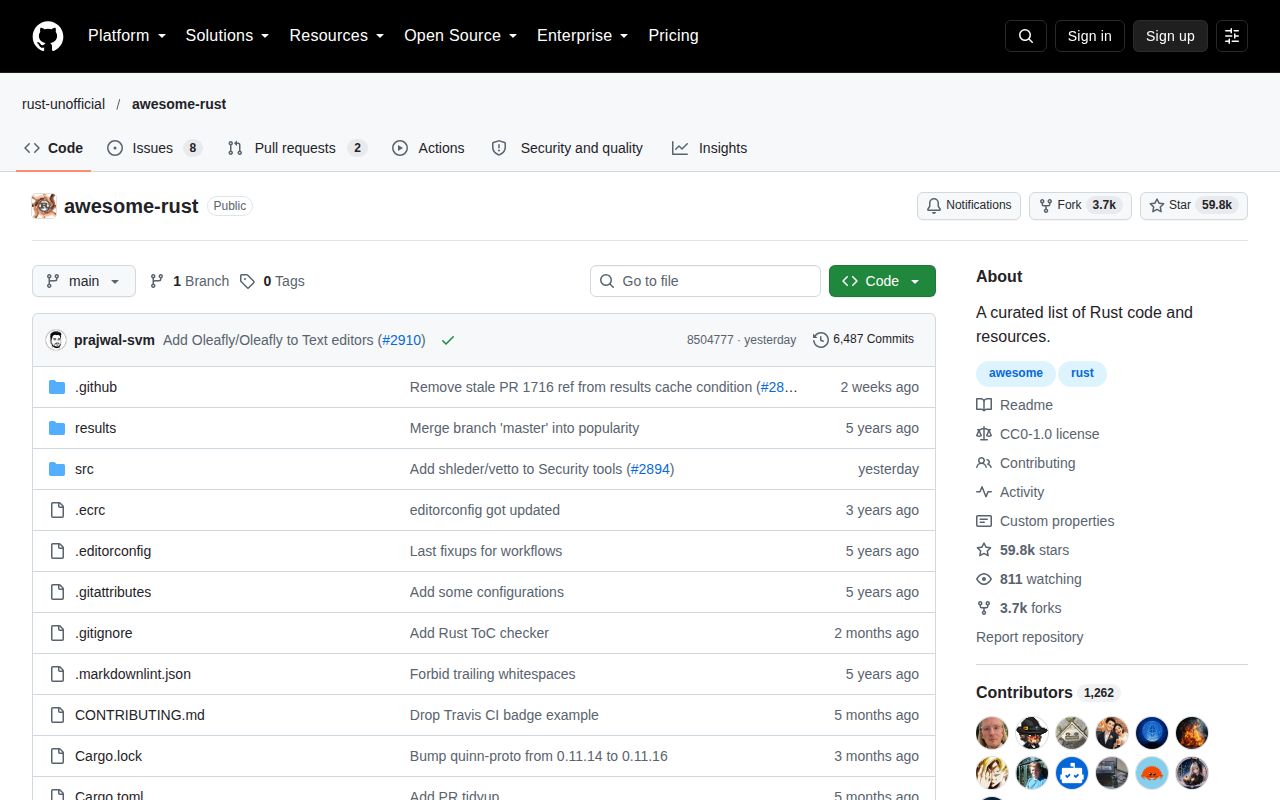
The last push was 2026-10-10. GitHub reported 59,788 stars and 10 open issues and PRs on October 12, 2026, while the latest-release endpoint returned no release. Recent contribution records give the dates substance: PR 2910, adding the Oleafly editor, was merged on October 10. This looks actively maintained as a directory. Its health is better judged by changes and contribution handling than by release tags.
Our 0-test result remains a separate limitation. A maintainer merging new entries doesn't verify the software behind every link, and a passing repository build cannot replace that verification. The list carries a CC0 dedication, which makes reusing the directory material straightforward. Check licenses at the destination repositories separately: the directory's license grants no permission to use their code under the same terms.
The Book and Cookbook help after discovery
The Rust Programming Language is the better starting point if ownership and borrowing still block your progress. The Rust Cookbook supplies task-focused code examples when a crate name leaves you unsure how to proceed. Awesome-rust links to learning resources too, but its alphabetical directory doesn't provide that teaching sequence. Before adding a shortlisted dependency, open its example closest to your task and check what you'll have to change to make it fit.