mrkeyoor.com_
Tue 01 Sept 17:41 UTC
Dev Toolsevaluationupdated 27 Aug 2026

book review

The Rust Programming Language, usually called the Rust Book, is the official free guide for learning Rust. It explains the language through an ordered course that starts with Cargo and basic syntax, then works through ownership, error handling, traits, concurrency, async code, and larger programs.

+23stars / 7d
Verdict

Our run installed 34 packages in 32 seconds, built in 38 seconds, and passed all 74 tests in 31 seconds, so working with the official Rust Book repository carries little setup risk. Start here if you learn well from a sustained technical text, then add Rustlings when ownership or lifetimes need hands-on repetition. Experienced Rust users should go straight to the Reference or standard library documentation for exact lookup.

We ran it

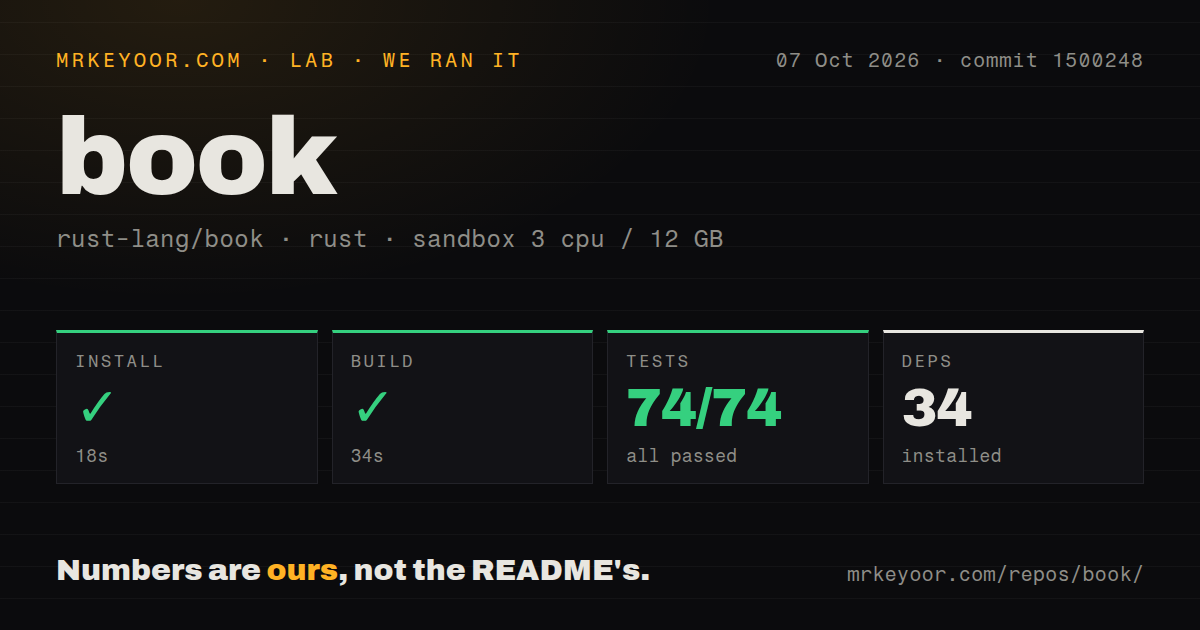
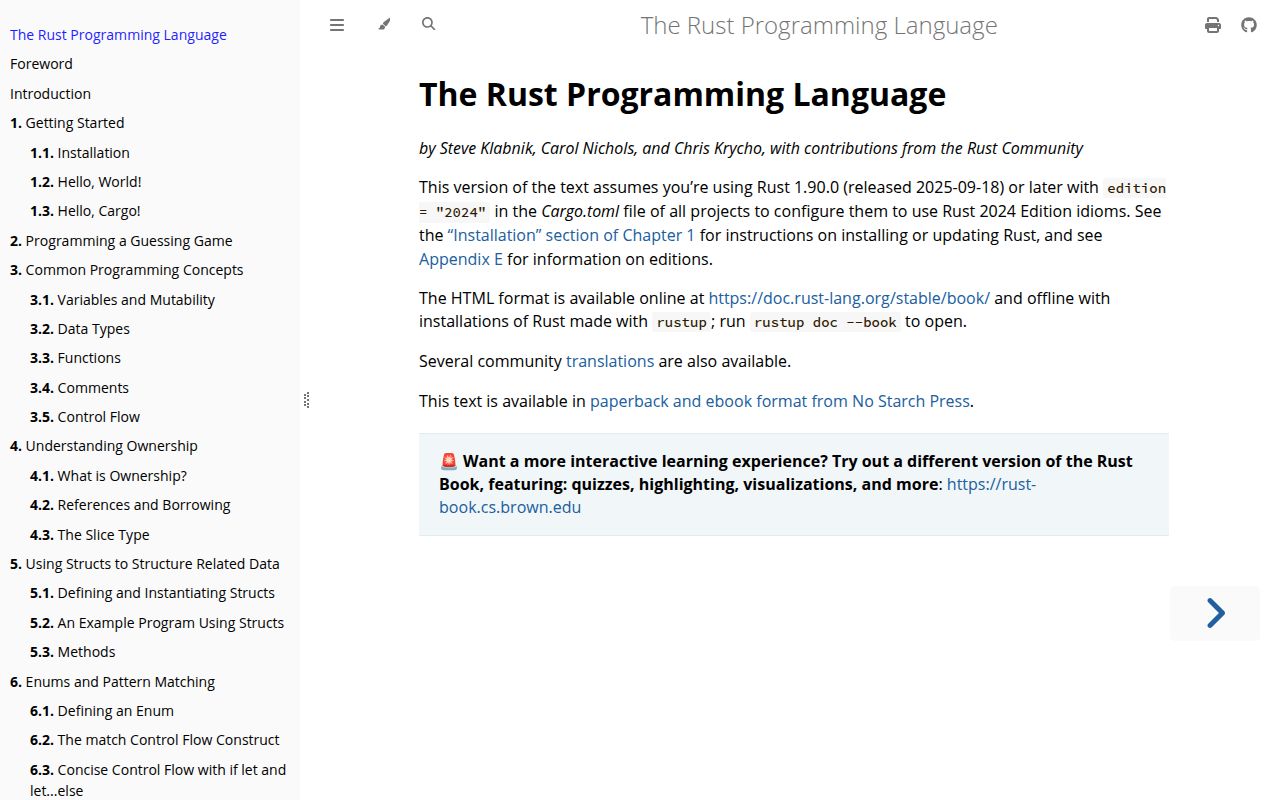
Lab card: what happened when we ran bookScreenshot of book (doc.rust-lang.org/book)
Install✓ · 32s34 packages
Build✓ · 38s
Tests✓ · 31s74 passed · 0 failed of 74 (cargo test)
Repo2653 files~18,977 lines of source · 10.5 MB · 1 CI workflows

Answers from our run

Does book build from source?

Dependencies installed in 32 seconds (34 packages), and the build succeeded in 38 seconds. We cloned commit 9175448 into a clean Debian container with 3 CPUs and no project-specific setup.

Do book's tests pass?

Yes: 74 of 74 passed when we ran the project's own test command (cargo test). Some failures need services or credentials a bare container does not have.

Who should not use book?

Experienced Rust developers looking up one API or exact language rule: this is a sequential course, while the standard library docs and Rust Reference are faster lookup tools.

What are the alternatives to book?

Rustlings, Rust by Example, 100 Exercises To Learn Rust. Our run installed 34 packages in 32 seconds, built in 38 seconds, and passed all 74 tests in 31 seconds, so working with the official Rust Book repository carries little setup risk.

Setup5/532-second install; build and all 74 tests passed
Docs5/5Ordered official course with free stable, beta, and nightly editions
Community4/5421 open issues and PRs, with reader reports still arriving
Maturity5/5Official text tied to Rust releases and published print editions

Who it’s for

Programmers learning Rust who want one ordered path through the language.
Developers who need a patient explanation of ownership, borrowing, lifetimes, traits, and Cargo.
Teachers and study groups that want free browser-readable material with runnable code listings.
Contributors correcting the official text or checking examples against current Rust releases.

Who it’s NOT for

Experienced Rust developers looking up one API or exact language rule: this is a sequential course, while the standard library docs and Rust Reference are faster lookup tools.
Learners who need questions after each chapter: open issue #4815 asks for that feature, and the current book relies mainly on examples and larger projects.
Readers who require an official downloadable PDF: issue #3863 remains open with blocked upstream and Online only labels.
Contributors proposing broad new material between Rust editions: the maintainers say changes beyond error corrections may wait months or years so the web and printed books stay close.

Setup reality

Our commit 9175448 checkout had 2,653 files, about 18,977 source lines, and a 10.5 MB footprint. Installation succeeded in 32 seconds with 34 packages installed. The build succeeded in 38 seconds, then cargo test finished in 31 seconds with 74 passed and 0 failed out of 74.

Reading the published book needs no account, credentials, or external service. A local build requires Rust and mdBook, ideally the mdBook version used by the main Rust repository. The output is a static site that opens in a browser.

The checkout had 1 CI workflow file, no Dockerfile, and no tests directory. The README also documents a separate mdBook command for checking code examples, while our measured result is specifically cargo test. Stable, beta, and nightly web copies can lag fixes already merged into this repository.

The ordered course is more useful than a pile of Rust links

The Rust Book starts with installation, Cargo, and familiar programming ideas before asking a learner to absorb ownership. Later material returns to those rules through collections, error handling, traits, lifetimes, smart pointers, threads, async work, and unsafe Rust. Rust syntax is easy enough to sample elsewhere, but borrowing and lifetime rules make more sense when each chapter inherits the previous one's assumptions.

The checkout we measured was only 10.5 MB, yet its range goes from a first Cargo project to a multithreaded web server. The command-line project combines argument parsing, files, errors, tests, and environment variables. The final server brings networking and graceful shutdown into the same frame. Neither is production architecture, but both expose choices that look harmless in a page-long example.

What happened when we ran it

Our sandbox run used commit 9175448 in an unprivileged container with 3 CPUs, 12 GB of RAM, and no secrets. The repository contained 2,653 files and about 18,977 source lines. Installation succeeded in 32 seconds and installed 34 packages. The build then succeeded in 38 seconds.

cargo test completed in 31 seconds with 74 passed and 0 failed out of 74. The checkout had 1 CI workflow file, no Dockerfile, and no tests directory. The measured cargo suite passed, and the README separately tells contributors how to run mdBook tests against the code examples. Our 74-test result is not a count of every listing printed in the book.

Ownership gets repeated when the consequences change

The ownership chapter introduces moves, borrowing, and slices before more abstraction arrives. References return through lifetime annotations, heap-owning pointers, shared state, and thread-safety rules. A moved string in an early function is one problem; deciding which values can cross a thread boundary is another application of related rules.

That teaching style rewards typing along. A clean run of 74 tests shows that the measured repository was healthy, but project checks cannot tell whether a reader can predict a borrow-checker error. Open issue #4815, filed on August 24, 2026, asks for chapter-end self-check questions with answers. Pair the text with exercises if passive reading starts to feel convincing too quickly.

The book hands lookup work to other Rust documentation

The book is strongest in sequence and weaker as a permanent reference. For the exact behavior of an iterator method, use the standard library docs. For a language rule, use the Rust Reference. Rust by Example is faster for an experienced programmer who wants a code-first tour. Appendices cover keywords, operators, traits, tooling, editions, and nightly Rust, but they do not turn the chapters into an API index.

Our install added 34 packages in 32 seconds, and reading the hosted edition needs no account. Contributors need Rust plus mdBook, preferably the version used by the main Rust repository. The build output is a static book directory that opens in a browser. The contributing guide also specifies rustfmt for Rust code and dprint for Markdown and other source files.

The official web editions can trail the repository

Readers can choose versions shipped with stable, beta, or nightly Rust, and the README warns that all 3 may lag a correction already merged into the repository. The contributing guide tells readers to check main before reporting a problem found on the stable site. When an example and a local compiler disagree, the published page may be older than the fix.

The 10.5 MB checkout is easy to keep locally for the newest text or an offline browser build. Issue #3863 remains open with blocked upstream and Online only labels, so the project does not offer an official downloadable PDF. The supported choices described by the README are the web editions, the repository build, and the printed book.

A 421-item queue reflects editorial constraints as well as defects

GitHub reported 421 open issues and pull requests combined when fetched on August 27, 2026: search results split that into 258 issues and 163 pull requests. The last repository push was July 14, while a new teaching request arrived on August 24. That shows continuing reader activity around a project that does not need a daily code release. The combined count is not a bug count.

The latest release, Rust 2024 Print Edition, was published on December 19, 2025 for a printing released in February 2026. Maintainers say substantial revisions tend to coincide with Rust editions, while corrections can land between them. A proposal beyond an error fix may sit for months or years because the online and print texts are kept close. That publishing discipline is a real constraint for contributors with ambitious additions.

Rustlings fills the practice gap without replacing the book

Rustlings is the natural companion when ownership needs repetition at the keyboard. Rust by Example suits programmers who want less narrative, while 100 Exercises To Learn Rust centers assignments. They change the learning loop by getting readers to compiler feedback sooner.

Our run passed all 74 tests in 31 seconds after a successful install and build. That makes the repository easy to recommend as a starting text, but setup is not the hard part of learning Rust. Choose it for the editorial sequence. Choose an exercise-led alternative if long technical chapters do not stick without immediate practice.

Alternatives

ProjectWhat it isPick it when
RustlingsSmall compiler-guided exercises that teach Rust by asking you to repair and complete code.pick this instead when concepts stick only after you solve short exercises and read compiler feedback.
Rust by ExampleA collection of runnable examples with less narrative than the Rust Book.pick this instead when you already program and want to learn Rust syntax by scanning code.
100 Exercises To Learn RustA self-paced course that builds Rust knowledge through repeated coding assignments.pick this instead when an exercise sequence will keep you moving better than long chapters.

What people are saying

  1. [mastodon-trends] GOP lawmakers quietly slash funds for Dolly Parton children's book charity
  2. [github-trending] rust-lang/book
  3. [hackernews] Python Polars Cheatsheet (based on our O'Reilly book)
  4. [github-trending] bojieli/ai-agent-book
  5. [mastodon-trends] Bondi library removes book How to Sell a Genocide from shelves after complaint
  6. [velocity-scout] alchaincyf/deepseek-harness-orange-book

Sources

  1. The Rust Programming Language repository
  2. The Rust Programming Language online book
  3. Rust Book contributing guide
  4. Rust 2024 Print Edition release
  5. Chapter-end questions request
  6. PDF download request

More dev tools reviews

workmux · v2rayNG · SecLists · hashcat · eslint · fastfetch · the whole board →