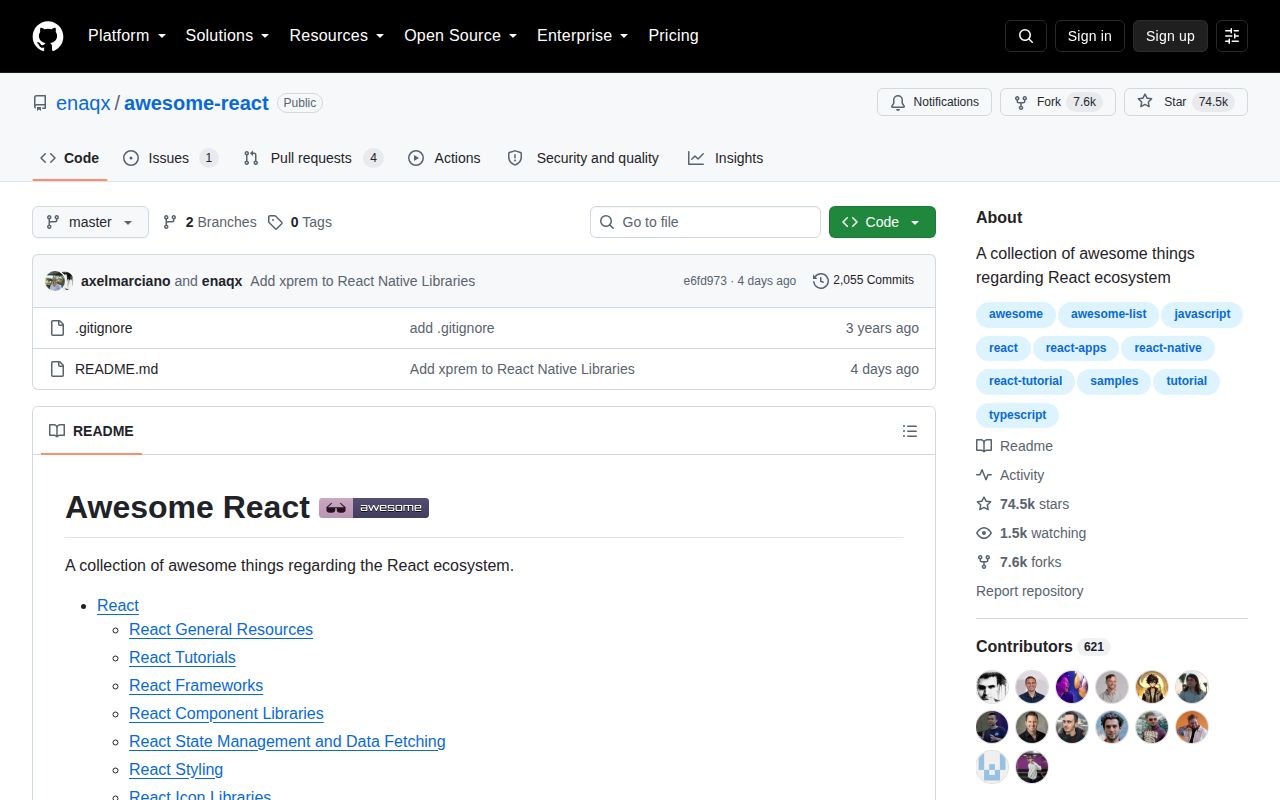
Two files make the README the entire product
The current default branch contains 2 files: .gitignore and README.md. There is no package, web application, command-line program, or data API behind the page. The README is the deliverable. It routes a developer toward other projects. We counted 148 linked resources in the category sections, spread across 26 subsections covering React and React Native.
That format works well for quick recall. A developer choosing a router can see React Router, Speedy Router, and TanStack Router together. The page also groups frameworks, component libraries, state tools, testing projects, forms, charts, renderers, animation libraries, and real applications. At commit e6fd973, the React Native side was much smaller, with 11 entries compared with 137 under React, so mobile developers get a thinner catalog.
The 148 entries support discovery rather than comparison
Awesome React's 148 entries are mostly names, links, and one-sentence descriptions. That is enough to remember that Ariakit exists or to find the repository for React Hook Form. It is too little to settle a technical choice. The list gives no compatibility table, bundle-size comparison, maintenance threshold, accessibility check, or opinion about when one state library should beat another. Readers must perform those checks in every linked repository.
Issue 731 makes that limitation unusually clear. Opened in 2017, it asks whether components could be sorted by stars, issue count, or last commit, and it has 12 comments. The README still does not rank entries by any of those measures. That restraint avoids pretending popularity equals quality, yet it also means the page cannot answer a buyer's main question: which two or three projects deserve a serious trial?
What happened when we ran it
Our sandbox did not run awesome-react on 2026-09-07 because there was no supported ecosystem and no Dockerfile. We cloned commit e6fd973 into a fresh unprivileged Debian container with 3 CPUs, 8 GB of RAM, and no secrets. The lab found no install, build, or test target to execute. That result matches the repository's form: a Markdown list should be read and checked, not started as an application.
There are no runtime credentials, services, ports, or configuration files to prepare. A browser is enough to use the list, and a local clone only gives you the same 2 files. The practical setup cost begins after you follow a link, because every listed framework or library has its own package manager, platform support, and release policy. Awesome React does not normalize any of that downstream work.
The free-resource rule narrows what gets listed
Across 148 entries, the clearest editorial rule appears in the contribution note. The maintainer asks contributors to avoid advertising and experiments, prefers GitHub links, and focuses on entirely free resources. That is useful protection for a popular list because a submission has to fit the collection rather than merely sell to its readers. The page also invites corrections for outdated projects and articles, which acknowledges that curation needs continuing work.
The rule remains subjective. There is no published checklist for activity, documentation, licensing, accessibility, or production use, and no explanation of how long a project must exist before inclusion. Recent pull requests propose individual additions, while the README gives readers no recorded reason for accepting one component and declining another. Treat inclusion as a discovery signal. It is not evidence that a linked project passed a technical review.
Five open items and a September push show current maintenance
GitHub reported 5 open issues and pull requests when we fetched the repository on 2026-09-08. Four were new pull requests proposing additions, and the remaining item was issue 731. The repository's last push was 2026-09-04. Recent closed work included additions, capitalization fixes, and a switch from HTTP links to HTTPS, which shows somebody is still reviewing changes rather than letting submissions accumulate untouched.
commit e6fd973 added the React Native library xprem and was committed to the default branch on 2026-09-04. Other entries landed during August and September 2026, including Excalidraw, Formisch, and Markstream. That activity matters more here than release cadence because the project has no packaged artifact to ship. The current queue is small, although one ranking request has remained open since 2017, so maintenance does not mean every editorial request is resolved.
Zero releases and conflicting license signals deserve attention
GitHub lists 0 releases for awesome-react, and the latest-release API returned no release record. For a README-only project, that does not make the list abandoned or unusable. It does remove versioned snapshots, release notes, and a clear way to cite a stable edition. Teams importing the links into another product should pin a commit, since the default branch can change whenever a contribution is merged.
The licensing signal is less tidy. GitHub detected no repository license. At the bottom of the README, the badge's alternative text says CC0, while its image URL and destination point to Creative Commons Attribution 4.0. Those are different terms. Reading and following links is uncomplicated, but anyone republishing the collection or turning it into a dataset should ask the maintainer which license applies before relying on the badge.
Three narrower directories make better final filters
The 148-entry list is broad enough that a narrower source can save time. React's official documentation repository is the right first stop for APIs, tutorials, and guidance owned by the React team. Awesome React Components concentrates on reusable interface pieces. Awesome JavaScript widens the search to browser libraries outside React. None of these substitutes performs the maintenance and fit checks required for a production dependency, but each starts with a clearer question.
Awesome React is worth bookmarking if you forget project names or want a map of the ecosystem. Its 74,526 stars and September 2026 contribution activity make it easy to find and maintained. Use the list to generate candidates, then inspect releases, open issues, licensing, accessibility, and recent commits at the destination. The README earns its place at the start of research, while your shortlist needs evidence gathered elsewhere.