Five hundred twenty-two links make a map, not a shortlist
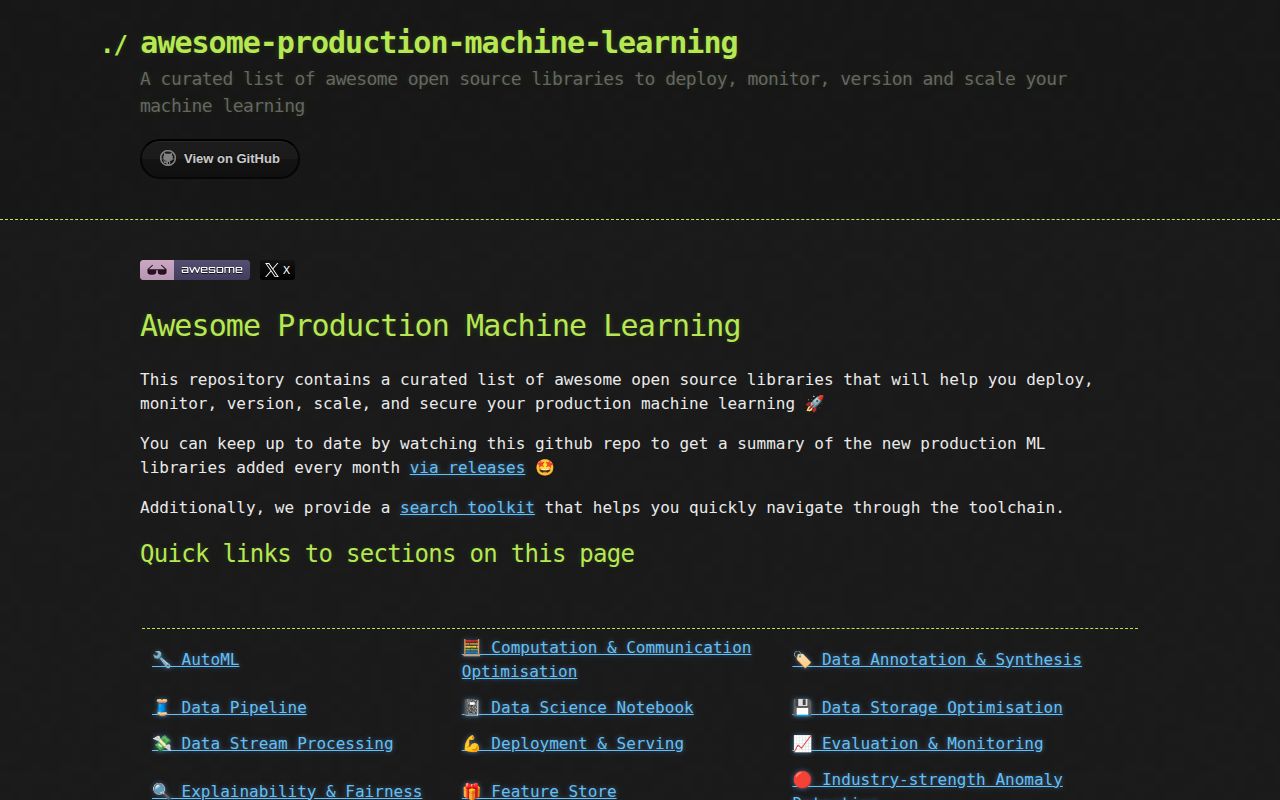
The README contains 522 GitHub project links spread across 24 sections. It covers AutoML, data pipelines, storage, streaming, serving, monitoring, feature stores, training, model storage, privacy, and several domain-specific areas. That breadth is useful when you know the job but not the names. An engineer researching feature stores can scan one section instead of starting with a general web search.
Breadth is also the list's main limit. A one-line description can tell you whether a project belongs in the first research pass. It cannot tell you how difficult it is to operate, whether its license fits commercial use, which cloud services it assumes, or how it behaves with your traffic. With 522 options, the repository saves discovery time and then hands the hard comparison back to you.
The 500-star floor removes obscurity, not operational risk
The contribution guide sets concrete admission rules. A tool needs at least 500 GitHub stars, cannot be archived, and must have been maintained during the previous 12 months. Entries stay alphabetical within a section and should appear in only one section. A proposed new section needs at least five candidates and prior discussion. Those rules keep the file navigable and deter a flood of brand-new self-promotional links.
Popularity and recency are rough filters. Five hundred stars can show that people noticed a project, while a commit within 12 months shows that somebody touched it. Neither fact establishes upgrade safety, on-call burden, or data correctness. The list does not publish a shared test, incident history, support policy, or maintenance score for its entries. Treat admission as permission to investigate, never as approval to deploy.
What happened when we ran it
We did not run commit 56d1bbf in our sandbox. GitHub reports no primary language for the repository, so our harness found no supported ecosystem, and there was no Dockerfile to use as a fallback. The environment had 3 CPUs and 8 GB of RAM, but none of that capacity was used for an install, build, or test. This repository is a document, not a packaged service.
That result does not say whether any of the 522 linked projects work. It says only that the list itself offered no executable path our harness supports. We also did not use the linked tools, compare model-serving latency, check feature-store consistency, or scan every destination for vulnerabilities. Every candidate begins a separate evaluation with its own repository, dependencies, license, and operating model.
Twenty-four sections follow the shape of an ML platform
The category design is better than a single alphabetical dump. Deployment and Serving sits apart from Evaluation and Monitoring. Model, Data and Experiment Management is separate from Model Training and Orchestration. Privacy and Safety has its own shelf. This makes the README useful during architecture work because it exposes the number of distinct jobs hidden inside the phrase put the model in production.
Some tools naturally cross those boundaries, yet the contribution rules allow each project in only one section. That keeps duplicates down but can hide secondary uses. A platform listed under experiment management may also serve models or track metadata. Follow the project link and read its current docs before excluding it based on placement. The category is an editorial home, not a statement about the full product surface.
Monthly releases show upkeep without ranking the additions
The latest release was dated October 1, 2026, and GitHub showed the repository pushed on October 3. The release history listed monthly snapshots through most of 2026, while the open queue contained 37 combined issues and pull requests. Of the 37 returned items, 28 were pull requests and nine were issues. Most recent submissions asked to add a tool to an existing section.
That activity is healthy for a catalog. It shows that people still propose entries and maintainers still publish snapshots. It does not mean every old link was re-audited in October. The project says releases summarize new libraries added each month, not that each release retests the full inventory. When a candidate matters, check its own last push, issues, release history, and archive state again.
One-line entries cannot answer the buying questions
Each entry usually provides a project name, GitHub link, star badge, and short description. Missing fields are the ones that decide an adoption: license type, self-hosted versus managed boundary, supported data stores, Kubernetes requirement, hardware needs, upgrade policy, security contacts, and pricing for commercial features. The companion search tool may make navigation faster, but it cannot create comparison data absent from the list.
Use the catalog as the first of three passes. First, choose one section and collect plausible names. Next, remove candidates that fail fixed constraints such as license, deployment target, or language. Finally, test two or three finalists with your data and failure modes. The list is strongest in the first pass. Asking it to choose a production stack skips the work that its maintainers never claim to have done.
The separate GenAI list keeps this catalog broad
The README points agent and generative-AI readers to EthicalML/awesome-production-agentic-systems. That separation helps this project retain classical production ML categories such as feature engineering, recommendation, anomaly detection, and model storage while still listing relevant modern evaluation and serving tools. It also prevents one fast-moving subfield from consuming the whole page.
Start here when you need to understand the production ML toolchain or discover names within one of 24 categories. Move to the GenAI companion for agent-specific infrastructure, or to a concrete platform such as MLflow or Kubeflow when your architectural choice is already narrow. Awesome Production Machine Learning is a well-maintained index. Its honesty depends on the reader remembering that an index points to evidence; it does not supply that evidence itself.