The directory covers far more than Python
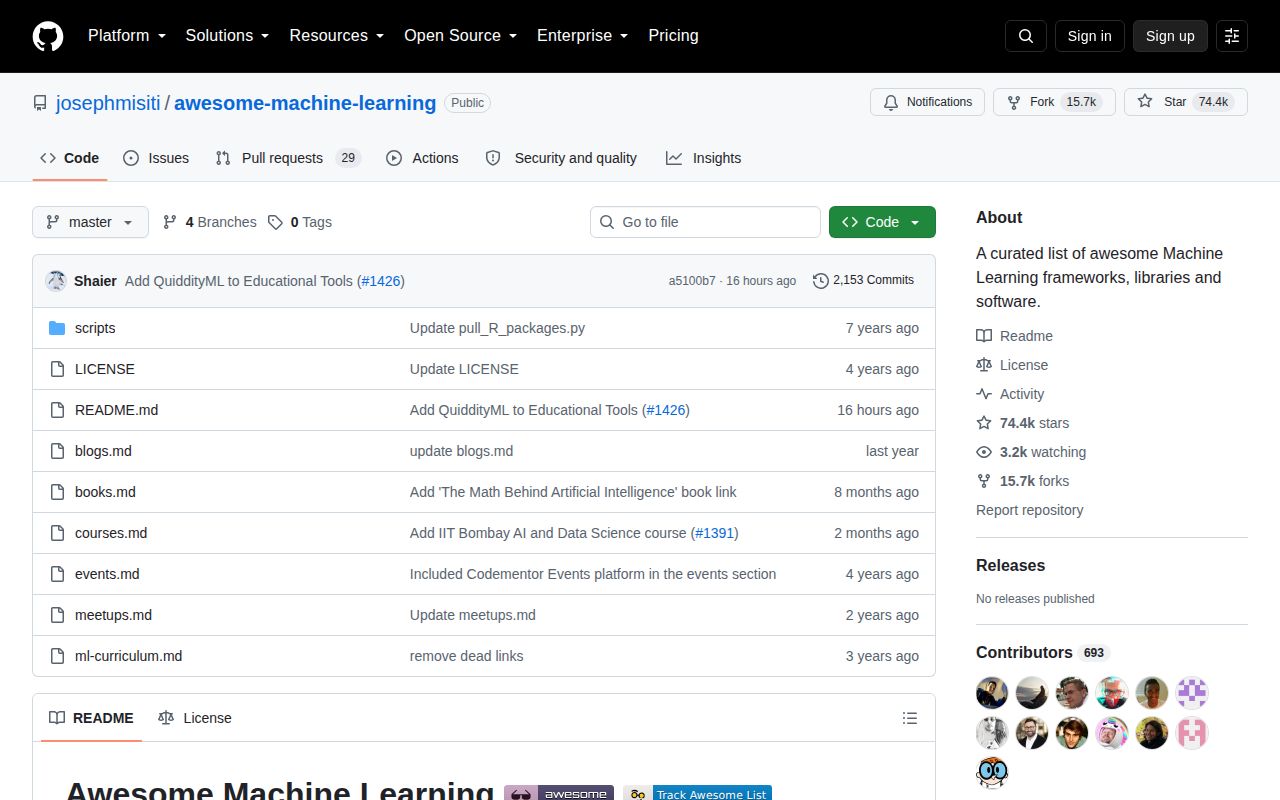
The 10-file directory groups ML frameworks and libraries by programming language, then divides many languages into topics such as computer vision and natural-language processing. The table of contents reaches APL, C, C++, Java, JavaScript, Julia, Rust, R, Swift, and several smaller ecosystems. Separate Markdown files collect books, courses, events, blogs, newsletters, and meetups. That reach is the reason to keep the repository bookmarked.
Our checkout was only 0.3 MB across 10 files, with roughly 31 lines classified as source. That source count is misleading in a useful way: the product is Markdown and outbound links rather than a software library. A Go developer can scan Go options; a Ruby developer can avoid a Python-first search. The list is especially good at reminding you that mature ML tools exist outside the ecosystem dominating current tutorials.
One-line entries cannot choose a library for you
Most projects receive 1 descriptive line and a link through the curation process. There is no shared table for license, last release, supported hardware, package size, security status, or maintenance team. CatBoost, ML.NET, Candle, Haystack, and tiny experimental repositories can appear in the same document even though adopting them creates very different work. The language headings organize discovery; they do not normalize the choices.
The README defines deprecation mainly through an explicit maintainer notice or 2 to 3 years without commits. That catches abandoned code, but it says little about release discipline, compatibility, issue response, documentation, or whether a project still fits your workload. Some items are marked deprecated, while others use old homepages, promotional descriptions, or claims copied from their own projects. Treat every description as a pointer to investigate.
What happened when we ran it
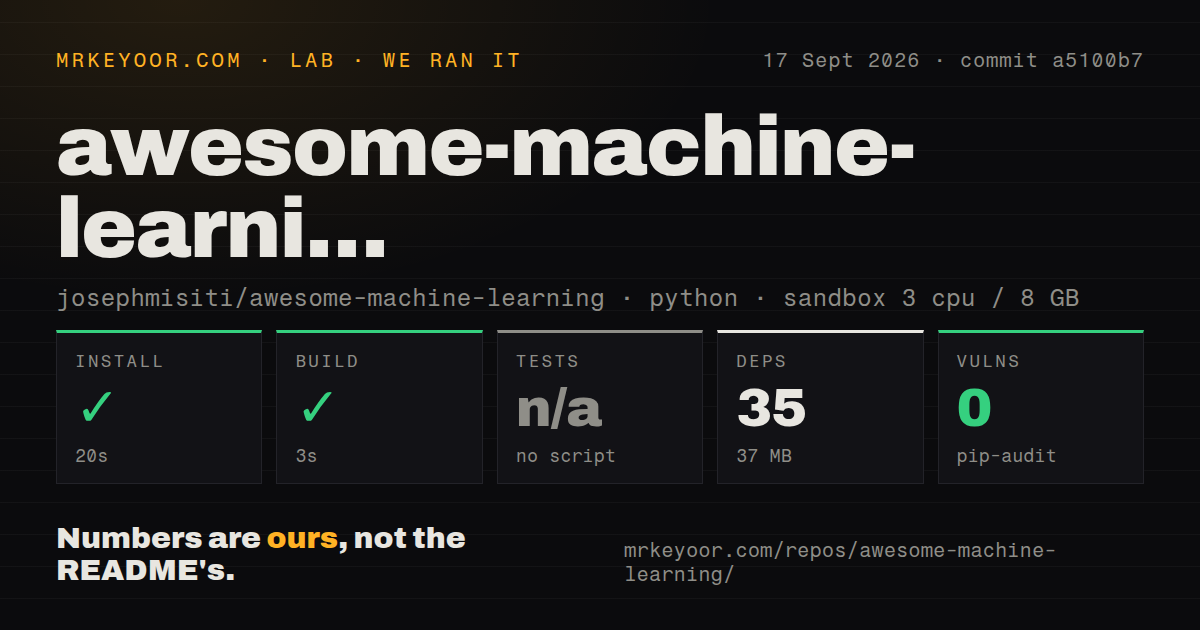
Our measurement setup used commit a5100b7 in an unprivileged Debian container with 3 CPUs, 8 GB of RAM, Python 3.12, and no secrets. Our install succeeded in 20 seconds, pulled 35 packages, and occupied 37 MB. The build completed in 3 seconds. For a 10-file repository whose main artifact is Markdown, those numbers describe its helper environment rather than reader setup.
There was no tests script or target, so the lab skipped tests. Our scan found no tests directory, Dockerfile, or CI workflow. Pip-audit reported 0 known vulnerabilities in the installed Python packages. That clean audit is good news for the small helper environment, but it does not audit dependencies belonging to any listed ML project. None of the outbound projects were installed or executed as part of this run.
The absent test target matters because a directory can fail quietly. A link may redirect, a repository may change owners, or a description may outlive the feature it describes. The current checkout contains both explicit deprecation labels and entries pointing to commercial services. With 0 automated workflows found, link and claim maintenance depends on contributors and the maintainer reviewing changes.
Human screening now sits in front of 29 open PRs
All 29 open pull requests face a human-verification rule added in April 2026. PR authors should email the maintainer with their PR link to show that a person is involved, a response to an unmanageable volume of LLM-generated submissions. GitHub's combined count was also 29, and search found 0 open issues. That is an active intake queue, not a bug backlog.
Maintenance itself is current. The last push was September 17, 2026, when commit a5100b7 added an educational tool. Earlier September commits added JavaScript NLP, C++ ML, and several Python projects. Recent closed issues also show the maintainer rejecting or processing proposed listings. The project is alive, although a current commit does not make every older link current.
The repository license needs clarification before reuse
GitHub reports no recognized SPDX license for this repository. Its 38-byte LICENSE file contains two short lines that refer to Creative Commons legal code without identifying a specific license or spelling out permissions. That is not enough clarity for a company planning to copy the directory into its own product. The linked projects each retain their own licenses, which require separate checks regardless of the directory's terms.
This also affects automated reuse. A team scraping the list into an internal catalog would need to preserve source links, decide how to handle commercial entries, and add its own freshness and license fields. The 35 installed packages do not supply that pipeline, and the 3-second build does not produce a verified dataset. The repository is most useful in its original human-readable form.
Use the list to start a shortlist, then leave it
The 10-file repository saves time only at the discovery stage. Open the language section that matches your stack and collect a few plausible names. Next, check each project's last push, release history, license, issue activity, documentation, and smallest runnable example. For production work, install and test the actual candidate in your own environment. That second pass is where the decision happens.
Awesome Machine Learning saves search time because its scope is hard to reproduce from memory. Its value ends at discovery. We measured a 20-second install, 3-second build, and zero-vulnerability audit for the small helper environment on commit a5100b7; those results say nothing about the hundreds of destinations. Keep that boundary intact, and the list remains useful.