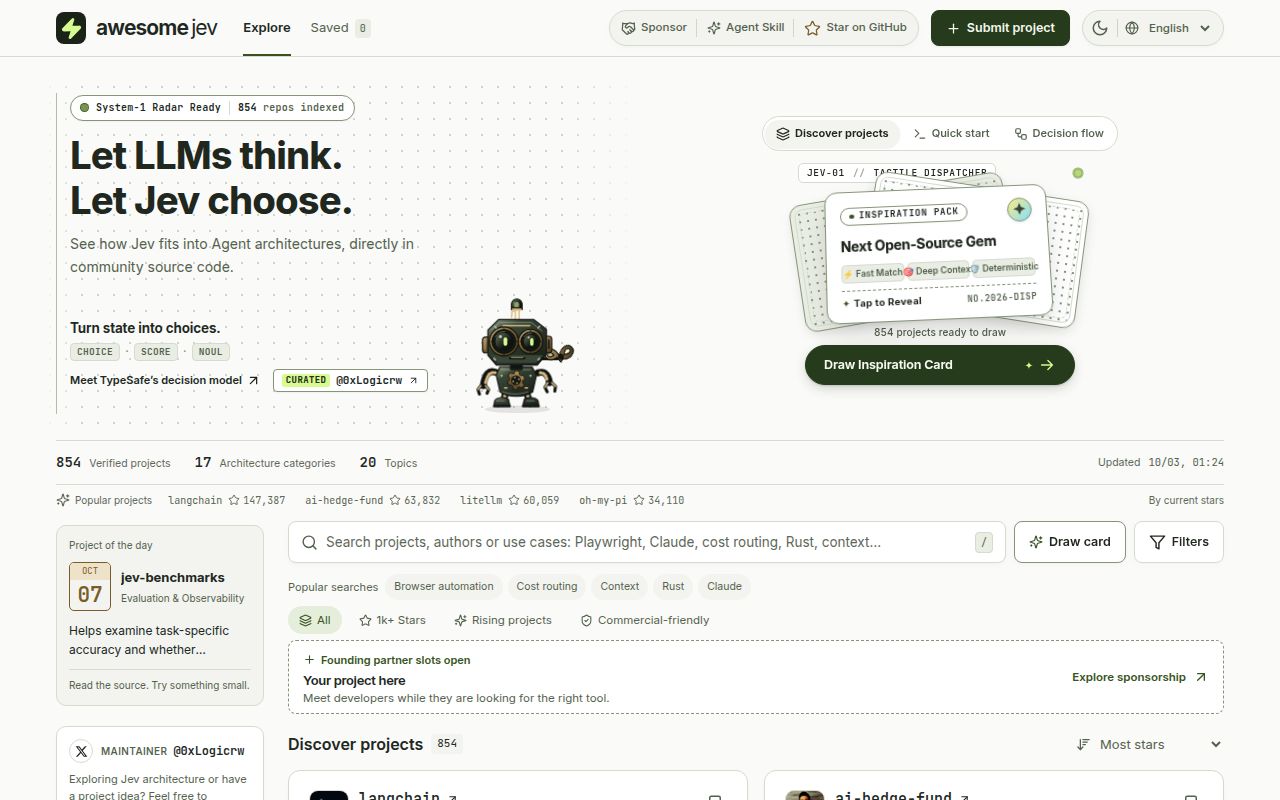
Each of 854 entries points to a fixed source location
Awesome Jev Projects catalogs more than 854 projects across 17 categories, ranging from browser control and model routing to security checks and SDK integrations. An entry links to the upstream repository, a commit-pinned source file, and the point where Jev makes a decision. That is much more useful than a logo wall when you need to see whether a project truly calls Jev or only mentions it.
The governing idea is narrow: Jev handles bounded choices, scores, or yes-and-no judgments while a larger model handles open-ended work. The catalog is therefore a map of one architecture, not a survey of every agent framework. If your question is simply "which AI agent should I use?", this list will omit many relevant projects. If you are deciding where a small typed model fits, its filtering is the advantage.
Search, filters, and an Agent Skill replace README scrolling
The project builds a static React and Vite site with search, tags, category filters, sorting, bookmarks, shareable project URLs, and evidence dialogs. English is the default, with Chinese, Japanese, and Korean README versions. The repository also publishes a skill, llms.txt, and a full machine-readable text view, so an agent can search the collection without loading the enormous README into one context window.
The interface has a playful gacha-style project picker and streak counter, but the workhorse is ordinary filtering. You can cut 854 entries down by domain, inspect the exact decision point, then leave for the upstream code. That path serves a buyer better than the README's broad latency and cost comparison, which describes Jev's intended position rather than an independent benchmark of every cataloged project.
What happened when we ran it
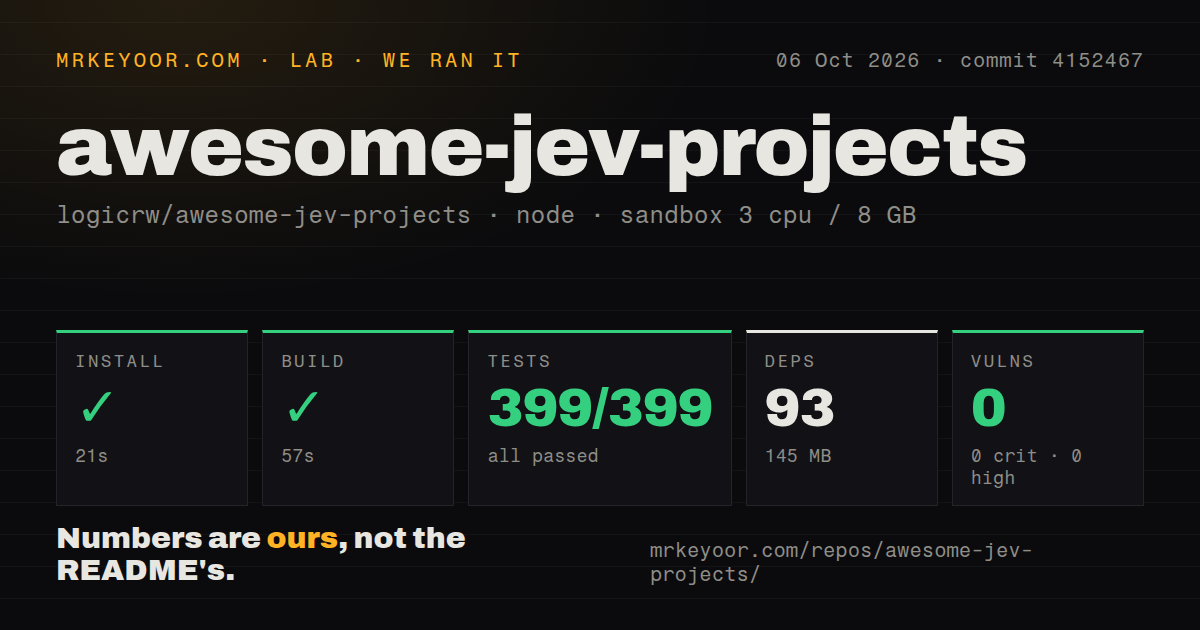
Our sandbox installed commit 4152467 in 21 seconds, pulling 93 npm packages and using 145 MB on disk. The build completed in 57 seconds. Node's test runner finished in 25 seconds with 399 passed and 0 failed of 399. Npm audit reported 0 known vulnerabilities across critical, high, moderate, and low severities.
The checkout contained 977 files, about 19,204 lines of source, and occupied 13.9 MB. We used a Node 22 image in an unprivileged Debian container with 3 CPUs, 8 GB of RAM, and no secrets. The repository has 6 CI workflow files and a tests directory, but no Dockerfile. These results verify the site and catalog tooling we ran, not the applications listed inside it.
Source verification stops short of runtime verification
The project's verification document draws a helpful line. Catalog records are checked against fixed source evidence, and the public build is audited for credential patterns, private paths, source maps, crawler logs, and fields outside the allowlist. Browser checks cover search, filters, bookmarks, keyboard use, dialogs, and phone layouts. Those checks establish that the radar works and that an entry has inspectable code behind it.
They do not establish that a listed tool runs correctly, saves money, reaches a claimed latency, or behaves safely in production. The document says no project runtime or performance verification is claimed. Some catalog descriptions repeat that cost and speed benefits have not been independently verified. Treat the site as a well-indexed lead generator: inspect and test the upstream project before adopting it.
Issue-only submissions keep the generated catalog controlled
Project additions and updates go through GitHub issues. The README says pull requests of any kind will be closed automatically because the frontend and automation remain under the core team's control. Four issues were open when checked: three proposed projects and one request for a prompt collection. That queue shows the intended workflow in use, though it gives outside contributors less direct control over corrections than a normal awesome list.
Automation then reviews and synchronizes records, generates README content and public data, compiles TypeScript, builds the Vite frontend, creates static pages, and audits the result. Six workflow files back that process. The repository does not ship a Dockerfile because the main deployment product is static output for GitHub Pages rather than a resident service.
October activity is current, but there is no release tag
GitHub showed 665 stars, 55 forks, and 4 open issues and pull requests on October 7, 2026. The fetched list contained four issues and no pull requests. The last push was October 3, four days before this review, and the recent submissions were updated between October 1 and October 5. Those dates show an active catalog and issue queue.
There is no GitHub release, so consumers cannot pin a named published version. Use a commit if the catalog or skill must stay stable in an internal workflow. The MIT license covers this repository, while each listed project keeps its own license and may declare none. That per-entry license field is worth checking before a promising source link becomes a dependency.
The catalog is evidence for discovery, not a product endorsement
Our run's 399 passing tests make the catalog itself credible software. Commit-pinned links make entries easier to challenge, and the static site makes a huge topic-specific list usable. The limit is equally plain: source presence proves that Jev appears in the code, while runtime quality still belongs to the upstream project and your own test environment.
Use Awesome Jev Projects when you already care about typed System-1 decisions and need concrete implementations to inspect. The site can get you from a category to a fixed line of code quickly. Stop there before believing the surrounding performance story. A catalog that admits what it did not run is more useful than one that silently turns inclusion into approval.