The list filters projects before it lists them
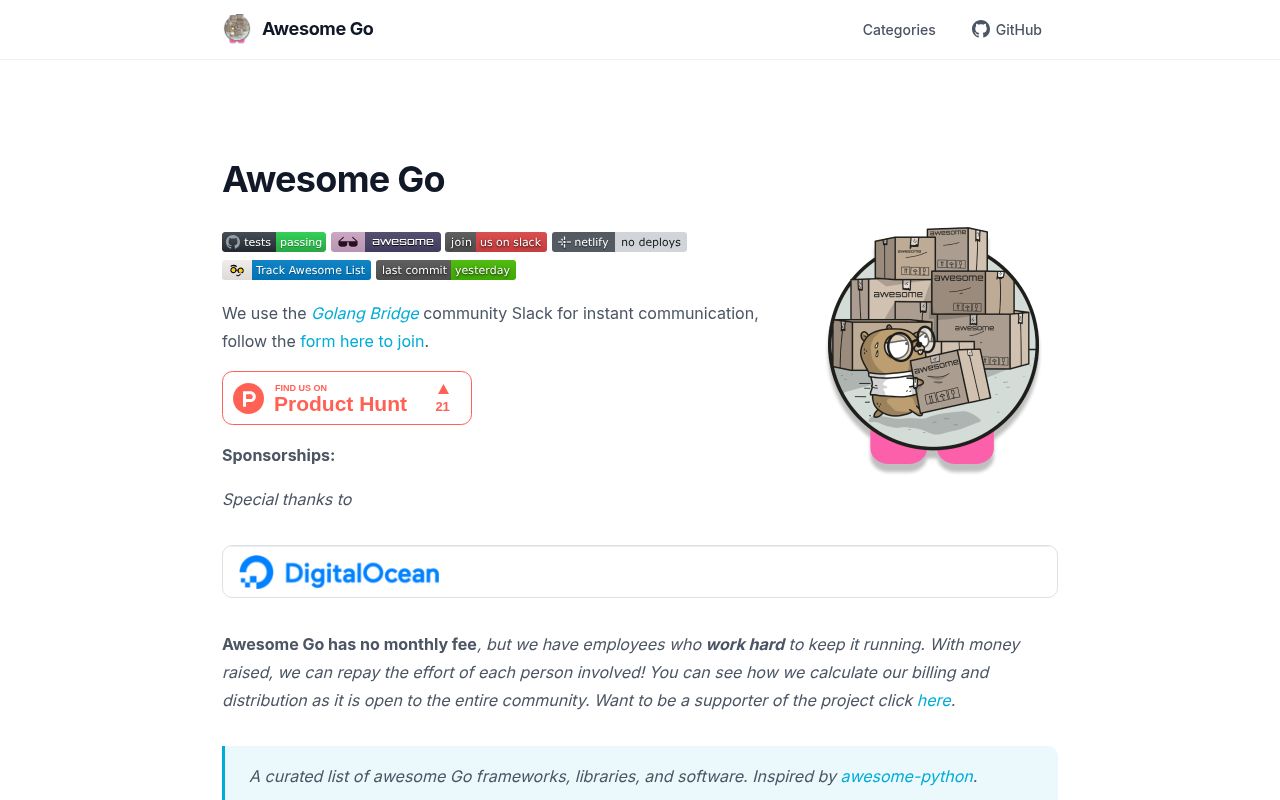
Awesome Go is a long README and companion website organized into categories such as databases, testing, command-line tools, web frameworks, security, artificial intelligence, and build automation. Each entry is a project name, link, and short description. That format works well when the question is broad, such as which Go routers or migration libraries deserve a closer look. It cannot answer whether one package fits a specific codebase.
Admission is stricter than adding a link to a wiki. The contribution checklist asks for at least 5 months of history, an open-source license, a root go.mod, one SemVer release, English documentation, and coverage evidence. The stated coverage guideline is at least 80% for ordinary packages and 90% for data packages when testing applies. Maintainers also review usefulness, category fit, documentation, and whether the software works as described.
Alphabetical categories give shortlists, not winners
Entries within a category are alphabetical. There is no score, recommendation order, compatibility matrix, or direct comparison of tradeoffs. That is a sensible editorial boundary: the project helps a reader discover candidates without pretending that one HTTP router, logger, or database driver wins for every workload. A serious choice still requires reading each candidate's documentation, release notes, license, API, and open reports.
The repository was only 2.5 MB in our checkout, with 92 files and about 2,383 source lines outside the huge list content counted by the lab. That small maintenance codebase checks a much larger body of outbound links and structured Markdown. The README itself remains easy to clone, search with local tools, or browse without JavaScript. The website is more convenient for casual navigation, while the repository exposes the editing history and review discussion.
What happened when we ran it
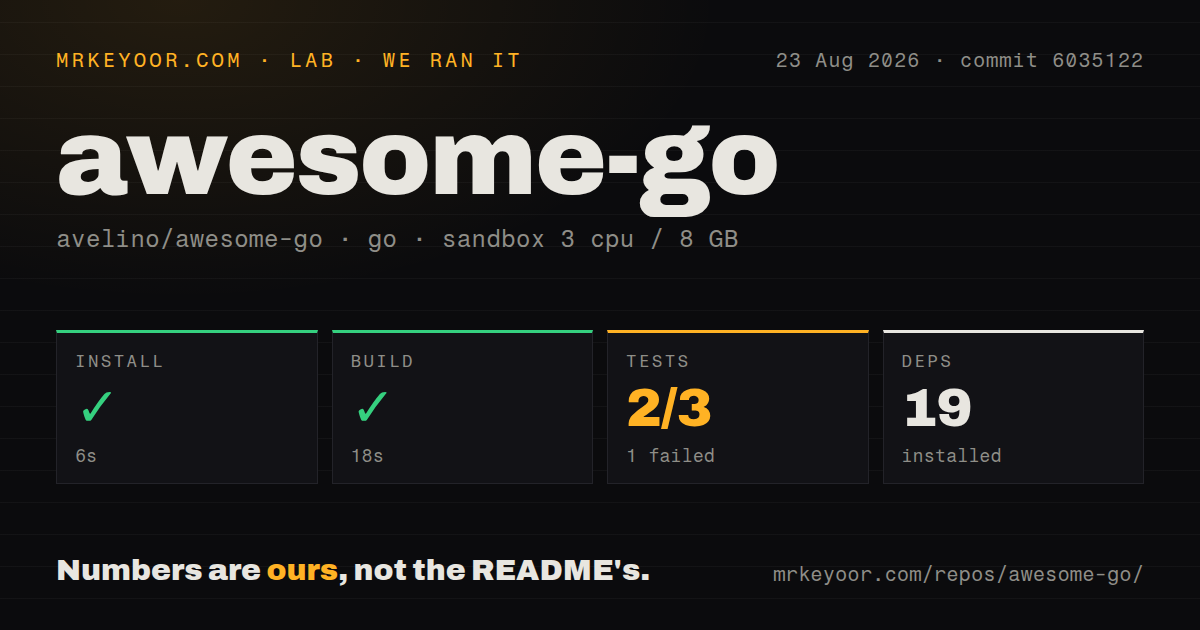
Our sandbox installed 19 packages in 6 seconds and built commit 6035122 in 18 seconds. The test run ended with exit code 1 after 366 seconds. Go reported 2 passing packages and 1 failing package out of 3. The pkg/markdown and pkg/slug packages passed quickly, while the main github.com/avelino/awesome-go package failed at 360.012 seconds.
The last log lines showed goroutines inside Go's HTTP/2 client request path. They did not show a failed URL, an assertion, or a stated reason for the timeout-length failure. We therefore cannot tell whether a remote site, network condition, or code defect caused it. The useful finding is narrower: the full check did not pass in our fresh Debian container with 3 CPUs, 8 GB of RAM, and no secrets.
Network-dependent maintenance can make checks slow
A directory of external projects has an unavoidable maintenance problem: links move, repositories archive, documentation sites disappear, and project health changes. Awesome Go uses automated checks for repository access, go.mod, SemVer tags, pkg.go.dev, Go Report Card, duplicates, alphabetical order, and entry formatting. Humans decide usefulness, accurate descriptions, category placement, documentation quality, and whether reported coverage is meaningful.
Our run lasted 366 seconds before failing, despite the local build taking only 18 seconds. The log does not prove network trouble, but its HTTP/2 goroutines show that remote HTTP work was active near the end. Contributors should expect checks to depend on services outside the repository. Readers should also understand that a passing submission review captures a point in time; the README explicitly asks the community to report packages that stop being maintained or no longer fit.
A 5-month rule trades novelty for evidence
The age and release rules reduce drive-by additions and give reviewers some history to inspect. They also mean a promising new library cannot enter immediately, even if its design is excellent. Projects without a versioned release, root module file, English API documentation, or the requested quality links face the same barrier. That bias is useful for conservative dependency selection and less useful for tracking experimental work as soon as it appears.
Classification still involves judgment. Open issue 6592 argues that Kong belongs under Standard CLI rather than Configuration because its configuration loaders supply defaults to a command parser. That disagreement is ordinary taxonomy work, but it matters to discovery: a reader may never inspect the second category. Search the whole README for important terms instead of assuming the first likely heading contains every relevant option.
Current activity supports using it as a first pass
GitHub showed 182,372 stars, 218 combined issues and pull requests, and a last push on August 26, 2026. The latest-release endpoint returned no release, which is unsurprising for a continuously edited directory and does not signal abandonment. Current pushes and issue discussions are better health evidence here than release tags. Six CI workflow files also show active automation around the list.
Awesome Go earns a bookmark because it narrows a huge ecosystem with visible rules and open review. Its 1 failed package in our lab means maintainers should reproduce the checks before changing the list. For users, the bigger caution is editorial: inclusion says a project cleared the directory's criteria, not that it is safe, compatible, or right for a particular system. Use the list to find names, then do the engineering review elsewhere.