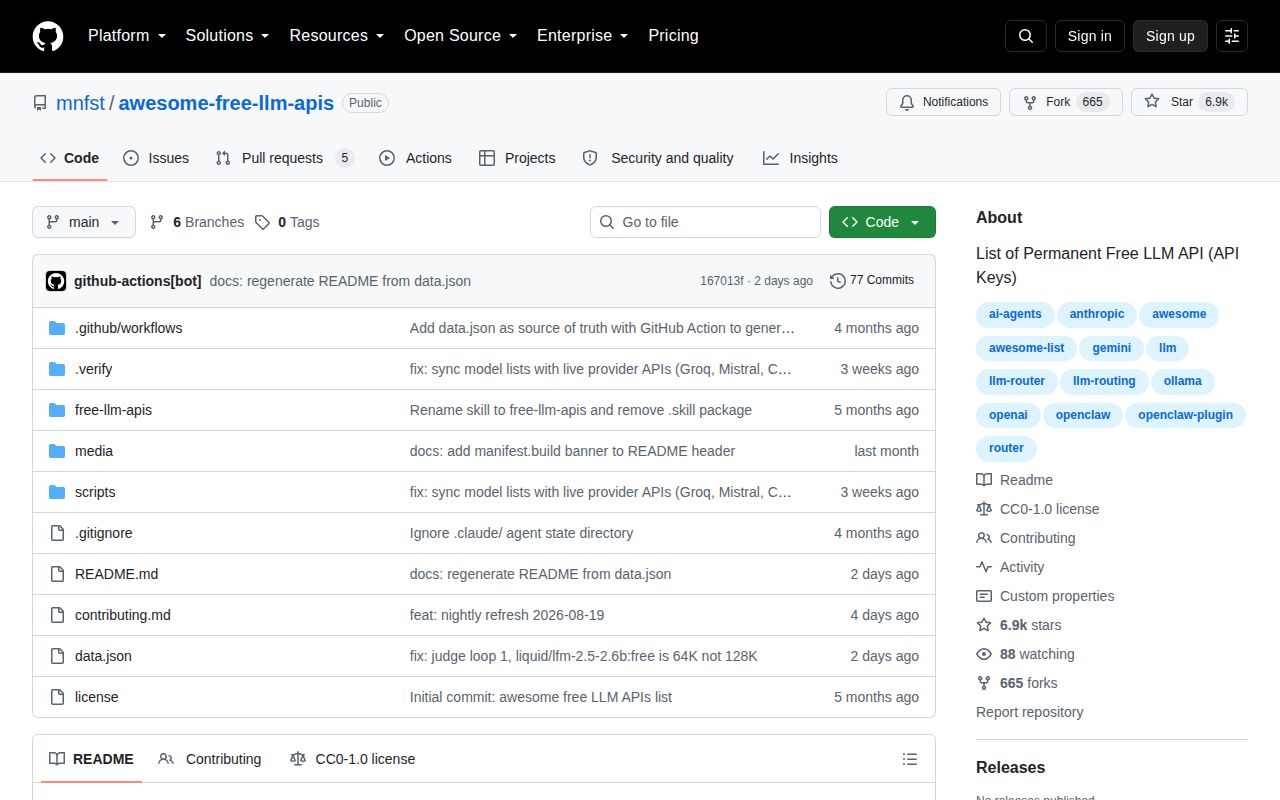
A comparison table for a slippery market
Awesome Free LLM APIs answers a question that sounds simple and rarely is: which hosted language-model APIs can a developer use without immediately paying? The repository separates model makers from third-party inference hosts, then lists key pages, base URLs, representative models, context windows, maximum output, modalities, and rate limits. A small glossary decodes RPM, RPD, TPM, and TPD.
This is much more useful than a page of provider logos. A developer can quickly see that one service has a daily request ceiling, another meters tokens, and another offers many models under a shared allowance. The README also records conditions that marketing summaries often hide, including regional exclusions, non-commercial terms, payment-method requirements, real-name checks, unpublished limits, and prompt-use policies.
The list's rule is recurring free access, not expiring signup credit. That keeps the catalog focused on services a small personal tool might continue using. The definition is not perfectly uniform in practice: Cerebras is listed with a payment method requirement, Hugging Face's tiny monthly credit is described as subject to change, and Ollama Cloud publishes qualitative rather than numeric limits. Still, these caveats are visible instead of buried.
The data structure is the best part
The human-facing README is generated from a 46 KB JSON file. Provider records carry categories, descriptions, endpoints, model rows, and footnotes, while a short Node script sorts them and builds consistent Markdown tables. A GitHub Actions workflow regenerates the README whenever the data changes. This is a better maintenance design than hand-aligning a large awesome list. It also makes the catalog easier to reuse in another interface or auditing tool.
The repository includes a substantial verification script. It knows how to call standard OpenAI-style endpoints as well as Gemini, Cohere, Cloudflare, and Ollama variants. It can read provider keys from a local verification environment, redact key-like strings, test models, classify responses, and perform connectivity checks when credentials are unavailable. Saved reports from July show that verification is more than an aspiration. Recent commits describe checking live model endpoints and correcting dead model IDs.
That tooling raises confidence, but it does not turn a snapshot into a service guarantee. Tests without keys are skipped or reduced to base-URL checks, and a successful request says little about tomorrow's quota, commercial terms, or data policy. The repository gives you better leads, not a contract.
Freshness can expire in days
The catalog's hardest problem is visible in its own tracker. The last repository push was July 30, 2026, when a large discovery and verification pass updated multiple providers. By August 3, contributors had opened pull requests saying GitHub Models had retired and Gemini limits needed changes. On August 13, new reports said SambaNova no longer offered free models and SiliconFlow required identity verification. The current README still contains the disputed GitHub Models and SambaNova entries.
Those reports need maintainer review, and not every user claim is automatically correct. Their timing nevertheless demonstrates the buyer risk: even careful, recently tested data can become questionable within two weeks. Model catalogs rotate, free quotas shrink, and providers change signup gates. Do not copy a model ID and quota into production planning without opening the linked official documentation and, ideally, calling the provider's live models endpoint.
The repository had 11 open issues and 14 open pull requests in August. That activity is healthy evidence of people checking the list, but the correction queue also means readers see known disputes before fixes land. More than 6,600 stars in roughly five months show strong interest, not long operational history. There are no GitHub releases, which is reasonable for a list but leaves no tagged snapshot to pin.
The bundled agent skill needs its own warning
A ready-made agent skill is included beside provider reference files. Its workflow asks what the user values, recommends one or two services, walks through key creation, and offers a small Python test using the OpenAI client. That is a smart extension of the underlying data: an agent can turn a large table into a short decision.
Unfortunately, the skill has drifted. It says every provider has a permanent free tier with no card, recommends GitHub Models, and presents older Groq and Cerebras limits that conflict with the newer README. It is also maintained separately from the JSON-to-README generator, so the project's best structural safeguard does not cover it. Treat the skill as a conversational template, not a current source of facts.
Contribution instructions have a similar mismatch. They tell contributors to add a line directly to README, but the generator reads data.json and overwrites README. An open issue documents the problem, and current pull requests correctly update the data file before regeneration. New contributors should follow the actual pipeline, not the prose guide.
How to use this list well
Start here when cost is the first filter. Pick two or three providers based on model support, quota shape, region, signup burden, and prompt policy. Then visit each official limit page, create a key, query the live model list, and run a small test that records errors and rate-limit headers. Keep credentials in environment variables, as the included skill correctly advises.
For a weekend prototype, that process may be enough. For a product, add a paid fallback or a second provider, because free access can change without notice. Awesome Free LLM APIs saves hours of discovery and asks many of the right questions. Its value is in narrowing the field quickly, provided you remember that every row has an expiration date the maintainer cannot know in advance.