8 sections organize 103 connectome resources
We counted 103 entries in commit ed5e006 before assessing how Awesome Fly defines terms that project pages often blur. A connectome records neurons and connections. A simulation adds dynamics, sensory inputs, and motor outputs. MaleCNS includes the adult male brain and ventral nerve cord, while FlyWire is an adult female brain dataset. Flybody and NeuroMechFly provide bodies and environments rather than brain wiring. Those distinctions stop readers from comparing unlike systems.
Our count of commit ed5e006 found 103 entries across 8 resource sections: games, desktop flies, language and art experiments, brain models, official datasets, analysis tools, tutorials, and related lists. Each entry links to the original work and tries to name the dataset, implementation, evidence, and important limit. That is far more useful than a wall of repository names.
What happened when we ran it
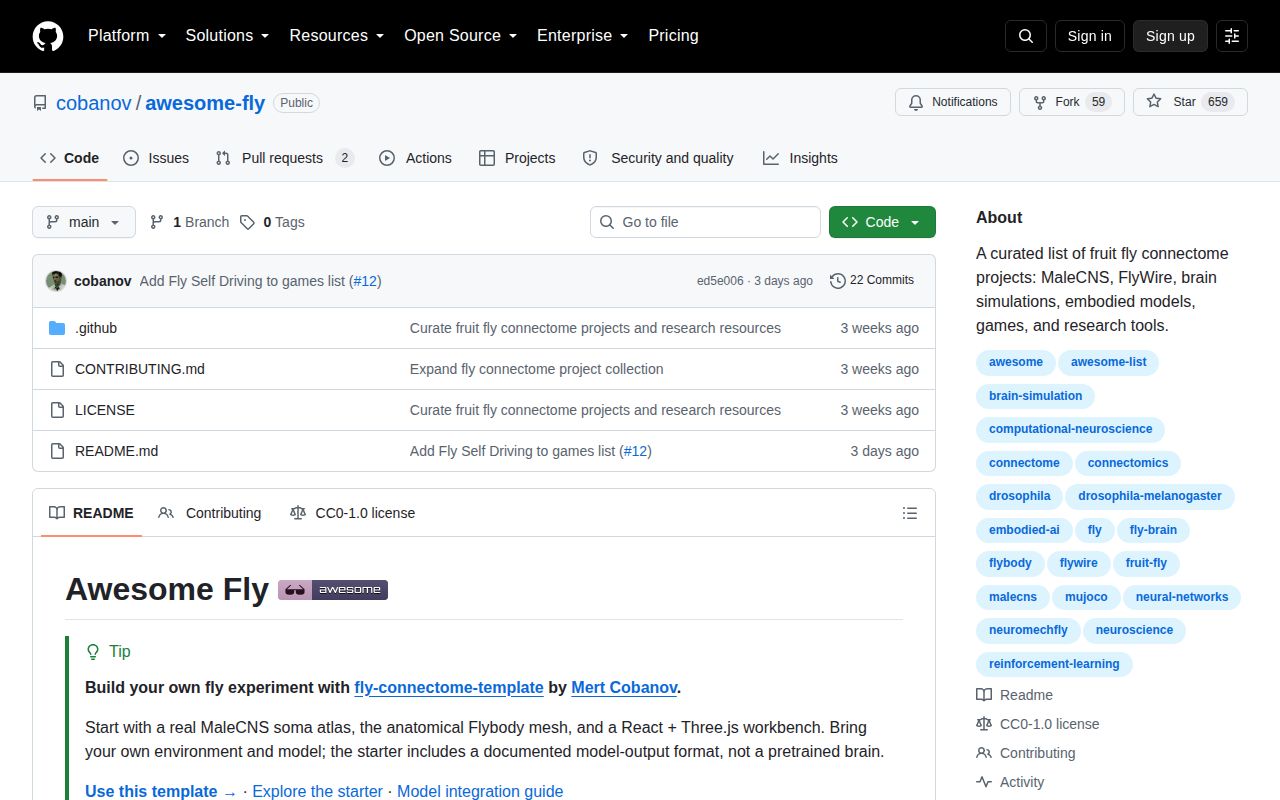
Our lab found 0 executable targets in the repository. GitHub reports no primary language, the root contains README, contribution, license, and GitHub metadata, and the repository has no Dockerfile. An install time, build result, dependency count, vulnerability audit, or test total would be invented for this kind of project. The review therefore evaluates the list as edited reference material.
We inspected 3 content files plus the .github metadata directory; the README itself is substantial. Its games section contains 22 entries, brain models and embodied simulation contains 17, and analysis libraries and viewers contains 21. The remaining sections add desktop projects, creative work, datasets, papers, and two related directories. Following even one entry moves you into a separate codebase with its own setup and risks.
4 recurring labels separate measured wiring from project design
Four recurring labels tell you whether an experiment retains the full graph, extracts a circuit, trains only a readout, or uses anatomy as a visual asset. A game can show whole-brain activity while its behavior comes from an engineered controller. Another may train gains on measured connections. Awesome Fly places those implementation choices in the description instead of letting a dramatic video carry the claim.
Specific examples show the editing standard. Fly Self Driving is summarized with its 64 by 32 pixel input, 165,122 neurons, 25,563,197 synapses, held-out course results, baselines, one-seed limit, and missing braking. FLYT3 includes its own weaker result against a simple image model. Several projects publish negative plasticity or topology controls. The list does not turn those project-reported results into independent findings.
The September 12 source review did not reproduce 103 projects
The README dates its overall community-entry review to September 12, 2026 and explicitly calls the work source review. Maintainers read the linked documentation and check whether public source or a stated release status matches the description. They do not claim to have rebuilt 103 projects, rerun training, confirmed demos, or checked scientific results against raw data.
That boundary matters because some entries quote neuron counts, success rates, model controls, or benchmark outcomes. Contribution rule 5 asks writers to keep claims proportional to evidence and link reported results. Rule 6 asks for link checks and disclosure of archival, missing source, upstream changes, or author affiliation. A reader still needs to open the cited repository before relying on any number.
The dataset guide prevents common connectome mix-ups
The 10-entry official-resources section separates MaleCNS, FlyWire annotations, BANC, optic-lobe data, and neurotransmitter ground truth. The analysis section then points to tools for morphology, graph queries, comparative connectomics, transforms, clustering, videos, and prepared matrices. This split helps you choose a dataset first and a compatible library second.
Dates and versions remain important. The list says MaleCNS v1.0 was dated June 8, 2026 and its Cell paper September 3, 2026. Other entries use FlyWire releases such as v783 or older graphs. A neuron count can change with a release or filter, and synaptic contacts are not the same measurement as connected neuron pairs. Awesome Fly warns about both traps near the top.
CC0 covers the directory, not the linked projects
Awesome Fly's own text is under CC0 1.0, and contributors agree to place original list text under that license. The README also says linked code, datasets, and artwork retain their own licenses. You must check each destination before copying code or packaging data. A missing license on an entry is called out in some descriptions rather than silently treated as permission.
The promoted fly-connectome starter has separate terms. Its custom license requires a linked template credit in a derived web interface and repository README. That banner sits above the 103-entry directory, so readers could easily assume the list's CC0 terms apply to it. They do not. Follow the template's license before using its React and Three.js workbench.
September merges and October pull requests show live maintenance
GitHub showed 659 stars, 2 combined open issues and pull requests, and a last push on September 30, 2026. Both open items were pull requests submitted on October 1 to add more games. Recent merges added Banana Quest, BioReservoir, and Fly Self Driving. The repository began on September 12, so its history is active but short.
Use Awesome Fly as a carefully annotated index to 103 entries. Its best editorial move is refusing to equate measured wiring with a biologically faithful mind, trained behavior, or validated learning. Pick an entry from the relevant section, confirm its graph and release, read the negative controls, and inspect its license. The list gets you to the right door; the evidence remains inside each linked project.