The collection is a starting point for Cursor project rules
Awesome Cursor Rules gathers .mdc files that tell Cursor how to behave in a repository. A rule can name preferred libraries, architecture, file patterns, testing commands, security constraints, or a workflow. The README organizes entries across frontend, backend, mobile, games, styling, data, testing, deployment, languages, security, and documentation. This makes the project useful when a developer knows the domain but has not yet found a good structure for expressing it to an editor agent.
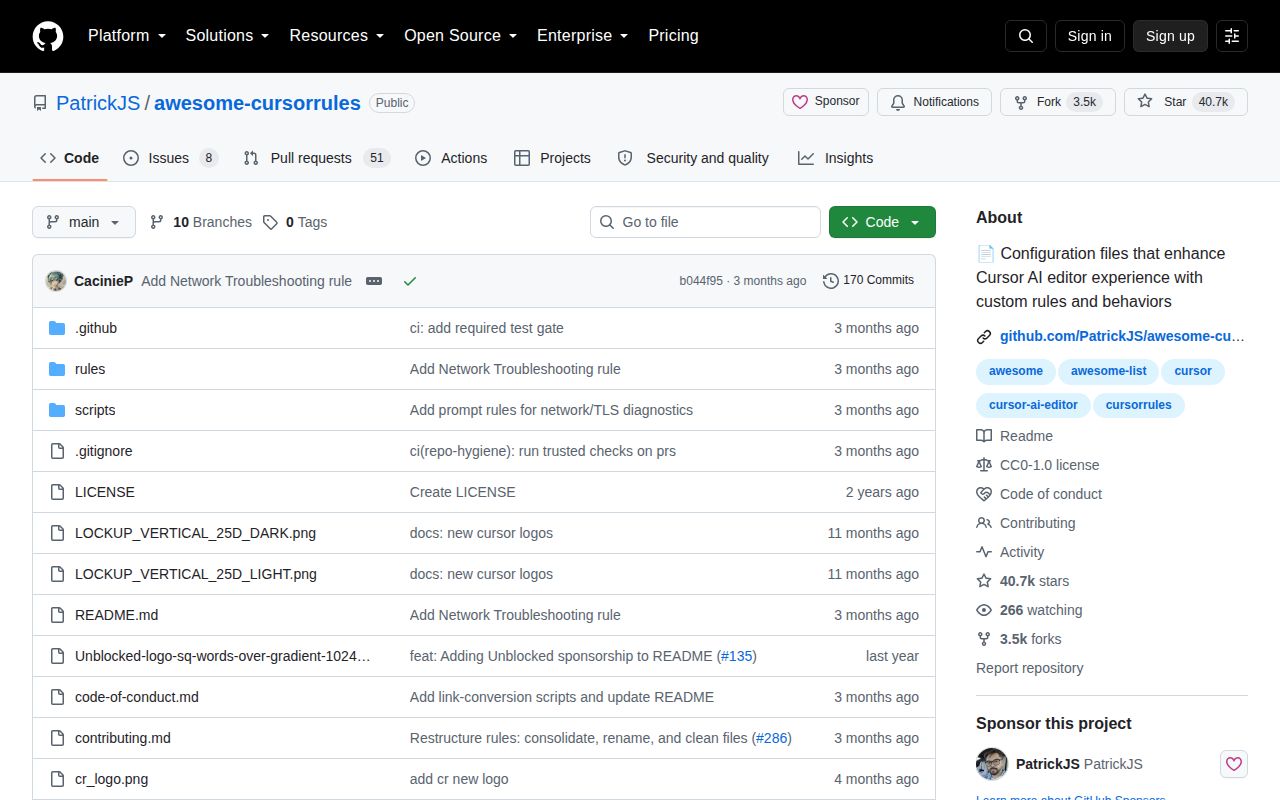
The repository is a catalog rather than a runtime. Our checkout held 295 files, roughly 3,283 source lines, and occupied 2.6 MB. GitHub showed 40,663 stars and 59 open issues and pull requests combined. The repository's last push was May 30, 2026, while several pull requests were created and updated in August. That means contribution activity is current even though the default branch push date is older.
Copying one rule is safer than importing the catalog
The documented process has five steps: install Cursor, choose a rule, create .cursor/rules/, copy the .mdc file, and customize it. The final step carries most of the value. A generic Next.js rule may assume a router, authentication method, test runner, package manager, or deployment target that your repository does not use. Leaving those assumptions unchanged can make generated edits look consistent while being wrong for the project.
Start with one file that matches the immediate task. Read every instruction, delete irrelevant sections, replace generic commands with the real ones, and add scope metadata so the rule applies only where intended. Test it on 3 representative requests: a small feature, a bug fix, and a refactor touching an existing convention. If Cursor repeatedly ignores or misreads a line, rewrite that line around a concrete file or command rather than adding more broad advice.
What happened when we ran it
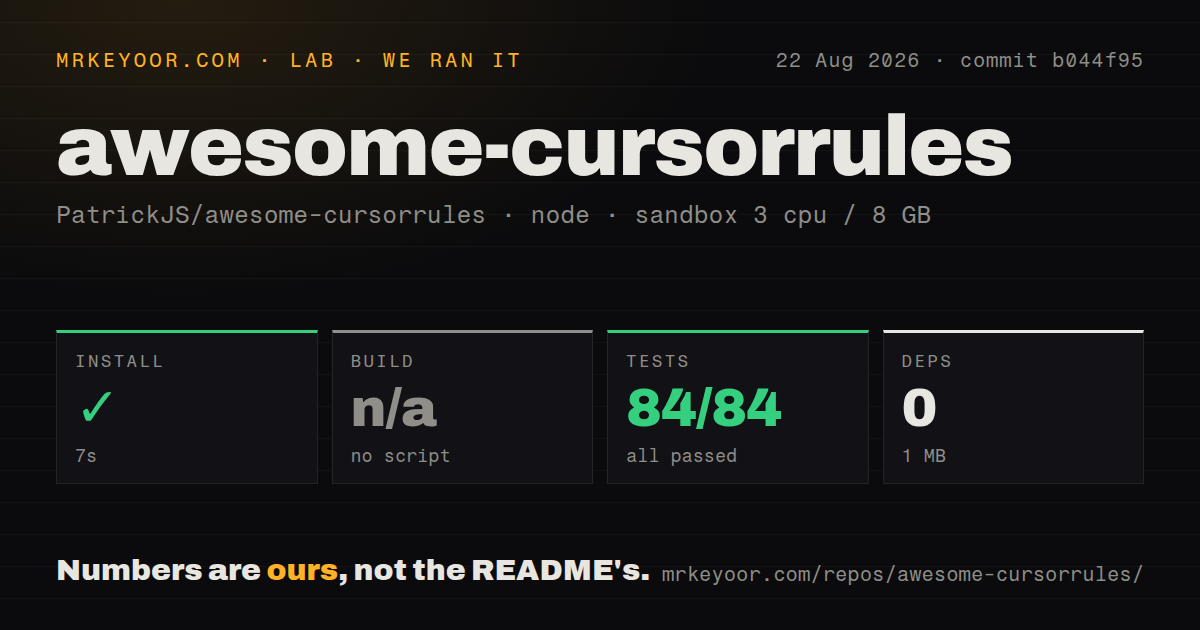
Our sandbox cloned commit b044f95 into a fresh unprivileged Debian container with 3 CPUs and 8 GB of RAM. The pnpm install succeeded in 7 seconds, added 0 packages, and left 1 MB on disk. There were no secrets. This is consistent with a mostly content-based repository whose useful assets are Markdown rule files.
The harness found no build script or target, so it skipped build. Tests succeeded in 7 seconds, with Node's test runner reporting 84 passed and 0 failed out of 84. The scan detected 1 CI workflow, no Dockerfile, and no tests directory. The passing checks establish that the collection met its repository-level validation at commit b044f95; they do not execute code generated from every rule.
That difference is easy to miss. A rule can pass filename, link, or metadata checks while recommending an outdated API or unsuitable security pattern. The 84-test result is still useful because it shows basic collection maintenance. Project owners must validate the effect of copied instructions through their own formatter, type checker, tests, security review, and diff inspection.
Community entries vary in scope and evidence
Some entries are narrow, such as a commit-message convention or README guidance. Others prescribe an entire framework stack, architecture, or security posture. Those categories should not receive equal trust. A short style rule is easy to audit. A 27-point authentication and database rule needs verification against current framework documentation and the application's threat model before it influences production code.
The README often describes entries in one sentence, which helps browsing but does not provide independent evidence for each instruction. Check dates and versions inside the selected file. Remove absolute wording that the source does not support. A useful rule should point Cursor toward local source files and tests, not ask it to remember a framework from the model's training data. Specific repository truth ages more slowly than copied best-practice language.
Rule conflicts become agent behavior conflicts
Two individually reasonable files can disagree about state management, folder layout, testing style, error handling, or whether a dependency is allowed. Cursor then has to resolve competing instructions during generation, and the result may change with the prompt. Keep an explicit order of authority: repository safety rules first, architecture decisions second, task-specific guidance next, and style last. Remove duplicate advice instead of hoping repetition makes it stronger.
Shared rules also need code review. An .mdc change can alter hundreds of future agent suggestions without changing application code on the day it lands. Treat it like a build configuration change: explain the problem, show a before-and-after agent task, and record the project evidence behind the instruction. A rule using an absolute instruction should survive an example from every directory in its scope.
No release tags means activity must be judged elsewhere
GitHub's latest-release endpoint returned 404, so the project has no current GitHub release to assess. That is not a sign of abandonment for a copied-rule catalog. The default branch was last pushed May 30, while pull requests for agent skills, MCP search, supply-chain security, testing, and other rules were active in August 2026. Health is better judged from merge response and file updates than package versions.
Awesome Cursor Rules is easy to recommend as a reference library because the 7-second install and 84 passing tests make inspection cheap. It is harder to recommend as a bulk dependency. Browse it for patterns, copy the smallest relevant file, and rewrite it around the repository in front of you. The payoff comes from better local instructions, not from the size of the collection.