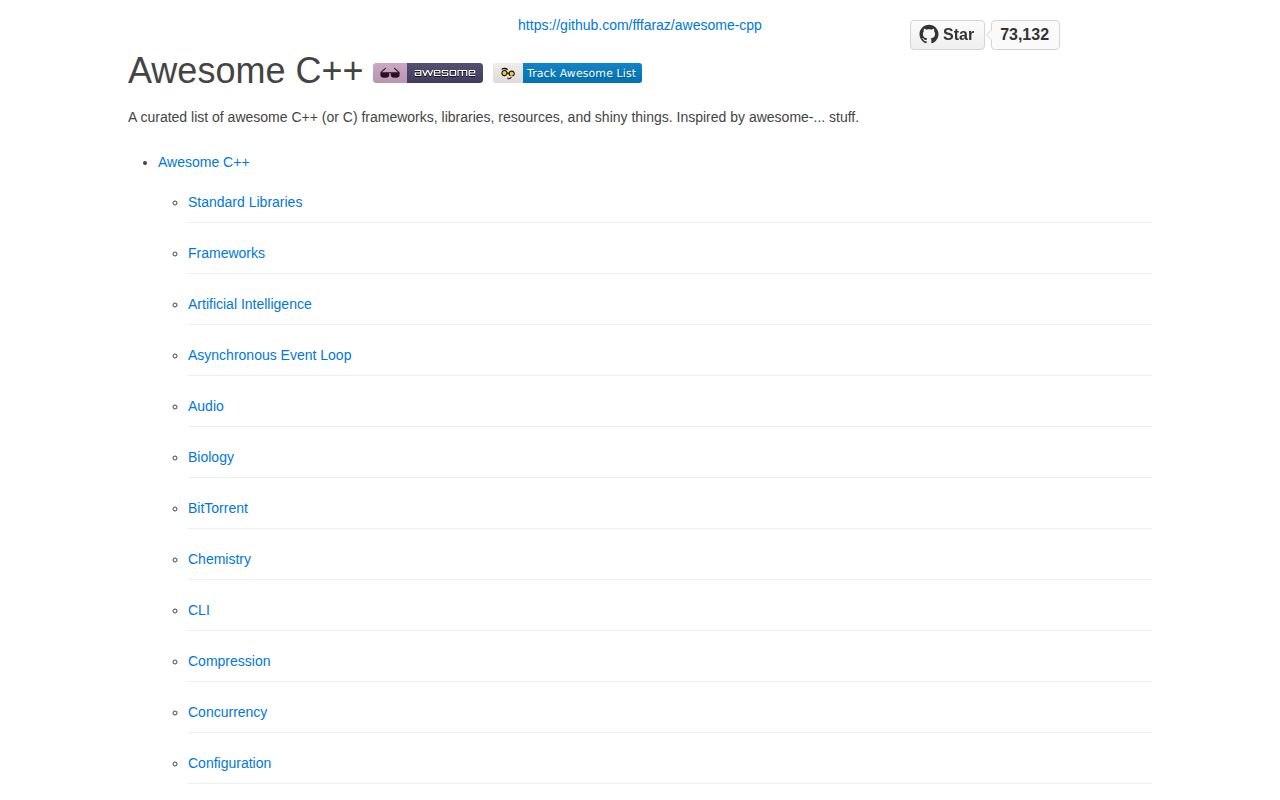
1,392 links make this a map, not a shortlist
The README we fetched contains 1,392 linked bullet entries across libraries, software, learning material, and other C++ lists. That breadth is the point. A developer looking for a JSON parser, event loop, allocator, GUI toolkit, compiler, coding standard, or conference archive can jump to the right section and collect names quickly. Many entries also carry a compact license label and a second link to the project's website.
Breadth does not tell you which dependency belongs in production. The descriptions mostly repeat what each project says about itself, sometimes in a single sentence. Awesome C++ does not publish a shared benchmark, maintenance threshold, security review, supported-platform table, or scoring method. Treat every entry as a lead. A familiar name and an MIT tag still require a visit to the source repository, current license file, release history, and issue tracker.
Seventy sections make browsing easy and comparison hard
Awesome C++ divides the README into 70 second-level sections, including frameworks, artificial intelligence, audio, databases, graphics, networking, testing tools, build systems, books, and talks. The table of contents is effective for lookup, and alphabetical ordering within categories makes a known project easy to find. Separate software and resources areas keep compilers and educational material away from reusable libraries.
Category boundaries can still blur. Artificial Intelligence and Machine Learning are separate, while a broad framework might also qualify under networking, concurrency, or web applications. The same short format covers projects as different as a header-only parser, a proprietary audio engine, and a standards committee. A category page gives no filter for C++ standard, operating system, package manager, commercial terms, or active maintenance. Search narrows the catalog faster than scrolling, but it cannot create missing metadata.
What happened when we ran it
Our lab classified the repository as having no supported ecosystem. GitHub reports the primary language as null, and the checkout contains no Dockerfile. There was no defensible install, build, or test target, because Awesome C++ is a set of Markdown links rather than an application or library. We therefore have no timing, dependency count, test total, or audit result to attach to the page.
The planned sandbox had 3 CPUs and 8 GB of RAM, but those resources say nothing about the listed projects because none of them was executed as part of this review. A clean result for the catalog would need a different test, such as checking every outbound URL and validating the Markdown structure. The supplied lab block contains no such result, so we are not turning a visual scan into a pass claim.
C++03 through C++23 entries do not share one support policy
The list includes entries that explicitly mention C++03, C++11, C++17, C++20, and C++23. That range is useful for discovery and awkward for selection. A team pinned to an older compiler cannot assume that a project in the same category supports it. Likewise, a C++20 label says nothing by itself about Windows, macOS, embedded targets, exception settings, ABI policy, or the availability of packages in vcpkg and Conan.
Licensing needs the same second pass. Many entries show familiar labels such as MIT, Boost, Apache-2.0, GPL, or LGPL. Others use mixed, custom, public-domain, or commercial descriptions. Those brackets are browsing hints rather than legal metadata, and the contribution format accepts free text. Before adding a dependency, read its current license at the destination and check whether optional modules change the terms. The catalog's own MIT license covers the list, not the software it links to.
The contribution rule excludes projects created after 2023
The Awesome C++ contribution rules say that accounts created after 2023 or repositories created after 2023 will be blocked and reported. That policy is unusually blunt and excludes legitimate new libraries regardless of documentation, adoption, or technical merit. Open issue 1872 asks for clarification from a maintainer who wanted to submit a 2025 project; it had no comments when we fetched it.
Freshness also depends on readers reporting decay. The README explicitly asks for pull requests when a project is no longer maintained or no longer fits. Open issue 1233 reports an invalid tutorial link and dates back to 2022, with an update in 2025. One stale link does not condemn 1,392 entries, but it proves that inclusion is not a continuing availability guarantee. Check the destination before putting it into an architecture proposal.
A September 1 push outweighs the absence of releases
GitHub recorded 73,132 stars, 311 open issues and pull requests combined, and a last push on September 1, 2026. The repository has no latest GitHub release, which makes sense for a document that changes through commits. Recent push activity shows ongoing editing, while the large combined queue shows that suggestions and cleanup can wait. Stars measure reach here more clearly than response time or entry quality.
Awesome C++ is best used at the start of research. Pick a category, open several plausible projects, and compare their own documentation, recent commits, unresolved bugs, license, supported standard, and package-manager story. C++ links is stronger for systems research, Awesome Modern C++ trims the historical spread, and Awesome HPP focuses on header-only code. Once you have 3 credible candidates, the catalog has done its job and project-level evaluation should take over.