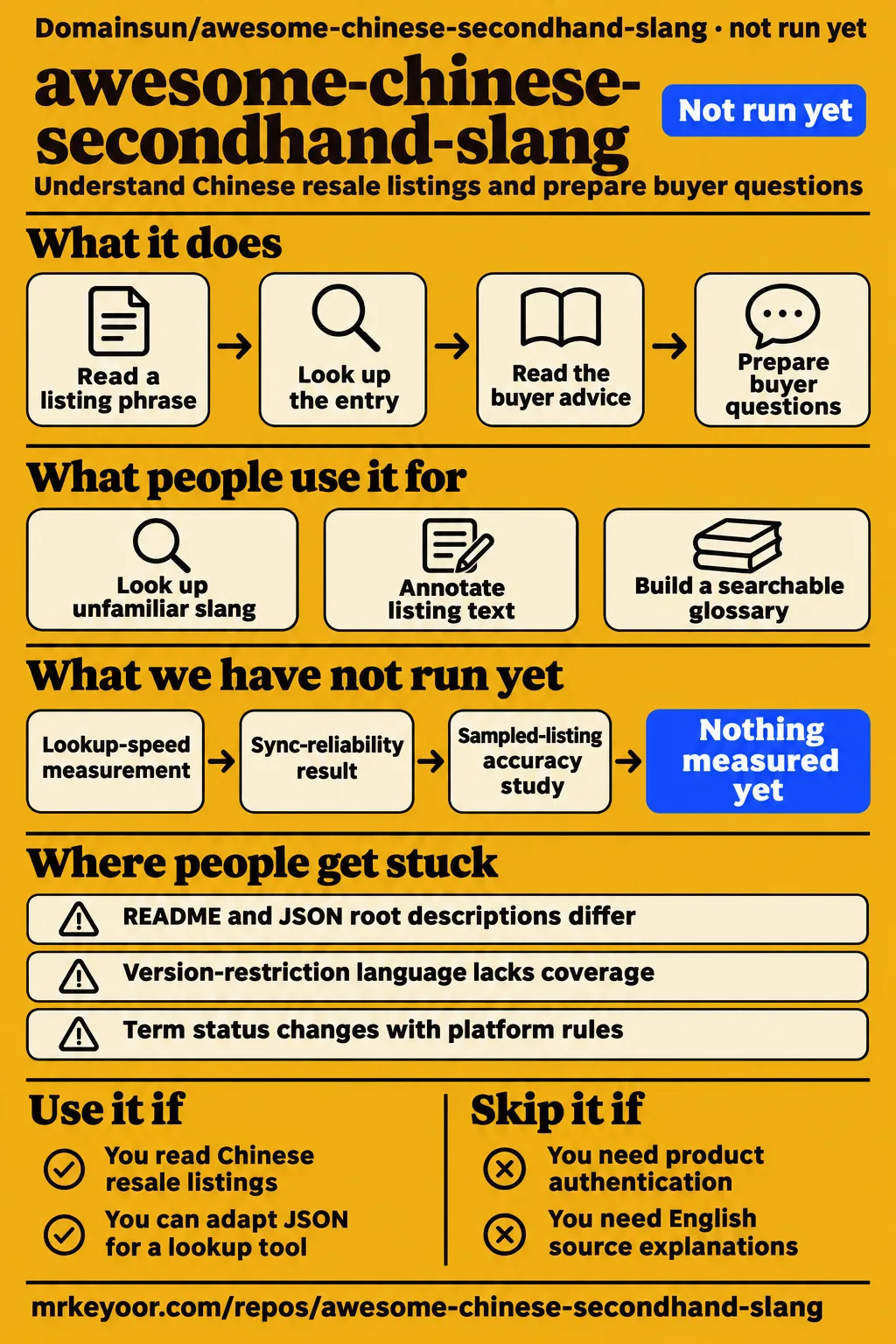
Short answer: use the corpus to prepare better buyer questions
Awesome Chinese Secondhand Slang combines Chinese reference tables with downloadable JSON, and two sites describe building interfaces around its entries. Use it if you read Chinese resale listings or want source material for a dictionary. Choose another approach if your task requires product authentication or a guarantee that marketplace filters accept a phrase. The practical distinction is between understanding a seller's wording and deciding whether to buy the item. Project README, 18btc integration account, baike.dev translator description
The developer decision turns on a specific discrepancy: the README describes statistics, categories, abbreviations and entries, while the supplied JSON starts with an array of entry objects. 18btc reports handling that difference by deriving display metadata during syncing. For a buyer, the useful distinction is equally concrete: the README treats a phone described as "all green" differently from a graphics card described as "exercised." Each expression leads to a different question about the item.
What people use awesome-chinese-secondhand-slang for
18btc reports daily syncing, search, filters and abbreviation lookup, while baike.dev describes annotation of pasted listing text. These accounts show two ways to present the same source material: start with a phrase the reader already noticed, or start with a listing and mark expressions within it. Both are attributed integration descriptions. 18btc dictionary integration, baike.dev listing annotation
| Who used it | What they describe | When that interaction fits |
|---|---|---|
| 18btc | Daily upstream syncing with search, filters and abbreviation lookup | You already have a phrase to look up. |
| baike.dev | A corpus-backed translator with listing annotation and category browsing | You want unfamiliar expressions identified within listing text. |
Aji_Notes also recommends the repository's data for building lookup tools in the supplied X extract. That recommendation supports describing developer interest, while the two integration accounts explain actual reported implementations. For your own interface, choose the reading task first. A search box helps someone who recognizes the unfamiliar term; annotation helps someone who needs to locate it. Preserve the original phrase beside its explanation so the reader can connect the result to the seller's wording. Aji_Notes in the supplied X record
What happened when we ran it
Our run at commit 8497083 on 2026-11-16 recorded NOT RUN: no supported ecosystem, language null, and no Dockerfile. The recorded sandbox configuration was 3 CPUs and 8 GB RAM, with image n/a. The consequence was a blocked execution attempt rather than an installation result. These figures describe the configured assessment environment; they are not resource requirements for reading the glossary or processing its JSON.
| Recorded check | Answer | Verdict | Why |
|---|---|---|---|
| Supported ecosystem | None; language null | Execution path unavailable | The harness recorded no supported ecosystem. |
| Dockerfile | Absent | No container execution result | The harness recorded no Dockerfile. |
| Installation, build and tests | Not run | No execution results | The corresponding harness results are null. |
The separate hands-on safety step failed because none of compose.yaml, compose.yml, docker-compose.yaml or docker-compose.yml existed. Its log calls the repository "unsafe" under a rule requiring a Compose file. That wording describes the runner's admission rule. The recorded failure concerns a missing deployment file, so it should not be read as a malware finding or an assessment of the glossary's explanations.
The generic hands-on header says the repository was deployed with its own Docker Compose and every port bound to 127.0.0.1. That conflicts with the specific safety failure and the harness's NOT RUN result. Teardown separately records "ok." Taken together, the records support reporting a blocked attempt followed by recorded cleanup. The README's reference tables and JSON download remain the documented entry points for readers. README
Where people get stuck: version restrictions need an explanation
Issue #1 proposes an entry for "不包更新 / 勿升级," covering language about excluded updates or instructions not to upgrade. The supplied thread is open with zero comments. Its author reports that the glossary already includes other transaction disclaimers but lacks this expression. The issue therefore documents a proposed coverage correction, with examples of how version restrictions affect different goods. Issue #1 entry proposal
The contributor says "不包更新" can be an honest disclosure. The concern is a purchase whose usefulness depends on a particular system, software or account state. Examples in the issue include modified phones, modified consoles, software licenses, shared accounts and firmware. The author also calls attention to combinations with "永久 / 终身" or "售出不退." Attribute those examples to the proposal rather than treating them as transactions observed for this review.
| Problem in the supplied records | Supported response | Recorded status |
|---|---|---|
| README and JSON root descriptions differ | 18btc derives category statistics and display names from the array during syncing. | Reported downstream workaround. |
| Version-restriction language lacks coverage | Issue #1 proposes an entry, variants and buyer questions. | Open proposal with zero comments. |
| Proposed active status is provisional | The contributor invites maintainer adjustment of the proposed label. | Contributor qualification attached to the proposal. |
The issue recommends asking for the current version and the consequences of official updates in marketplace chat, then preserving the answers. That gives the buyer a specific next step: establish what the seller promises to support. For a dictionary interface, our recommendation is to show an unmatched phrase plainly and make a contribution route available. A missing match should lead to a question or correction request rather than a reassuring label. Issue #1 buyer advice
The JSON needs an adapter for the advertised metadata
The supplied JSON begins with an array, and 18btc says it derives category statistics and display names during syncing. This is the implementation detail to settle before designing an importer. The README's four-part description can help explain the intended information, but the actual root value determines how a consumer reads the supplied file. Supplied upstream JSON, 18btc schema account
Keep source content separate from presentation metadata. The supplied entries include fields for a standard name, variants, platforms, explanation and buyer advice. An interface can display these together so readers see both the matched wording and the explanation behind it. If the interface needs category totals or display names, derive those deliberately, following the approach 18btc describes. This avoids treating an advertised statistics object as a required root field.
For an integration, we recommend recording the source revision and sync date, checking the root shape before replacing a local copy, and keeping local additions identifiable. These are proposed integration practices, not repository features. They help explain whether a reported omission belongs to a local copy or to the upstream material being used. They also keep an unmerged issue proposal distinguishable from entries obtained directly from the repository.
Baike.dev says it preserves copyright and license notices under MIT. Its source page identifies this repository and describes using upstream categories and variants for search and decoding. Preserve those notices when reusing the data, and keep the source relationship visible in your interface. Readers should be able to distinguish an upstream explanation from a translation, annotation or additional interpretation supplied by your own product. Baike.dev source and license description
The source explanations are Chinese
The supplied README and glossary explanations are Chinese, including the descriptions of seller subtext and buyer advice. English section labels and JSON field names help identify the structure, but the explanation attached to a phrase still carries the meaning a buyer needs. An English-facing interface should retain the original expression beside any translation it supplies, so the reader can connect the explanation to the listing. Supplied project README
The README associates "高A" with counterfeit goods and "矿渣" with former mining graphics cards. Those entries raise different inspection questions: authenticity for the former and condition for the latter. A generic warning label would discard that distinction. The same principle applies to "全绿 / 爱思全绿," which the README describes as a passing inspection-software result while warning against equating it with original parts. Preserve the explanation, not just the warning color.
For readers preparing a seller conversation, start with the original phrase and the entry's stated meaning. Then use the associated buyer advice to decide what item-specific information to request. For developers preparing translated copy, keep the term, explanation and category connected throughout the interface. This is a presentation recommendation drawn from the different kinds of advice in the supplied tables, rather than a claim about a downstream site's translation behavior.
awesome-chinese-secondhand-slang vs 18btc and baike.dev
18btc and baike.dev describe downstream interfaces built from this corpus, making this a choice between source material and an existing lookup experience. The repository provides the tables and JSON; the two sites describe ways to search or annotate that material. Choose according to the task you need to complete and whether you want to maintain an integration. 18btc integration, baike.dev translator
| Choice | Documented or attributed behavior | Pick it when |
|---|---|---|
| awesome-chinese-secondhand-slang | Chinese reference tables and downloadable JSON | You want to read the source or incorporate entries into a tool. |
| 18btc dictionary | Reports daily syncing, search, filters and abbreviation lookup | You have a phrase to search. |
| baike.dev translator | Describes pasted-listing annotation and category browsing | You want expressions identified within listing text. |
For a one-off lookup, an existing interface is a reasonable starting point. Maintaining your own copy makes sense when you need a recorded source revision, your own presentation or integration with another product. In that case, the array shape and derived metadata become part of your work. The comparison is about the interaction each option describes: manual reading, phrase lookup or listing annotation. That is the basis for the recommendations in the table.
What the other reviews get wrong
GitHub.Locker describes a JSON dataset containing statistics, categories, abbreviations and entries, while the supplied file starts with an array. 18btc explicitly reports the mismatch and derives metadata during syncing. For an importer, inspect the root value before relying on the directory's description. The correction changes how a developer consumes the file, rather than merely changing how the project is summarized. GitHub.Locker description, 18btc implementation account
GitNova's supplied extract lists zero issues and pull requests, whereas the supplied issue #1 is open and Git Now reports one open issue. Present those as differing snapshots rather than using the zero count to describe the current contribution queue. The specific issue is more useful to a prospective contributor: it identifies a requested expression and includes proposed wording and buyer advice. GitNova extract, Git Now extract, open issue #1
The supplied GitHub metadata records the last push as October 19, 2026. That dated fact and the open proposal describe different parts of the maintenance picture. A push timestamp tells an integrator when repository content last changed; the issue tells a contributor what addition someone requested. Use those facts for their respective decisions instead of turning a directory's popularity or momentum description into a judgment about the next correction request.
FAQ
The repository supplies structured JSON alongside its Chinese reference guide, and issue #1 asks for an additional version-restriction entry. The supplied questions also cover risky phrases, marketplace scope, trust and places to perform a lookup. The answers below connect those questions to the README, the contribution proposal and the two integration descriptions, so readers can choose a starting point that matches their task.
Is awesome-chinese-secondhand-slang just a Markdown list, or does it include structured JSON data?
It includes a Markdown guide and a downloadable JSON file whose supplied root is an array. The README links data/slang-dictionary.json, while 18btc describes consuming that file and deriving category statistics and display names during syncing. Use the tables for manual reading and the JSON for an integration. Inspect the file's structure before implementing the four-part root described in the README. README, 18btc schema description
Does every slang term still work on the platforms today?
Baike.dev says term status changes with platform rules and describes the material as reference information rather than purchase advice. The source also contains status labels, and issue #1 proposes a label for its requested addition. Read those labels alongside the entry's explanation and applicable platforms. For the evidence boundary around current acceptance and the proposed label, see the final section. Baike.dev disclaimer, issue #1
What risky listing phrases should buyers watch for?
The README associates "买包烟成色 / 战损成色" with seriously damaged devices and warns that "全绿 / 爱思全绿" is not equivalent to all-original parts. These are different descriptions with different follow-up questions. Read the entry's buyer advice before asking the seller for supporting information, and keep the wording of the listing connected to the explanation you consulted. README condition tables
Does the glossary cover counterfeit goods and mining GPUs?
Yes. The README includes "高A" for counterfeit goods and "矿渣 / 锻炼过 / 战术成色" for former mining graphics cards. Its buyer advice addresses authenticity for the former and condition checks for the latter. That distinction is useful when choosing what to ask a seller: a phrase about provenance and a phrase about prior workload call for different supporting information. README glossary tables
Is the slang specific to one marketplace or shared across Xianyu, Zhuanzhuan and Xiaohongshu?
The README names Xianyu, Zhuanzhuan and Xiaohongshu, and supplied JSON entries include a platforms field. Keep that field visible when presenting an entry in your own interface. It lets readers see the marketplace scope attached to the source explanation. Retaining the platform names also makes a translated or shortened display easier to trace back to the original entry. README, supplied JSON
Can I trust awesome-chinese-secondhand-slang?
RepoAlerts describes its assessment as quick checks from public data and says those checks offer no guarantee. The more concrete grounds for using this reference are its inspectable explanations, downloadable entries and attributed downstream reuse. For a buyer, start by reading the relevant explanation; for an integrator, inspect the file and preserve its source attribution. Those are useful, distinct ways to assess the material. RepoAlerts qualification, 18btc reuse account
Can the dictionary add an entry for "不包更新 / 勿升级"?
Issue #1 already proposes that addition and is open with zero comments in the supplied record. It includes variants, an explanation and buyer advice about current versions and update consequences. Contributors can use that proposal as a starting point for related wording. Keep its proposed entry identifiable when discussing it or incorporating it into a local copy. Issue #1 proposal
Where can I look up unfamiliar slang I encounter on social platforms?
The repository provides reference tables, 18btc describes a searchable dictionary, and baike.dev describes listing annotation. Start with the interaction that suits the material you have: read a table, search a phrase or paste a listing. Aji_Notes recommends the repository data for lookup tools in the supplied X record, giving developers another route when an existing interface does not fit their intended presentation. README, 18btc, baike.dev, Aji_Notes record
What we have not tested yet
The supplied assessment contains no executed installation, build, test suite or live dictionary workload. It supplies no lookup-speed measurement, sync-reliability result, translation assessment or sampled-listing accuracy study. The downstream extracts establish English descriptive pages, but English translations of dictionary entries remain unverified. The recorded image is n/a, and the configuration supplies no actual runtime or operating-system version. Live-source extracts are also not proof that every inspected passage belongs to commit 8497083.
The records contain no measured reduction in buyer losses, product-authentication result or seller-moderation outcome. Current marketplace acceptance lacks a documented checking schedule, and the issue contributor says the proposed active label was not checked individually against platform restrictions. Entry completeness, explanation accuracy and maintainer response times also lack measured assessments. The downstream behavior remains attributed to the sites describing it; this correction introduces no new execution or dataset test.
The next useful evaluation would preserve a sample of real listing text, record the source revision, and compare each matched explanation with item-specific evidence. That is a proposed evaluation, not work completed here. The supplied records also leave rendered layout, resolved links, related links, recommendation modules and template behavior untested. This review's conclusions concern the supplied text, JSON extract, metadata and recorded assessment results.