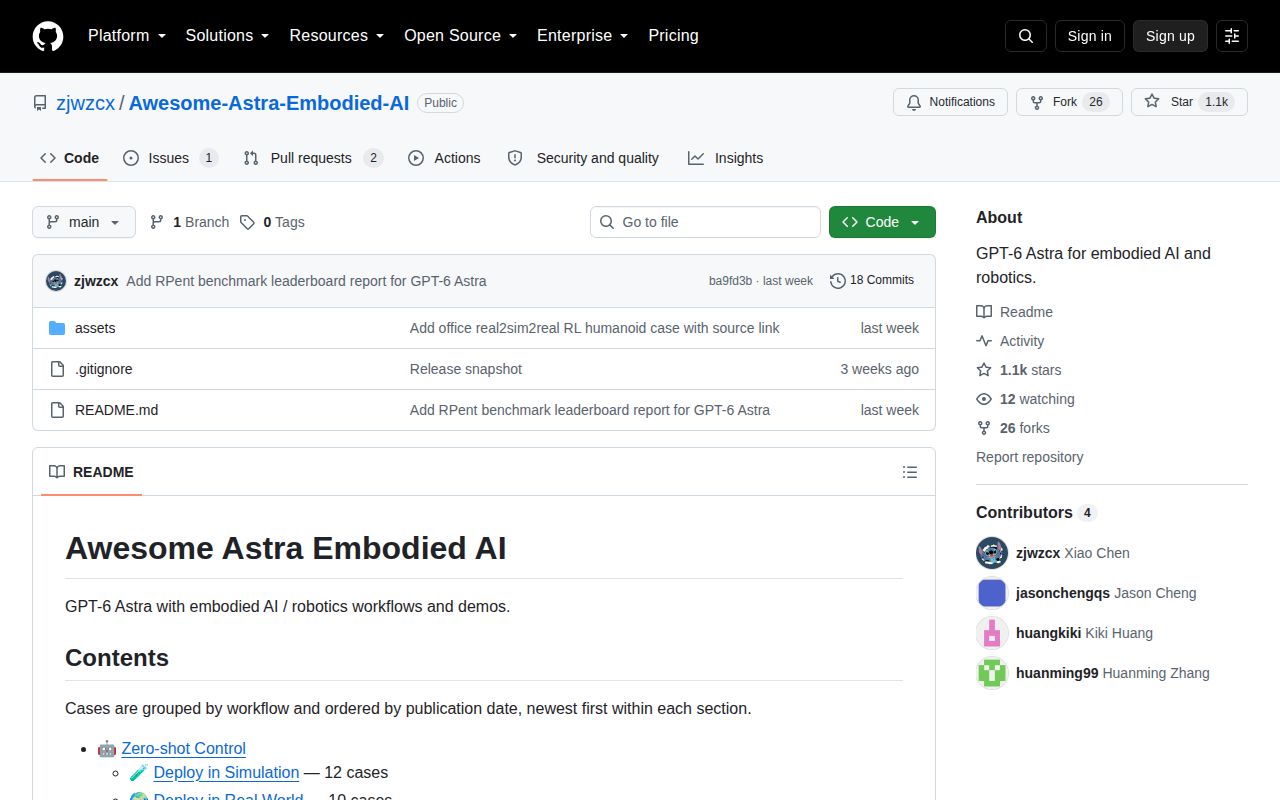
Thirty-seven cases form a fast-moving demonstration index
The README groups 37 Astra examples by what the model is doing around a robot. Twelve cover zero-shot control in simulation, 10 show real-world deployment, 2 use Astra for higher-level calls into an embodied policy, 7 cover real-to-sim replay or data rollout, and 6 show environment creation or reinforcement-learning work. Cases are ordered by publication date inside each section, which makes the file useful as a recent-activity map.
Each entry names a source, gives a date, includes an image, and adds a short interpretation. Across those 37 entries, several descriptions separate Astra's role from the low-level controller, such as planning a trajectory that another system executes. That distinction matters. A robot finishing a task does not establish that the language model generated every control action or learned the physical policy itself. The better entries say which planner, simulator, or VLA carried the rest.
Source quality ranges from social posts to public evaluations
Many of the 37 cases originate on X or Rednote. Those posts can show a real setup and still omit seeds, failure rates, hidden interventions, prompt history, controller details, or unedited trials. The list improves discovery by preserving credit and context, but its summaries do not convert a demonstration into a reproducible experiment. Follow the original link before treating any one-sentence capability description as settled evidence.
The public evaluation section is more useful for comparison. It links RoboCurve, GPT-Policy-Eval, GPT-as-Policy, RoboDojo, and RPent. The README labels those figures as reported by their maintainers and tells readers to interpret them within each hardware and protocol. RoboDojo, for example, reports 42 simulation tasks and says real-robot testing was stopped for safety. That caveat carries more decision value than a polished clip.
What happened when we ran it
On October 2, 2026, commit ba9fd3b had no supported runtime ecosystem, no detected primary language, and no Dockerfile. The lab therefore classified it as not runnable. This was not a failed install or a test failure. There was no package manifest or container target for the harness to execute, which matches the project's job as a markdown catalog with image assets.
There are no lab timings, dependency counts, build results, test totals, or vulnerability results for this repository. None should be inferred from how quickly the README opens. The useful checks here are editorial: whether links resolve, credits match sources, dates are accurate, claims preserve the source's limits, and an entry points to code or methods when those artifacts exist. The repository does not automate those checks.
One listed failure leaves the selection tilted toward success
The README includes a failure section, but it currently contains 1 example: a rope-driven dexterous-hand reconstruction with simplified mechanics and unfinished tendon physics. Elsewhere, individual entries sometimes disclose ideal grasps, missing self-collision, illustrative deformation, or work that remains planned. Those notes are good. They also reveal how much more useful the collection would become with a consistent limitation field for every case.
A capability list attracts successful demos because those are the posts people publish and share. That selection effect matters in robotics, where hardware resets, safety stops, and failed attempts are expensive and easy to leave outside a short video. Readers should resist turning 37 selected cases into a success rate. The repository does not claim such a rate, and its evidence cannot produce one.
No license or machine-readable catalog limits reuse
GitHub reported no license for the repository on October 3, 2026. The README calls the collection non-commercial and credits the original authors, but that statement is not a standard reuse license for the repository's text and image assets. A team that wants to mirror the catalog, publish a derivative dataset, or redistribute its images should get clear permission rather than treating public visibility as a grant.
The data model is also one long markdown file. There is no JSON, CSV, schema, API, link checker, or per-case identifier beyond section numbering. That is fine for browsing 37 entries. It is awkward for tracking source changes, deduplicating cases, querying by simulator, or recording whether code and a paper exist. Researchers building a living dataset will need to extract and verify the material themselves.
September contributions continued after the last push
GitHub showed 1,074 stars and 3 combined issues and pull requests on October 3, 2026. The repository was created September 12 and last pushed September 26. Two pull requests opened September 30 propose another evaluation and a recursive distillation item, while the only open issue asks what open-source code is available. There is no tagged release.
That activity is enough to call the list maintained, while its age is too short to judge durability. The strongest editorial choice is the separation of simulation, real hardware, policy calls, replay, training, failures, and benchmarks. Keep that structure and deepen the evidence labels. For now, use Awesome Astra Embodied AI as a trailhead: the decision-grade material lives in the linked code, paper, methods page, or evaluation report.