mrkeyoor.com_
Mon 21 Sept 15:52 UTC
AI Toolsevaluationupdated 21 Sept 2026

awesome-artificial-intelligence review

Awesome Artificial Intelligence is an English-language shortlist of books, courses, papers, tools, and operating advice for developers building AI systems. It solves the blank-page problem by making a small set of editorial choices instead of collecting every AI link it can find.

Verdict

Our run installed 35 packages in 15 seconds and passed all 12 tests, but those checks validate the list machinery rather than the merit of every recommendation. Use this repository when you want a disciplined starting map for AI engineering and are comfortable with an opinionated editor. Read the affiliation signals and follow primary sources before spending money or choosing a production dependency.

We ran it

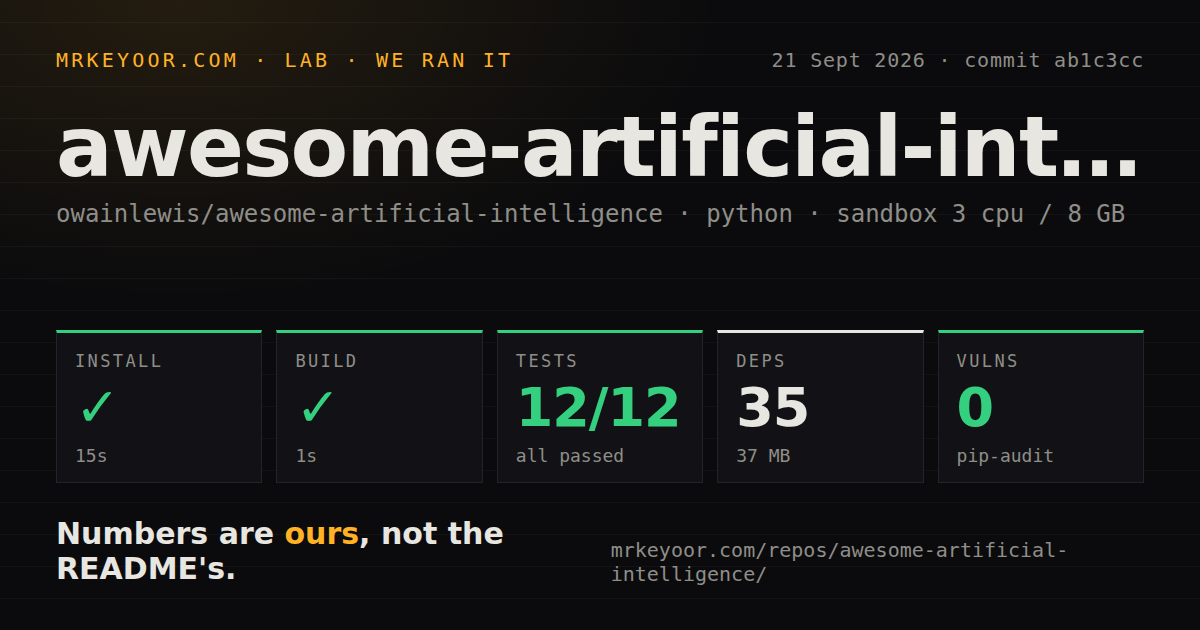
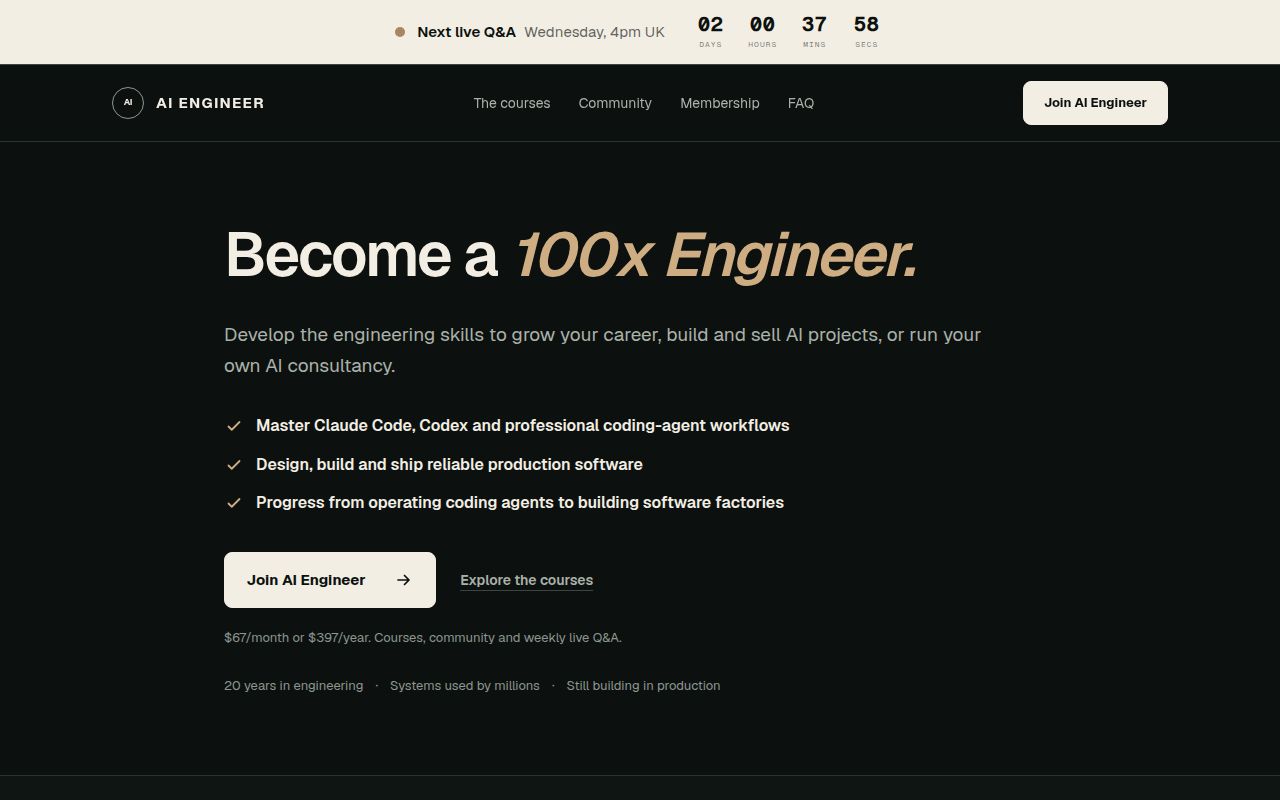
Lab card: what happened when we ran awesome-artificial-intelligenceScreenshot of awesome-artificial-intelligence (aiengineer.co)
Install✓ · 15s35 packages · 37 MB
Build✓ · 1s
Tests✓ · 1s12 passed · 0 failed of 12 (pytest)
Known vulns0(pip-audit)
Repo18 files~398 lines of source · 0.1 MB · 1 CI workflows · tests dir

Answers from our run

Does awesome-artificial-intelligence build from source?

Dependencies installed in 15 seconds (35 packages), and the build succeeded in 1 seconds. We cloned commit ab1c3cc into a clean Debian container with 3 CPUs and no project-specific setup.

Do awesome-artificial-intelligence's tests pass?

Yes: 12 of 12 passed when we ran the project's own test command (pytest). Some failures need services or credentials a bare container does not have.

Does awesome-artificial-intelligence have known vulnerabilities in its dependencies?

pip-audit found none in the dependency tree at the time of our run.

Who should not use awesome-artificial-intelligence?

Researchers seeking an exhaustive AI bibliography: the README explicitly says the collection is not a complete directory.

What are the alternatives to awesome-artificial-intelligence?

Best of ML Python, Applied ML, Awesome. Our run installed 35 packages in 15 seconds and passed all 12 tests, but those checks validate the list machinery rather than the merit of every recommendation.

Setup5/5Nothing to run for readers; contributor checks passed in 1 second
Docs5/5Scope, scoring, evidence, churn, and contribution rules are explicit
Community4/516,524 stars and current proposals, with 75 issues and PRs open
Maturity4/5Tests and review gates exist, but there are no versioned releases

Who it’s for

Software developers who want a compact route into AI engineering and coding agents.
Teams assembling a reading list across foundations, retrieval, evals, deployment, and agent workflows.
Contributors willing to support a recommendation with primary sources and maintenance evidence.
Readers who prefer an opinionated shortlist over a large directory.

Who it’s NOT for

Researchers seeking an exhaustive AI bibliography: the README explicitly says the collection is not a complete directory.
Buyers who need hands-on product comparisons or rankings: entries are short recommendations, not standardized reviews or benchmarks.
Readers who require editorial independence from the maintainer's own work: the list includes AI Engineer, Neo, Blueprint, and Factory, all linked to the maintainer or related projects.
Consumers looking for chat apps, media generators, prompt collections, or narrow end-user products: the curation policy normally excludes those categories.
Systems that require tagged, versioned data releases: the repository has no GitHub release, so snapshots must be pinned by commit.

Setup reality

Our sandbox installed 35 packages in 15 seconds and used 37 MB. The build succeeded in 1 second. Tests finished in 1 second with 12 passed and 0 failed, and pip-audit reported 0 known vulnerabilities.

Readers do not need to install anything because the product is the README. Contributors need Python 3.13 according to pyproject.toml. The scheduled curator also needs authenticated GitHub access and a Codex desktop automation, but that machinery is for maintaining the list rather than reading it.

The checkout has no Dockerfile and does not need a runtime service. Its recommendations point to external sites, so the useful content can change or disappear outside this repository. GitHub has no tagged release for the project; pin a commit if another system consumes the list.

Three editorial pillars keep the list smaller than its name suggests

Awesome Artificial Intelligence uses 3 editorial pillars: learning AI foundations, building AI systems, and using agents for software engineering. The mix includes books, courses, foundational papers, agent frameworks, retrieval tools, evaluation systems, deployment projects, and coding agents. Every entry gets one short description and a link. You can scan the whole thing in one sitting, which is the point. This repository is a map for developers, not a database of everything carrying an AI label.

Its boundaries are more useful than the topic coverage. The curation policy normally excludes news feeds, prompt collections, narrow consumer products, shallow demos, affiliate lists, and vendor pages without technical teaching. A category is allowed to stay short when no candidate clears the bar. That saves a beginner from opening 40 near-identical tool pages, although it also means the editor's judgment determines which options you ever see.

An 80-point gate gives contributions a stated standard

The policy sets an 80-out-of-100 minimum for practical resources after hard checks for working links, current maintenance, distinct value, and supportable claims. The rubric gives technical quality, developer usefulness, maintenance, and real-world evidence most of the weight. Foundational work gets a separate scale that does not punish age. Contributors must disclose affiliation and explain what problem their suggestion solves, which is more demanding than the usual 'add my project' pull request.

Weekly changes are constrained too. Automation may alter no more than 6 resource entries, add at most 3 net entries, and touch only 1 foundational entry. A challenger replaces an existing recommendation only when it scores at least 10 points higher or the incumbent fails a hard check. The automation can merge a README-only proposal after unit, structure, link, review, workflow, and exact-commit checks pass. Policy or workflow edits still require human review. Those limits make churn legible, even if readers cannot reproduce every editorial score from the README alone.

Maintainer-owned links deserve the same scrutiny as submissions

The README includes AI Engineer plus 3 repositories under owainlewis: Neo, Blueprint, and Factory. It also promotes a free starter pack that advertises more than $1 million in software discounts. None of that proves the resources are poor. It does mean this is not an independent buying guide, and the one-sentence entries do not provide enough evidence to audit each inclusion from the page itself. Treat those links as recommendations from an interested editor and inspect the underlying documentation before adopting or paying.

The contribution rules say self-promotion is allowed when it is disclosed, while undisclosed promotion is rejected. That is a sensible policy for outside contributors. A stronger reader-facing version would mark maintainer affiliations beside the affected entries, since most visitors will never open CONTRIBUTING.md. Until then, the repository works best as a set of leads. It should not be the only source behind a tooling choice, especially for paid courses or infrastructure that will sit in a production path.

What happened when we ran it

We measured a 15-second install for commit ab1c3cc, adding 35 packages and using 37 MB in our sandbox. The build completed in 1 second. Tests took another 1 second, with pytest reporting 12 passed and 0 failed out of 12. Pip-audit found 0 known vulnerabilities in the installed Python packages. This was a small checkout: 18 files, roughly 398 lines of source, and 0.1 MB before installation.

The successful suite checks repository mechanics, not each recommendation's quality. The source tests cover entry formatting, HTTPS links, duplicate titles and normalized URLs, empty categories, punctuation, error classification, and weekly churn limits. The GitHub workflow separately runs live-link checks on Python 3.13. Our supplied lab result establishes that the available 12 tests passed; it does not turn external descriptions into comparative product evidence. The repository has 1 CI workflow, a tests directory, and no Dockerfile.

August maintenance is current, while 75 proposals remain open

The default branch was last pushed on August 15, 2026, and GitHub listed 16,524 stars plus 75 combined open issues and pull requests when fetched. New pull requests were still arriving in September, including proposals for agent workflows and courses, so the queue is active after the last push. There is no latest GitHub release. That is acceptable for a Markdown reading list, but downstream users should pin commit ab1c3cc or another reviewed revision instead of assuming a stable release channel.

Use this list to decide what deserves an hour of your attention, then leave it and read the primary material. The 12 passing tests and strict churn rules make the collection easier to trust as a maintained document. They do not settle whether its favored course, framework, or coding agent fits your team. The repository is most useful at the start of research, where a short list beats an empty search box.

Alternatives

ProjectWhat it isPick it when
Best of ML PythonA ranked catalog of maintained Python machine-learning libraries by category.pick this instead when you need to compare Python packages rather than assemble an AI engineering curriculum.
Applied MLA collection of papers and articles about machine learning systems in production.pick this instead when real company implementations matter more than introductory books or coding-agent tools.
AwesomeA directory of topic-specific awesome lists spanning software and technical subjects.pick this instead when breadth and routes to many specialist lists matter more than one editor's AI shortlist.

What people are saying

  1. [github-trending] owainlewis/awesome-artificial-intelligence

Sources

  1. Awesome Artificial Intelligence README
  2. Curation policy
  3. Contribution guide
  4. Repository stewardship contract
  5. README validation tests
  6. GitHub quality workflow

More ai tools reviews

ncnn · OpenCreator · editor · autoclip · financial-services · Portable-Local-Studio · the whole board →