The active product is a workflow platform, not Classic
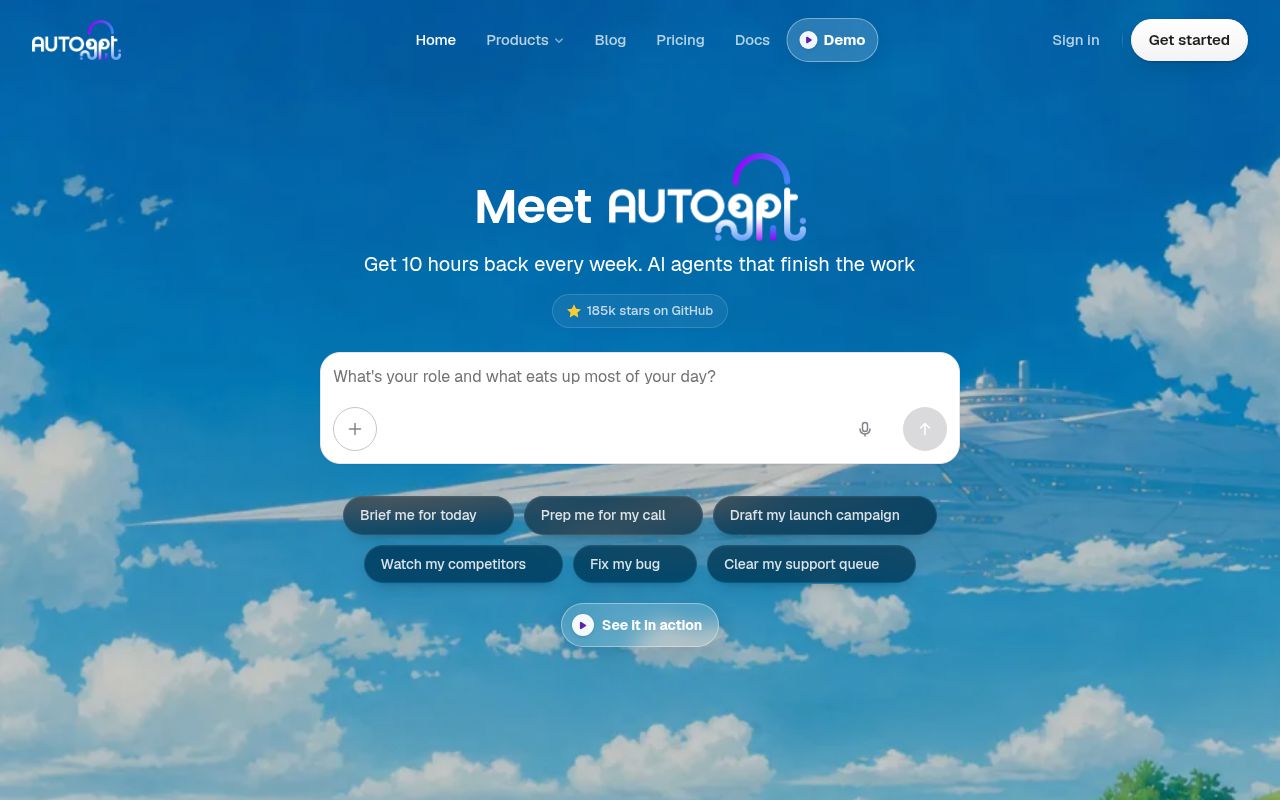
AutoGPT's current product builds agents from a conversation or a visual graph of connected blocks. Agents can run on demand, from schedules, or from triggers. The platform tracks runs, costs, and actions that need attention, while a marketplace supplies starting graphs. Its README also lists integrations across email, calendars, documents, developer tools, CRM systems, payments, and publishing services.
That is different from the original terminal agent that made the repository famous. AutoGPT Classic remains under classic/, but its README calls the experiment concluded and unsupported. It recommends the Platform for actual use and says Classic dependencies will not be updated. A buyer should ignore old tutorials that send a production project into Classic, even if those pages still rank well in search.
Managed and self-hosted paths sell different kinds of control
The hosted Platform includes infrastructure, model access, credentials, updates, and operational support. It is a paid product with usage-based agent runs. The self-hosted path has no license fee for permitted use, but operators supply Docker, configuration, model API keys, compute, storage, and maintenance. Both expose the builder and runtime; only one removes the service stack from your responsibility.
The source deployment starts through Docker Compose. Its platform README names PostgreSQL, Redis, and RabbitMQ as core services, plus backend and frontend processes, migrations, and generated API clients. Persistent volumes need explicit attention. Credentials for models and connected services raise the stakes further: backup, secret rotation, tenant isolation, outbound network rules, and audit logs are part of a serious deployment.
What happened when we ran it
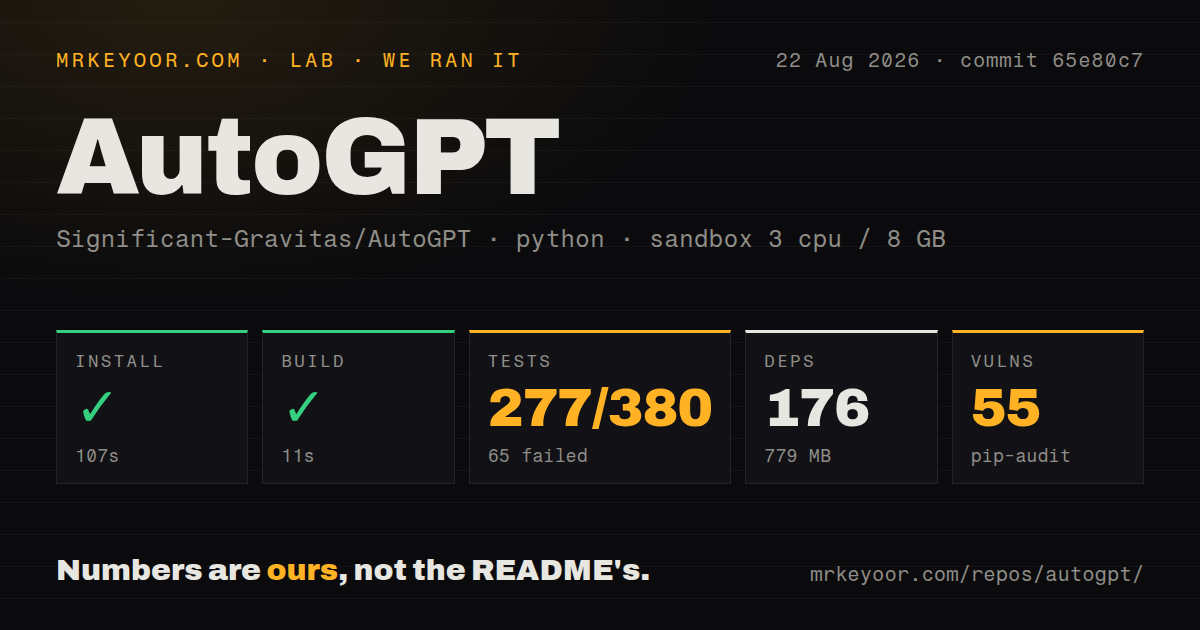
Our lab tested commit 65e80c7 under classic/ in a fresh unprivileged Debian container with 3 CPUs and 8 GB RAM. The repository contained 5,481 files, about 945,736 source lines, and 189.3 MB. Installation succeeded in 107 seconds, adding 176 packages and using 779 MB. The Classic build then completed in 11 seconds.
Pytest ran for 92 seconds and exited 1. It reported 277 passed, 65 failed, 4 skipped, and 38 collection or setup errors out of 380. The supplied tail lists failures in search and webpage-fetch tests, including Serper search, fallback behavior, timeouts, HTTP errors, metadata, links, and content-length handling. It does not show the underlying exception for those cases, so missing keys or network access cannot be asserted as the cause.
Pip-audit found 55 known vulnerabilities in the installed Classic environment. The scan also found 37 CI workflow files, no root Dockerfile, and no top-level tests directory. Classic's own security notice independently says the code has known dependency vulnerabilities and will not receive dependency updates. The lab result therefore confirms a maintenance problem the maintainers already disclose rather than revealing a supported product regression.
Classic permissions do not make unsupported code deployable
Classic has a thoughtful layered permission model. Workspace and agent files can allow or deny tool patterns, with deny rules winning and interactive approval used when no rule matches. Defaults block sensitive file types, destructive commands, sudo, and operations outside the agent workspace. Agent state and history persist under .autogpt, while file work stays inside a sandboxed subdirectory.
Those controls are useful research material, but they do not erase 55 audited vulnerabilities or 103 failed and errored test outcomes combined. Permission matching is only one layer around model behavior, dependency code, network requests, parsers, and external services. The maintained recommendation is unambiguous: study Classic or benchmark it, but do not build a new production agent on it.
Platform licensing permits internal use but limits competition
The repository cannot be summarized by one common open-source license. Classic and most other files use MIT. autogpt_platform/ uses Polyform Shield. The main README describes that platform license as free for personal and internal business use while prohibiting sale as a competing hosted service. A company embedding the platform in a product should review the actual license text, not rely on the repository's old reputation as wholly MIT.
This distinction also affects alternatives. A team wanting a private internal automation system may fit the stated permission. A vendor planning a branded agent SaaS could cross the competitive-use boundary. LangGraph offers a code-first graph library, while Dify and n8n present other platform tradeoffs. License, hosting model, and workflow control matter as much as the block catalog.
MCP and integrations widen the credential blast radius
The current tree includes MCP routes and MCP blocks alongside integrations for many external services, so the required mcp tag belongs on this review. Every connection gives an agent a new capability and a new credential boundary. Start with read-only or narrowly scoped accounts, require human approval for destructive actions and payments, and test what happens when a provider returns malformed or partial data.
Release autogpt-platform-beta-v0.7.2, published August 21, 2026, added team and expert work surfaces, memory controls, schedules, payment-related flows, a Microsoft Teams adapter, and fixes around entitlements and private experts. The beta label matters. Features touching money, memory, credentials, and cross-service actions deserve adversarial tests before unattended schedules run against production accounts.
Current activity supports Platform, not Classic
GitHub showed 186,908 stars, 504 combined open issues and pull requests, and a last push on August 27, 2026. Those figures demonstrate a large, active repository; they do not restore support to the frozen Classic directory. The latest release and recent changes center on Platform features, tests, integrations, and user experience. Health must be judged per product inside the monorepo.
The decision is straightforward. Do not deploy the measured Classic environment after a run with 65 failures, 38 errors, and 55 known vulnerabilities. If AutoGPT's visual builder, schedules, marketplace, and managed option suit the workflow, run a separate Platform evaluation against its Docker stack. Require clean Platform tests, dependency audits, recovery drills, credential-scope checks, and legal approval for Polyform Shield before launch.