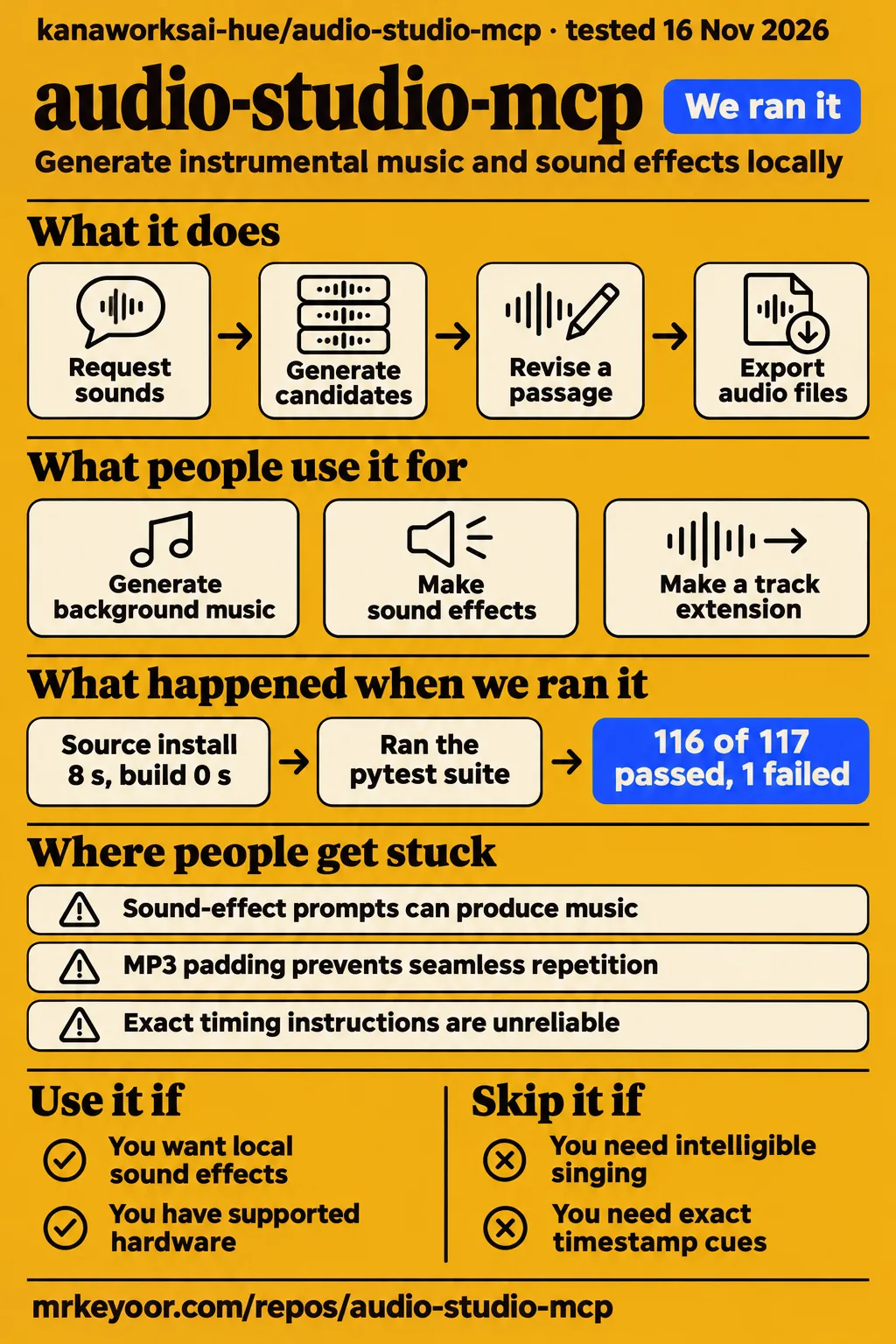
Short answer: use it for local drafts you can audition
Our sandbox installed Audio Studio MCP in 8 seconds, but its test command exited 1 with an ffmpeg-not-found error. Use it if you make instrumental beds or sound effects, own supported hardware, and want your coding agent to generate files locally. Skip it if your job needs intelligible singing, reliable musical hits at exact timestamps, or a browser service shared across machines.
The attraction is the complete small job: ask for candidates, choose one, replace a passage, make it loop, then export it. The README describes those operations in one server. My recommendation is to try it for a background bed or a draft effect you can judge in context. Keep your stock library available: the strongest supplied listener comparison had winners on both sides.
What people use audio-studio-mcp for
People have used Audio Studio MCP for production-oriented audio drafts, demonstration videos and comparisons with stock effects. The useful evidence is what they made and selected. Tokyo AI Visuals reports 570 GitHub stars and more than 670,000 announcement-post views on November 3, 2026. Those figures show attention; its announcement says the tool came from internal game and film production.
| Who used it | What they did | What the source actually reports |
|---|---|---|
| Tokyo AI Visuals LLC, the developer | Built it for its own game and film production | The company's announcement describes its internal workflow. |
| X user hiro_ai_guild | Compared generated effects with stock sounds without revealing their origins | The user's post reports choosing AI sounds in four of six scenes; stock won two, including a confirmation-button sound. |
| Damon's AI development diary | Requested demonstration effects and background music through Claude Code in Japanese | The presenter reports two candidates appearing after about a minute, including startup and Claude Code processing. |
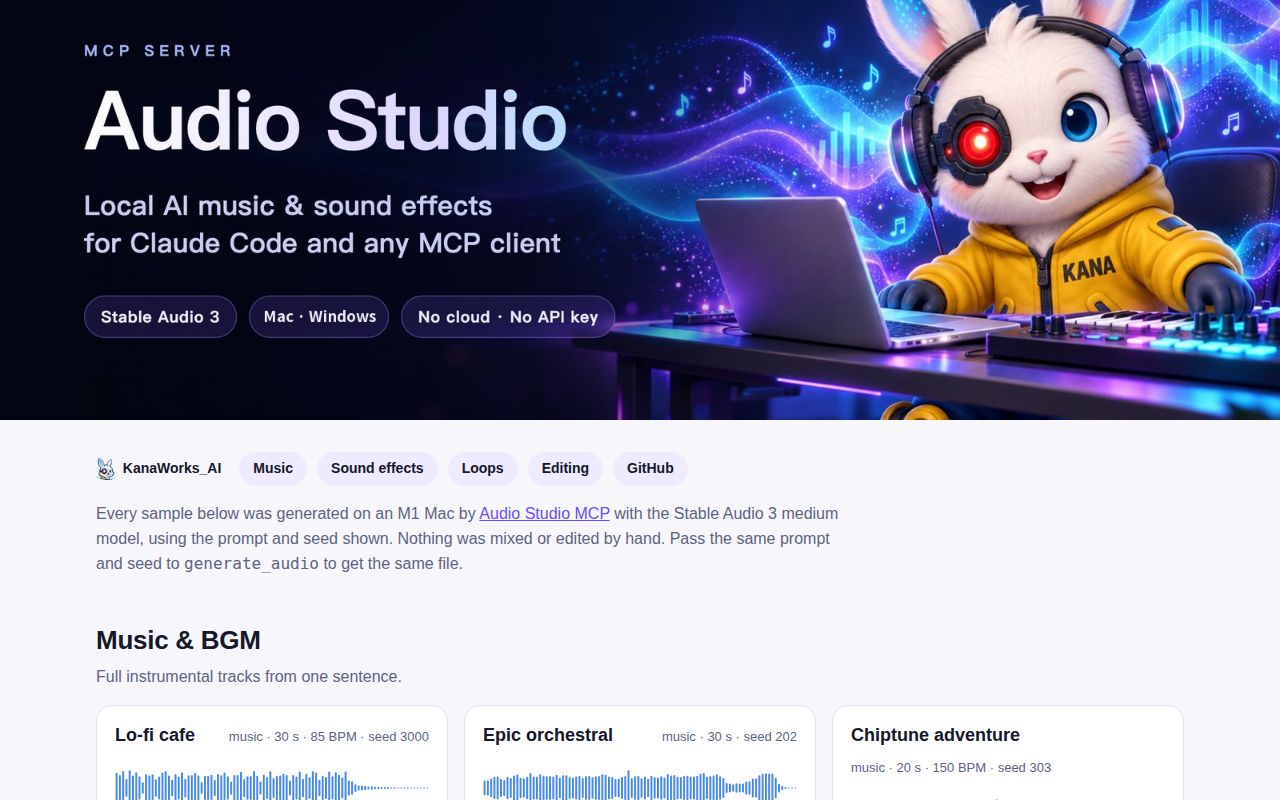
| Project author | Published music, effects and an extension made on an M1 Mac | The sample descriptions say these files were not edited by hand. |
The confirmation-button result is worth keeping in mind. A tiny interface cue has a different job from rain ambience or a music bed. In hiro_ai_guild's account, generated audio did not win every task even when its origin was hidden. That makes auditioning a better selection rule than choosing a source category in advance.
In Osumazawa's video, the presenter says an M4 Mac with 32 GB created audio very quickly. That is a user's assessment of their own experience. The author's samples offer more concrete listening material: lo-fi, orchestral and chiptune music, glass shattering, rain with thunder, and an extended synthwave clip. Listen for the kind of asset you need, rather than treating one appealing sample as a promise for every prompt.
What happened when we ran it
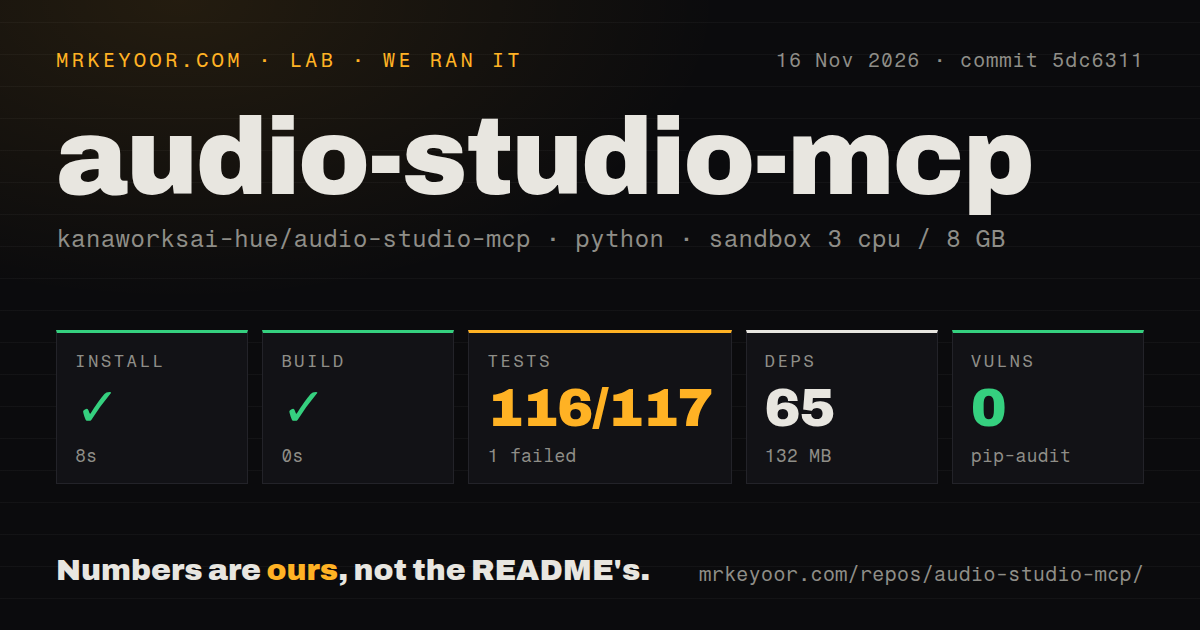
Our November 16, 2026 sandbox run at commit 5dc6311 completed installation in 8 seconds and the build step in 0 seconds; tests failed with exit 1 after 13 seconds.
| Recorded check | Result |
|---|---|
| Dependency installation | Succeeded in 8 seconds; 65 dependencies recorded, 132 MB on disk |
| Build step | Succeeded in 0 seconds |
| Test command | Failed, exit 1, in 13 seconds |
| Pytest log summary | 116 passed, 1 failed, 5 skipped |
| pip-audit | 0 known vulnerabilities |
| Repository scan | 107 files, approximately 6,810 source lines, 11.3 MB checked out |
| Project signals | One CI workflow file, a tests directory, no Dockerfile detected |
The failing case was tests/test_server.py::test_sidecars_are_utf8_whatever_the_locale. It called process_audio and received RuntimeError: ffmpeg not found. The error recommends installing ffmpeg or setting AUDIO_STUDIO_FFMPEG, and says it is needed for resampling and loudness. A test about sidecar text encoding therefore stopped at an audio-processing dependency. The log gives us that immediate failure, not evidence that the sidecar encoding itself is wrong.
The sandbox configuration recorded 3 CPUs, 8 GB RAM and image label ghcr.io/astral-sh/uv:python3.12-bookworm. That label is configuration metadata; actual runtime and operating-system versions require the raw toolchain logs. The 132 MB dependency footprint also needs to stay separate from the model downloads described below.
A separate hands-on deployment attempt stopped at its safety check: none of compose.yaml, compose.yml, docker-compose.yaml or docker-compose.yml existed, and that runner required a Compose file. Its run summary says it deployed with its own Docker Compose, which conflicts with the detailed failed step. We treat the detailed stop as the result. A runner's Compose requirement is not an upstream installation requirement.
Where people get stuck: architecture, duration and OGG
Three issue threads document specific failures and completed repairs: an Apple Silicon Python mismatch, ignored duration arguments and a Windows OGG crash. Check these before spending time rewriting prompts or reconnecting the client.
| Symptom | What the reporter or maintainer found | Resolution in the thread |
|---|---|---|
| Apple Silicon reports that Intel Macs are unsupported | Issue #3 traces an x86_64 environment to Intel Homebrew Python under Rosetta; MLX was skipped | PR #5 merged. Update main and rerun the installer, which chooses arm64 Python and checks MLX. The reporter confirmed reconstruction of the problem environment. |
| A requested duration becomes the default music length | In issue #7, the maintainer says seconds was silently dropped and music defaulted to 60 seconds |
PR #8 merged support for both duration_seconds and seconds in generation and editing. |
| Windows client reports Connection closed during OGG export | Issue #10 records a native libsndfile Vorbis encoder stack overflow on v0.2.1 | Fixed in v0.2.2 by writing Vorbis in blocks. The maintainer reproduced the crash and reported a successful MCP call and decodable output after the repair. |
The duration bug is the easier one to miss. A generated file can exist and play normally while being the wrong length. Contributor peercaster reports checking both the WAV and JSON metadata for the requested 30-second BGM. Make that comparison part of accepting an asset, especially when an agent supplies arguments. A successful tool call alone would have missed the maintainer's silent-default case.
Windows authentication is another stop with a specific next action. The README requires access to gated Hugging Face weights. Accept the relevant model license and log in through your own terminal, then rerun installation. An unattended installer stops to ask for that action. Skipping the weight download simply postpones the same access problem until generation.
Hardware and setup: choose the platform before the prompt
The documented routes are Apple Silicon through MLX and Windows with an NVIDIA GPU through PyTorch. The README recommends 16 GB RAM for the Mac route and requires at least 8 GB VRAM for Windows, with a current NVIDIA driver.
| Platform | Documented preparation |
|---|---|
| Apple Silicon Mac, M1 or later | Git, ffmpeg, about 6 GB disk for the model; run ./install.sh after cloning |
| Windows NVIDIA PC | Git, ffmpeg, about 14 GB disk for the model and PyTorch, Hugging Face access; run install.ps1 |
The installer prepares the Python environment and vendors the upstream Stable Audio 3 runtime before obtaining weights. It prints the registration command containing your actual executable path. Use that path when adding the server to Claude Code. Cloning the repository into a skills folder does not perform those steps or register an MCP server.
For sound effects, select audio_type=sfx and describe the source, action, material and space. The README explains that omitting the SFX prefix can yield music instead. For an effect such as breaking glass, the structured description gives the model a physical event to produce. After choosing a candidate, use the finishing tools for the delivery format and loudness your editor or game needs.
Shared sessions use one model and one queue
The browser interface and MCP clients can share a single loaded model through the same local HTTP server, according to the README. Ordinary separate client sessions normally launch separate server processes, so choose how you connect before opening several agents.
The v1.0.0 release introduces the local web UI. GitHub lists the last push on October 24, 2026; the three closed issue threads above supply concrete repair history alongside that activity date. The documented shared route serves MCP at /mcp; --web adds the browser interface on the same port. Requests from the page and agents wait in one queue. That is useful for keeping one model available across sessions, but a browser request can wait behind an agent request. Local generation removes a remote provider from the audio-generation path; it does not remove scheduling inside your own server.
The project also exposes unload_models to release model memory and documents an idle-unload timeout. Treat those as operating controls when the same computer runs an editor, game engine or other models. A warm model and a model that has just been unloaded are different starting points for a speed comparison.
Security: keep the browser on localhost
The local browser interface has no login and listens on 127.0.0.1, and the README warns against exposing it through port forwarding, a reverse proxy or a tunnel. Anyone who can reach it can use the GPU and write files to the output folder.
That warning is more useful than treating directory badges as a security verdict. MCP Vetted says it scores public metadata, while SkillsLLM calls its automated scan limited and explicitly denies that it is a certification. Clelp's detailed findings label endpoint detections as static signals that do not assert exfiltration, including an evil.example endpoint in test code.
Our dependency audit found zero known vulnerabilities. That result concerns known dependency advisories in the recorded environment. Keep the no-login interface local regardless of that result, and assess the permissions you grant the connected coding agent separately.
Japanese requests work through an English model prompt
In Damon's AI development diary, the presenter requests sounds in Japanese and Claude Code prepares English instructions for Stable Audio 3. The transcript describes the model creating the sound and placing the resulting files in the specified folder, after which the presenter compares candidates.
This division of work is useful if you know the scene you want to describe but do not want to construct the model prompt yourself. The README supplies English, Japanese and Chinese documentation links; its browser interface supports those languages and follows the browser language, with a setting to change it. An English-speaking reader has a documented entry point, while the Japanese issue discussion about Rosetta supplies a particularly detailed diagnosis.
Audio Studio MCP vs stock libraries, sonilo and hosted SFX
The supplied comparisons point to different jobs: local candidates, a ready-made recording, licensed catalogue scoring or hosted effects. Choose by the asset you need to deliver.
| Choice | Pick it for | What supports that choice |
|---|---|---|
| Audio Studio MCP | Locally generated instrumental beds and effects that you can edit and export | Its documented tools include generation, inpainting, continuation and processing. |
| Stock sound libraries | Auditioning a finished effect alongside a generated candidate | hiro_ai_guild preferred stock in two of six scenes. |
| sonilo | Looking for sync-to-picture scoring from licensed catalogues | This is the mcp.film curator's recommendation. |
| ElevenLabs or the fal MCP | Evaluating a hosted sound-effect service | These are mcp.film's hosted alternatives. |
Creator OS recommends generated audio for background beds and transitions while keeping commissioned themes and licensed songs for recognizable or signature material. That is a sensible editorial distinction: if the brief depends on a particular song, generating another piece cannot satisfy it.
Also distinguish this repository from flujo-app/mcp-audio-studio-mcpapp. The similarly named MCP Audio Studio is a separate digital audio workstation with sequencing and mixing. Its npm instructions belong to that project. Choose it to investigate an agent-operated DAW; choose this Python server to investigate local Stable Audio generation.
What the other reviews get wrong
Windows requires Hugging Face account access to gated weights, contradicting Creator OS's blanket no-account statement. The official setup instructions make that distinction explicit. No hosted audio-generation API key is required, but those are different claims.
Creator OS also says there is no fixed published benchmark and presents generation as having no queue. The project documentation mirrored on Glama includes hardware-specific timings, and the current README describes a shared request queue. Published timings are useful only with their workload and warm or cold starting state attached.
SkillsLLM's skills-directory installation advice omits model setup and MCP registration. Deduped's royalty-free wording also needs the model-license qualification described by mcp.film. MIT code does not grant unrestricted use of the model's outputs.
The skycem Glama fork listing mentions a Flash Attention 2 requirement; the official README says Flash Attention is unnecessary because PyTorch's built-in attention is the fallback. AlphaSignal's bit-identical-output summary also extends too far: upstream limits its bit-for-bit claim to Mac and says Windows calls the official PyTorch API.
Clelp's telemetry label is stronger than its underlying findings. Its detailed endpoint flags explicitly stop short of alleging exfiltration, and the README discloses downloads of uv, the upstream runtime and Hugging Face weights. Neither a static flag nor a directory's clean scan resolves runtime network behavior.
Questions people ask
Clone the repository, run its platform installer, then use the printed executable path to register Audio Studio MCP with Claude Code, as the README instructs.
How do I install Audio Studio MCP and connect it to Claude Code?
On Apple Silicon, clone kanaworksai-hue/audio-studio-mcp, run ./install.sh, then run the printed claude mcp add --scope user audio-studio -- ... command. Windows uses install.ps1 and the executable in .venv/Scripts. The official instructions include both registration forms. Register the installed executable rather than copying the clone into a skills directory.
Will Audio Studio MCP work on my computer, and what hardware does it need?
The documented targets are an M1-or-later Mac, with 16 GB RAM recommended, or Windows with an NVIDIA GPU offering at least 8 GB VRAM. Budget disk for weights as well as the Python dependencies. Intel Macs and AMD GPUs are unsupported; the project's Linux and low-memory evidence boundaries are collected below.
Does Audio Studio MCP need an API key, an account or an internet connection?
Audio generation needs no hosted API key, but Windows weight downloads require a Hugging Face account and acceptance of the gated license. macOS downloads can be anonymous, according to the README. Fetch the software and weights first. The local-generation route can then operate offline, as the Creator OS explanation describes; your chosen assistant's connectivity is a separate consideration.
Does generating audio cost money, and is Claude Code usage charged separately?
The project describes no per-generation audio charge. In Damon's walkthrough, the presenter distinguishes free sound creation from code-assistant usage. Owning suitable hardware does not make the assistant's usage free. Check the terms of the client you choose; the browser interface is another documented way to operate the same local audio server.
Can I use locally generated music commercially on YouTube, TikTok or in a game?
The code is MIT licensed, while the model and its outputs have separate Stability AI terms. The mcp.film notes state that free commercial use is limited to organizations below US$1M annual revenue and that larger organizations need a Stability license. Apply the model's current terms to your organization before shipping; the destination platform does not erase those conditions.
Can local AI audio replace licensed music and stock sound effects?
It can supply candidates for background beds and everyday effects, but stock won two scenes in hiro_ai_guild's six-scene comparison. Creator OS keeps recognizable songs and commissioned themes outside its replacement recommendation. Audition the generated asset against the actual scene, including the small button sounds that promotional music samples cannot answer for you.
How long does it take to generate a 30-second track locally?
There is no single supported 30-second completion time for every computer. The published table reports approximately 10 seconds for 20 seconds of warm-model music on an M1 Mac with 16 GB, and approximately 1.3 seconds for that workload on an RTX 3060 with 12 GB. Damon's presenter describes about a minute to two candidates including startup and Claude Code processing. Those measure different portions of the workflow; none is our generation benchmark.
Can I use Audio Studio MCP in clients other than Claude Code?
Yes: the README names Claude Desktop, Cursor and other MCP clients, with a configuration entry pointing to the installed executable. The same server also offers a local browser interface. Choose the client for how you want to request and select audio; the audio model still runs through this server.
What we have not tested yet
We have no completed model-generation or listening run of our own for this review. Our dependency and test harness used a CPU sandbox, and the separate deployment runner stopped before a working session. We have not tested the supported Mac or Windows installation routes, their model downloads, real-model smoke checks, browser operation, exports on those platforms, generation latency, concurrent clients or sustained memory use.
The supplied harness headline says 117 tests while its pytest tail lists 116 passed, one failed and five skipped. We report the explicit tail counts without constructing a total. The 0-second build is the recorded step duration, not evidence of an instantaneous model setup. Zero known dependency vulnerabilities is not a runtime security audit; no network trace in this pack settles telemetry behavior.
The README calls Linux untested with no installer, and says an 8 GB Mac has not been tested. Those remain outside our compatibility recommendation. The company's production-use announcement names no shipped title and supplies no outcome measurement. Osumazawa's speed assessment and the author's selected samples cannot substitute for a controlled listening study; the six-scene stock comparison is one person's preference test.
Exact timestamp cues and intelligible singing are documented limitations. Use inpainting or continuation to revise timing, and use WAV or OGG for loops because MP3 padding obstructs continuous repetition, as the prompting and FAQ notes explain. We have not evaluated delivery acceptance, output rights for a particular commercial organization, or a controlled comparison against hosted audio services. The next useful check is one asset in your actual scene: confirm its length, listen to its loop boundary, and decide whether you would ship that file.