ArtCraft puts scene decisions before model generation
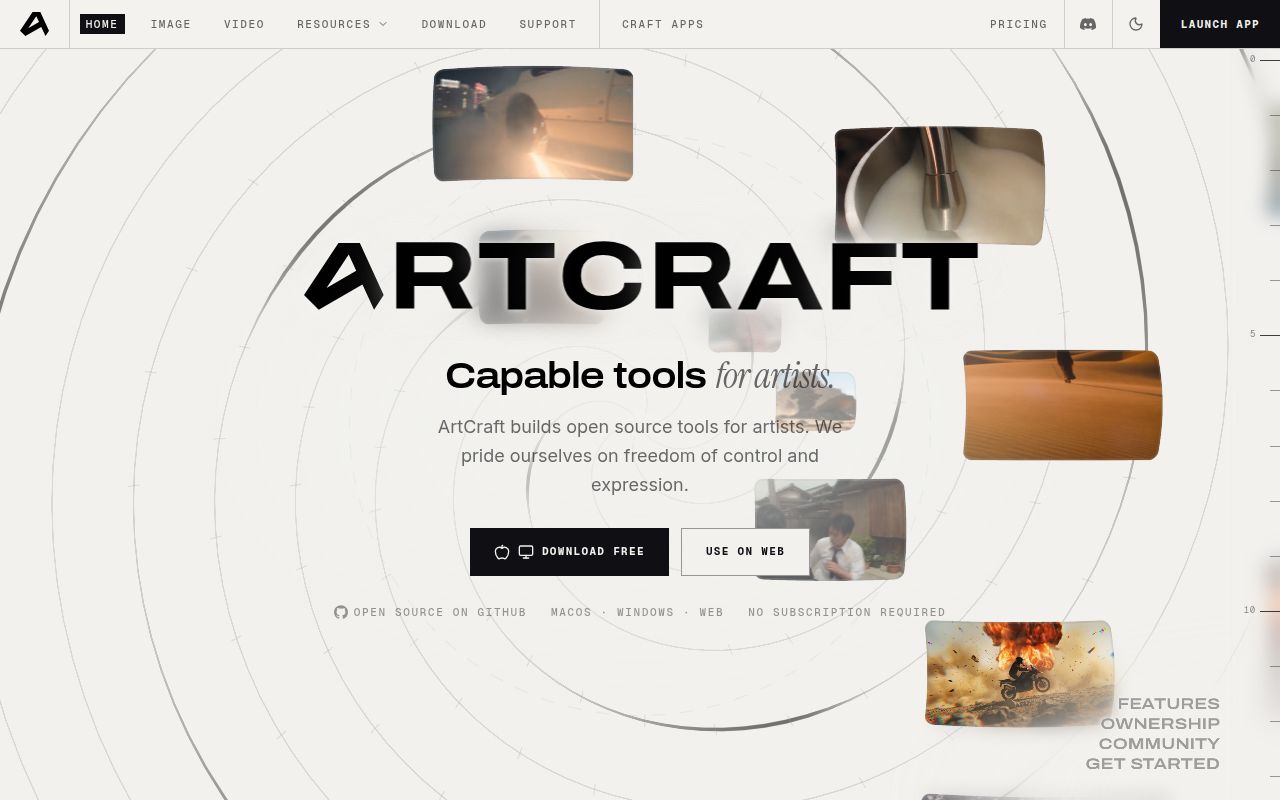
Most AI image interfaces begin and end with a prompt. ArtCraft gives you a canvas and stage first. You can arrange 2D layers, remove backgrounds, draw masks, place props in depth, pose a character, and set a camera before generating the final asset. That is useful when composition must repeat across several shots and a fresh prompt would move everything around.
The README presents a 62-model ArtCraft catalog across image, video, sound, mesh, and world generation. Some entries are marked disabled or restricted. Outside providers include Grok, Midjourney, Sora, and World Labs. These are integrations, not 62 model weights in the 51.1 MB checkout. Access, pricing, moderation, and availability can still differ by provider and model.
The visual range is wider than a local image editor
Image-to-location and scene blocking let an artist build around spatial relationships, while image-to-mesh turns a reference into an object that can be framed in 3D. The 2D side covers layers, masks, inpainting, and prompted edits. Video, music, sound, Gaussian splats, and character identity tools broaden the project beyond a Stable Diffusion front end.
That breadth also creates service dependence. The roadmap names removal of ArtCraft-hosted-service dependence as a 2026 goal, which means it should not be described as completed. Issue 968 asks for connections to local generation services such as ComfyUI. Until that path lands and is documented, buyers wanting offline generation or their own local GPUs should treat ArtCraft mainly as a hosted-model workspace.
What happened when we ran it
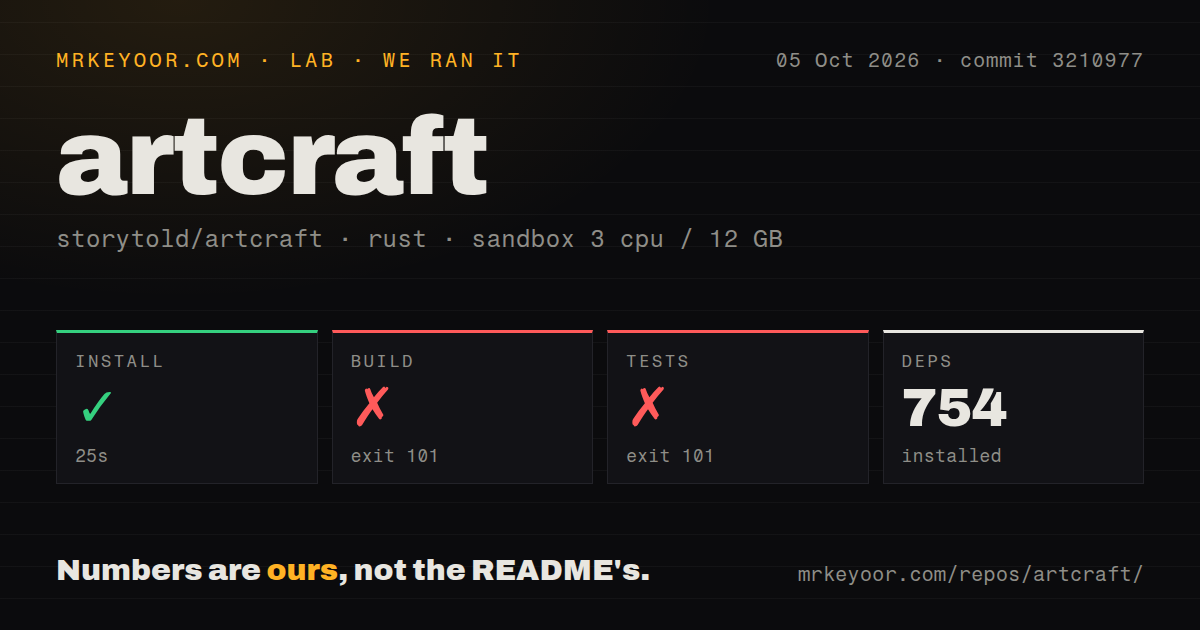
Our sandbox installed commit 3210977 in 25 seconds and added 754 packages. The checkout itself contained 5,716 files, about 473,347 lines of source, and occupied 51.1 MB. We used an unprivileged container with 3 CPUs, 12 GB of RAM, and the lab Rust image. Installation completed, but that was the last green step.
The build failed with exit code 101 after 508 seconds. Rust said sqlite_tasks could not compile because of 19 previous errors. In the final reported case, list_tasks_for_frontend.rs mapped a value into TaskFailureType::from_str, and error E0277 said str had no compile-time known size. The log does not identify one root cause for all 19 errors, so we will not infer one.
Tests failed with exit code 101 after 3 seconds. Their log ended on the same sqlite_tasks compiler error rather than a test assertion. That means our run provides no passing test count and no functional result for the editor. The repository scan found 2 CI workflow files, no Dockerfile, and no tests directory. A fresh source checkout at this commit did not reach a usable binary.
Packaged downloads avoid the build, not the service choices
ArtCraft publishes stable installers for Windows and macOS, and release v0.41.0 arrived on September 26, 2026. Linux appears in the source-development instructions, not the stable-download line. Open issue 1392 asks for an AppImage. Another open issue records Windows Defender blocking an install, with the repository note asking how to establish trust and reputation for the package.
Building from source requires Rust, Node 20 or newer, local Nx and Vite dependencies, and Tauri CLI. The development guide names Node v24.13.0 and tauri-cli 2.10.0 as known working examples. A Unix launcher starts the frontend and Rust app together, while Windows uses separate frontend and Rust scripts. Backend services and website builds live in a different repository, so this monorepo is not the whole deployed system.
The license permits personal work and blocks competing products
The root license calls itself a work in progress and describes ArtCraft as fair source. It permits private personal copying, modification, compilation, and use. It also says generated media belongs to the user. The restrictions prohibit selling ArtCraft, using the code to build a competing business or product, and removing ArtCraft community, donation, or paid-service links from a fork.
Those terms are materially different from the GPL, Apache, or MIT licenses used by the 3 alternatives in this review. GitHub reports the license as NOASSERTION, and the document itself says it is not finished legal language. Personal experimentation may fit the stated permission. Distribution, a hosted fork, or work inside another media product needs careful review of the actual terms rather than an assumption that public source equals open source.
Current development is active despite the failed commit
The default branch was pushed on October 5, 2026, one week after our measured commit. GitHub listed 2,403 stars and 42 open issues and pull requests, split into 39 issues and 3 pull requests. Dependency updates and user reports were both active in early October. That is healthier than judging the project by our one broken build alone, but it does not turn that build green.
ArtCraft's reason to exist is concrete: artists can control framing and spatial layout before paying a model to render. The packaged application is the sensible trial path today. If you need a source build, pin a newer verified commit only after reproducing compile and test results. If you need local models or permission to build a competing commercial tool, ComfyUI, InvokeAI, or Krita AI Diffusion starts from cleaner terms.