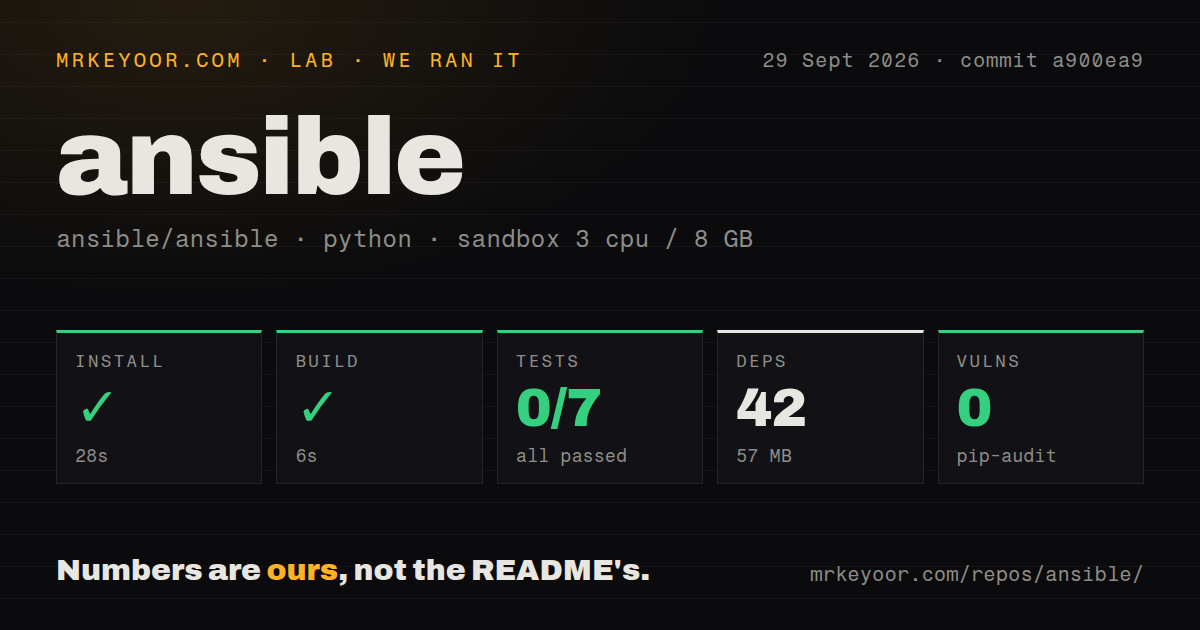
The 28-second install gives you ansible-core alone
Our sandbox installed 42 packages in 28 seconds, which makes ansible-core easy to try. It contains Ansible's language, command-line runtime, and built-in content. The larger ansible package adds a curated set of community collections, and other collections are installed separately. Finding a module online does not mean it ships in this repository. Check the collection name and supported version before writing around it.
At commit a900ea9, the checkout held 5,790 files and about 281,873 lines of source, yet used 15.4 MB. Day-one use can still be a short YAML play sent over SSH. Working on the engine is another scale of job: plugin boundaries, collection ownership, inventory behavior, and Ansible's test tools all enter the picture. A 57 MB environment made the code cheap to install in our run. It did not make the codebase small.
What happened when we ran it
Our run of commit a900ea9 installed in 28 seconds and built in another 6 seconds on 3 CPUs with 8 GB of RAM. The unprivileged Debian container had no secrets. Pip-audit reported 0 known vulnerabilities, and the environment occupied 57 MB after 42 packages arrived. We measured repository setup only. No managed host, live playbook, task-speed benchmark, or collection integration was part of this run.
Pytest failed after 4 seconds with exit code 3. Its summary was 0 passed, 0 failed, and 7 collection/setup errors out of 7. The tail ends in Python's argparse code, where an error path raises SystemExit 2. It does not expose the invalid argument or name a missing system package. The container image specified Python 3.12, while that traceback path named Python 3.14.7. We cannot tell from the supplied tail whether that difference caused the failure.
Contributors are directed to ansible-test sanity, ansible-test units, and targeted integration runs. Our scan found 0 CI workflow files and no Dockerfile. The README still carries an Azure Pipelines badge, and the testing guide says pull requests run there. A scanner looking only for repository workflow files misses that setup.
SSH removes the target agent, while inventory becomes operating data
Ansible v2.21.4 uses an agentless model: install it on a Unix-like control node, then reach managed machines through SSH, PowerShell remoting, or another transport. Most POSIX targets need Python and an account with an interactive shell. Network modules are one documented exception. You avoid maintaining an Ansible service on every Linux host, but reachability and authentication move to the control side.
The 28-second install configured no hosts. Inventory must name targets, arrange groups, and provide connection variables. A static file can cover a small fleet; plugins can discover changing cloud resources. Both become production data, since a stale group can aim a correct playbook at the wrong machines.
Readable YAML lowers the entry cost, but it cannot promise a safe second run. Module behavior, check-mode support, variable precedence, handlers, and collection versions decide what changes. The 281,873 source lines in our checkout are a warning against treating Ansible as a thin SSH wrapper. Begin with one bounded task, inspect the changed result, and test failure recovery before widening the host pattern. That work matters more than shaving seconds from installation.
Windows can be managed, but the control node needs WSL
For the current v2.21 line, the installation guide supports nearly any Unix-like control machine with Python, including Windows through a WSL distribution. Windows without WSL is not natively supported as a control node. Teams with Windows-only administrative machines must therefore add a Linux environment somewhere, then patch it and connect it to enterprise credentials.
Managed Windows machines are a different case because Ansible can reach them through PowerShell remoting. POSIX targets usually use SSH, and some network modules do not require Python on the device. Each transport brings separate authentication and failure modes. Our 3-CPU sandbox exercised none of them. A successful 6-second build says nothing about domain authentication, host keys, proxies, or privilege escalation in your network.
A September 29 push matters more than the 859-item queue
GitHub showed 70,816 stars, 518 open issues, and 341 open pull requests when checked on September 30, 2026. The repository was pushed on September 29, recent items were updated on September 30, and v2.21.4 was released on September 8. Those dates show current maintenance despite a large public queue. They do not promise a quick answer for a niche bug, which may compete with hundreds of discussions and patches.
Ansible is the first tool I would trial for readable, central automation where installing an Ansible daemon on every target is unwanted. Inventory discipline, connection management, and collection selection are the price. If your team will develop against the core repository, reproduce ansible-test on the Python line you support. Our a900ea9 run ended with 7 collection/setup errors and no executed tests, the question its 28-second installation could not answer.