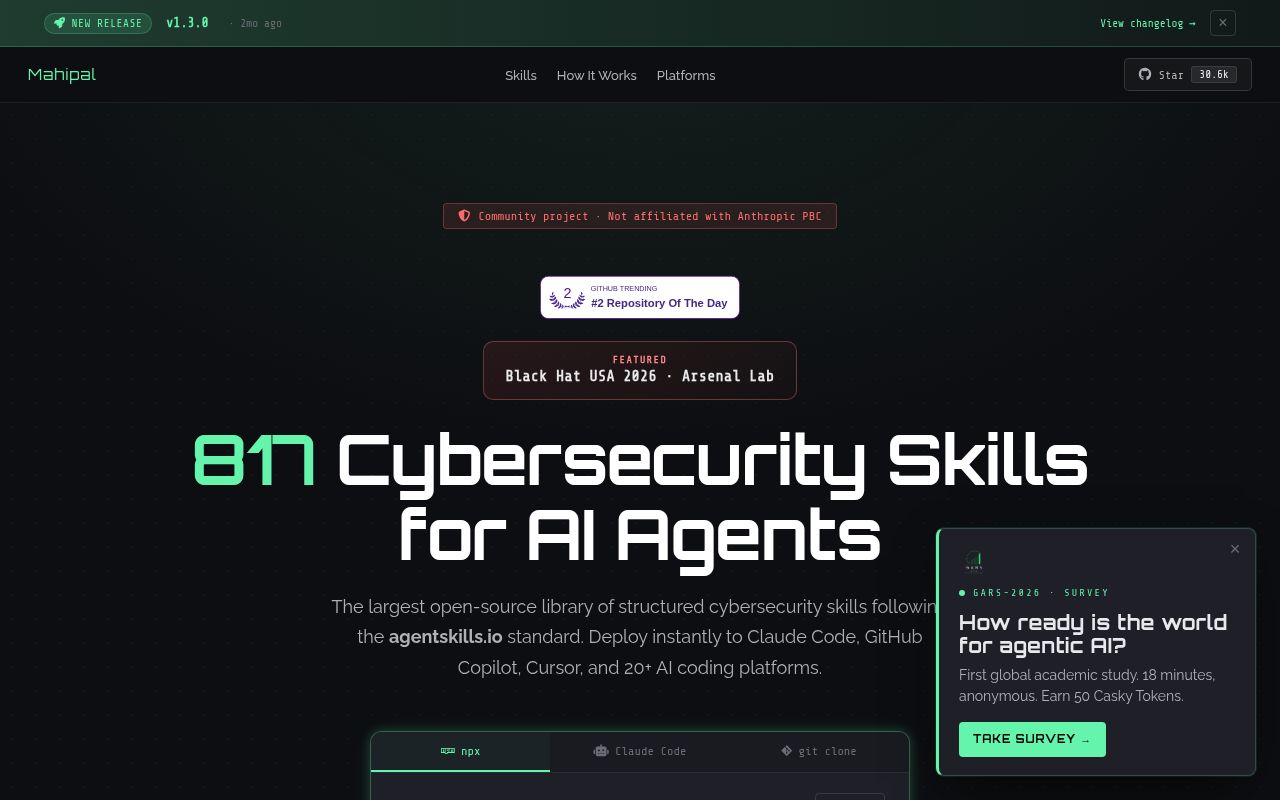
The promise of AI in cybersecurity has always been to offload the repetitive, high-volume work from human analysts, letting them focus on the truly novel threats. The reality is that large language models, for all their fluency, are born as blank slates. They don't inherently know how to triage a phishing alert, analyze a memory dump, or correlate logs across three different cloud providers. The Anthropic Cybersecurity Skills project is one of the most effective solutions to this problem I've seen. It’s not an AI, but rather the expert-level curriculum that turns a generic AI agent into a seasoned security professional.
At its core, this project is a massive, meticulously organized library of 817 discrete skills. Think of them as function definitions for an AI. Instead of just knowing about concepts, an agent equipped with this library knows how to do things, from running a specific Volatility3 plugin to identifying signs of Kerberoasting. The skills span 29 security domains, covering everything from cloud security and incident response to digital forensics and red teaming. This breadth alone makes it a significant time-saver for any team building a security agent.
More Than a List: Deep Framework Integration
Where the project truly shines, and elevates itself from a simple collection of scripts to a professional-grade tool, is its rigorous mapping to industry-standard cybersecurity frameworks. This is the feature that should catch the eye of any security manager or GRC professional. Each of the 817 skills is mapped to as many as six different frameworks, providing crucial context that is often missing from automation tools.
The coverage is impressive: MITRE ATT&CK, NIST CSF 2.0, MITRE D3FEND, and frameworks for AI-specific risks like MITRE ATLAS and the NIST AI RMF. This multi-framework mapping means that when an agent uses a skill, it doesn't just perform an action; it understands where that action fits into the larger security picture. A skill for detecting credential dumping isn't just a command; it's also mapped to ATT&CK Tactic TA0005 (Stealth) and NIST CSF function DE.CM (Detect, Continuous Monitoring). This is invaluable for generating audit-ready reports, justifying actions to leadership, and ensuring that your AI's operations align with your organization's security posture and compliance requirements.
The project's maintainers demonstrate a clear commitment to staying current. A prime example is the inclusion of the MITRE Fight Fraud Framework (F3), which was only released in April 2026. This framework fills a critical gap left by ATT&CK by cataloging the tactics, techniques, and procedures (TTPs) of cyber-enabled financial fraud after the initial compromise. The library already includes 94 skills mapped to F3, covering fraud-specific tactics like 'Positioning' and 'Monetization'. This timeliness shows the project isn't a static artifact but a living resource that evolves with the threat landscape.
Where It Fits (And What You Still Have to Build)
It’s crucial to understand what this project is not. It is not a standalone application or a ready-made security chatbot. It is a library, a box of incredibly powerful parts for developers and security engineers to build with. The README's claim to "Give any AI agent the security skills of a senior analyst" is accurate, but you have to bring the agent.
A typical implementation would involve integrating this library into a custom-built AI agent or a commercial platform that allows for custom tooling. Your orchestration layer would be responsible for presenting these skills to an LLM as available tools. When a security alert comes in, the LLM reasons over the alert data and selects the appropriate skill from the library. Your code then executes that skill, feeds the result back to the LLM, and the cycle continues. This project provides the structured definitions and metadata for the tools, but you provide the agent, the execution environment, and the glue that holds it all together.
Project Health and Responsible Use
With over 27,000 stars and a recent release in June 2026, this is a healthy and highly trusted open-source project. The 46 open issues are a reasonable number for a repository this popular, suggesting active user engagement without indicating neglect. It's a safe bet for a team to adopt as a foundational component of their security AI strategy.
Naturally, a library containing skills for both offense and defense comes with a heavy responsibility. The README includes a stark warning that these tools are for authorized and lawful use only. It's a necessary disclaimer. Automating techniques for phishing simulation or exploitation, even for red teaming, requires strict oversight and a mature security program. This is a toolkit for professionals, and it demands professional ethics.
In conclusion, Anthropic Cybersecurity Skills is a landmark project. It provides the structured, contextual, and comprehensive knowledge base that AI agents need to be truly effective in cybersecurity. By meticulously mapping hundreds of skills to the frameworks that professionals use every day, it bridges the gap between the raw capabilities of LLMs and the nuanced demands of modern security operations.