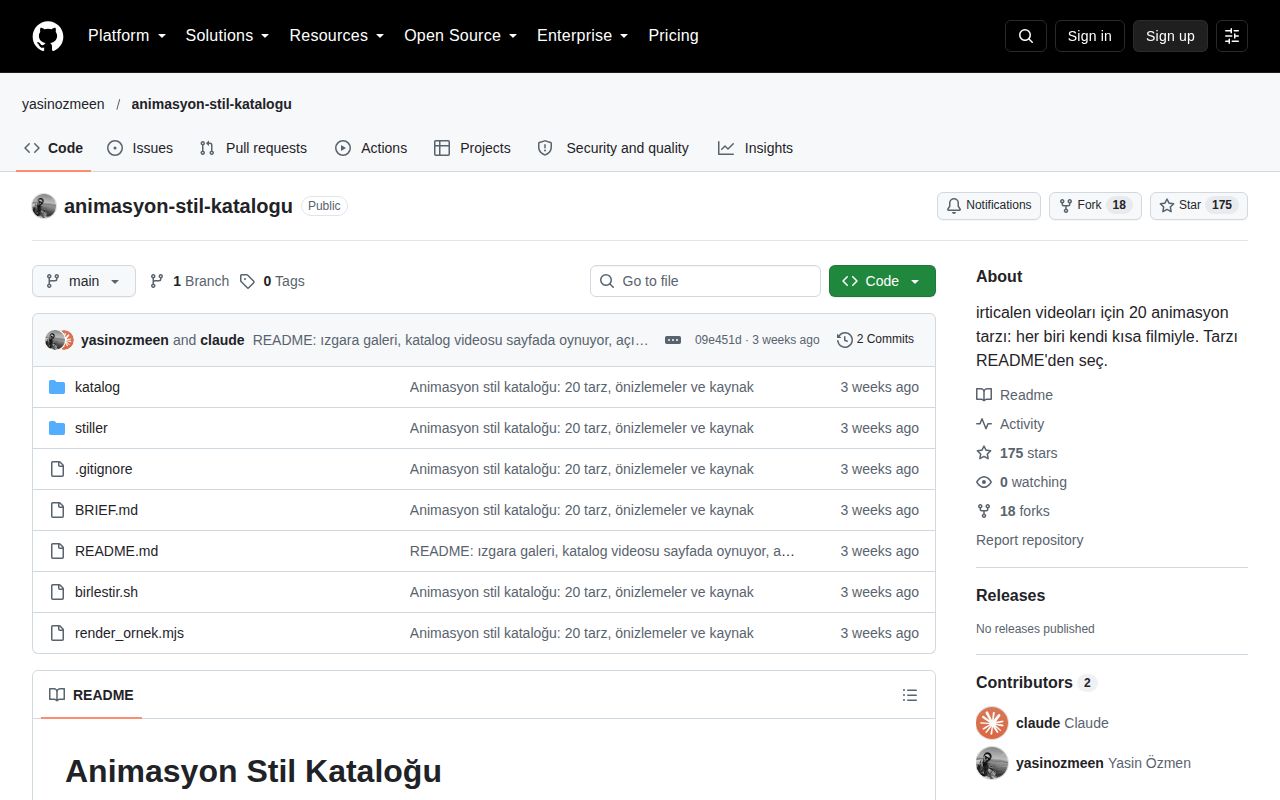
Choose “blueprint” before you ask an assistant to animate your explanation, and you've already made a useful production decision. Animasyon Stil Kataloğu gives that choice something concrete: a Turkish catalog of rendered clips with their scene code. The README presents 20 styles, each with a different subject chosen to suit its visual approach. I'd use it to agree on a direction with a collaborator before spending time adapting any code.
The catalog helps you name the look you want
The README pairs GIF previews with links to MP4 clips and source folders for 20 animation styles. Its table connects each style to a practical use: blueprint for technical detail, isometric scenes for systems, and kinetic typography for a sentence that needs emphasis. Those pairings make the catalog easier to use than a folder of unexplained examples. You can choose by the job your video must do.
English readers will need translation for the README and production brief. There is no English README in the repository tree we inspected, and the brief explicitly requires Turkish text in the animations. Familiar labels such as Bauhaus and Memphis help you navigate, but they don't translate the explanatory table. If you're handing the source to an English-speaking editor, allow time to explain the labels and replace scene text.
What happened when we ran it
We did not run commit 09e451d in our sandbox on 2026-10-15: the lab classified its language as HTML, found no supported ecosystem, and found no Dockerfile. Our fresh Debian container had 3 CPUs and 8 GB of RAM, ran without elevated privileges, and held no secrets. The result records a skipped execution path. It supplies no evidence that the renderer succeeds or fails.
The 8 GB allocation is context for that skipped run, not a memory requirement for making these videos. We have no measured render duration or completed export to report. That distinction matters here because the repository includes finished media alongside its source. The presence of an MP4 tells you an output exists, while reproducing it on your machine remains a separate question.
The renderer assumes a Mac browser cache
The sample renderer reads Playwright's browser cache under Library/Caches/ms-playwright and searches for a chrome-headless-shell-mac-arm64 executable. That's a specific portability problem visible in render_ornek.mjs, rather than a failure observed in our lab. A Linux user should inspect and adapt that browser-selection code before expecting the documented rendering route to work. The README's general list of tools doesn't explain this path assumption.
The README names Node, globally available @playwright/test, Chromium headless shell, and ffmpeg as requirements for reproduction. Its scene format uses a 1920×1080 canvas, with window.draw({t}) supplying the frame at a requested time. That is readable enough for a developer comfortable with browser graphics. You're still taking responsibility for the local rendering environment, and the catalog doesn't provide a single application interface for changing every scene.
The brief exposes useful decisions, including its limits
The production brief asks for a complete entrance and exit within each short clip, legible Turkish lettering, and deliberate composition. It also tells the generator to prepare expensive textures once rather than recreate them for every frame. These are useful constraints to borrow when writing your own animation brief. They explain what the author asked for, without proving that every finished scene meets the requested standard.
The 20 styles don't share a common story. The brief deliberately lets each scene use a subject that suits its strengths, so this catalog cannot tell you which treatment explains identical material best. The README also mentions earlier experiments with watercolor and Vox-style collage, then says those examples aren't in this repository. Choose from the supplied material rather than treating every named experiment as an available asset.
Reuse needs a license answer and some script editing
GitHub's license field is empty, and the repository tree contains no project license file. The README identifies the bundled Google Fonts as SIL Open Font License material, but that statement addresses the fonts. For client work, I'd ask the maintainer about permission to reuse the animation code and rendered clips before incorporating them into a deliverable. Publicly readable source doesn't settle that decision.
The assembly script has another machine-specific assumption: it loads Georgia fonts from /System/Library/Fonts/Supplemental. Its Python section imports Pillow to create title cards before ffmpeg combines the clips. Those details are visible in birlestir.sh. Someone who only wants a reference can stay with the supplied clips. Someone who wants a fresh combined catalog should expect to review the script and font choices first.
September activity supports a small, unfinished reference project
The last push was 2026-09-27, and GitHub showed 175 stars on 2026-10-15. The issues endpoint returned an empty list, with no open issues or PRs in the repository facts, and the latest-release endpoint returned no published release. Recent source activity prevents an abandonment claim. The empty discussion history also gives us little evidence about how the maintainer handles reproduction problems or contributions.
Motion Canvas is the alternative I'd consider for an ongoing animation project with a dedicated code framework. Remotion makes more sense when React is already how you want to compose videos. Neither replaces the immediate usefulness of this catalog's style menu. Keep Animasyon Stil Kataloğu handy for choosing a direction, then resolve the license and inspect the relevant scene's scripts before promising a client an editable production asset.