Code keeps the illustration editable after the first export
Keeping a drawing's pose, timing, and sound in a coherent source takes work. Anidoodle packages an art engine with agent instructions for illustrations, animation, and interactive web pieces. The README lists styles including woodcut and pencil with watercolour, plus workflows that turn the same drawing code into a still or moving piece. Its useful proposition is an editable program you can revisit when the design brief changes.
Our checkout contained 1,089 files, about 94,903 source lines, and 47.3 MB before installation. The measured project lived in skills/anidoodle/engine/. That location explains the product: a coding-agent skill carries recipes and working methods, with a TypeScript engine underneath. You can drive the engine directly, but ordinary use expects someone or an agent to write drawing code. A designer looking for a conventional canvas editor should make that distinction before choosing it.
What happened when we ran it
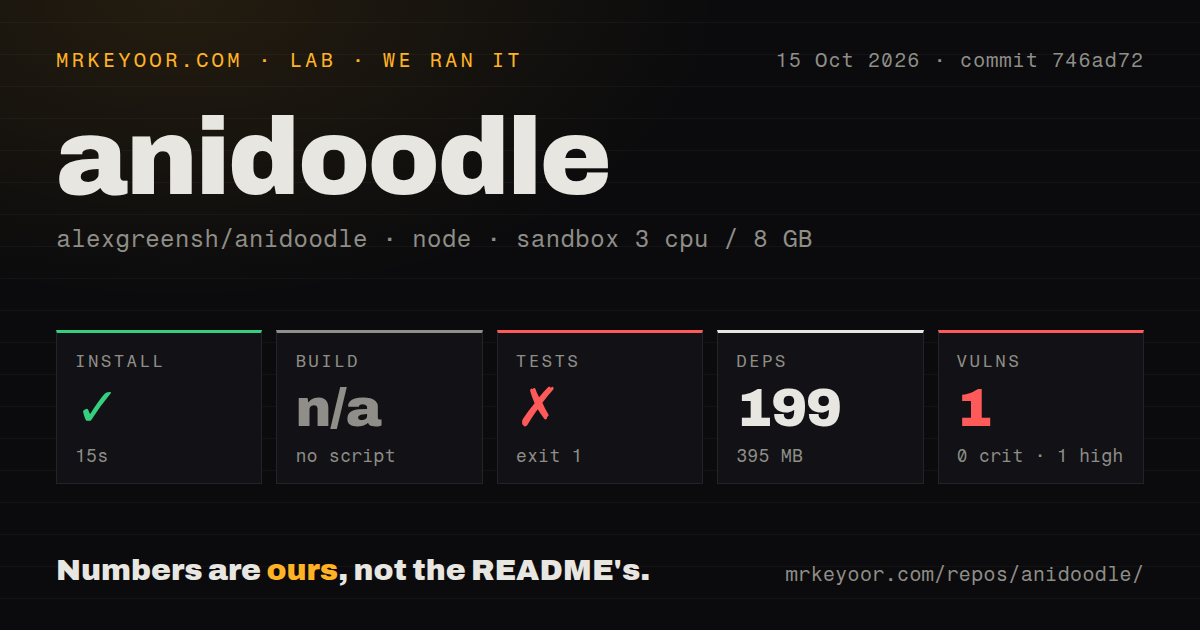
Our run installed commit 746ad72 in 15 seconds, adding 199 packages and occupying 395 MB on disk. The container used Node 22, 3 CPUs, and 8 GB of RAM, without secrets or elevated privileges. There was no build script or target, so the harness skipped that step. Skipping a nonexistent target is different from a successful build, and the result should not be presented as compilation passing.
The test command failed with exit code 1 after 81 seconds. Its summary reported 659 passed and 3 failed. The supplied tail shows passing checks for finite geometry, iris rims, and wipe behavior, followed by the failing summary. It does not name the failed cases or show their assertions. That supports saying the suite was not green in our environment. It does not support blaming Chromium, an operating-system package, or a particular drawing algorithm.
Npm audit reported 1 known vulnerability, classified high, with none in the other severity categories. The supplied measurements do not name its package or describe whether an exported artwork exposes it. Our scan found a tests directory, no Dockerfile, and 0 CI workflow files. Before adopting the tool into an unattended publishing job, inspect the advisory and get a clear explanation for the failing cases. A passing majority does not establish that the file you plan to ship is correct.
Chromium and ffmpeg sit beyond the plugin entry point
The README requires Node 20 or newer, a Playwright Chromium installation for stills, and ffmpeg for moving outputs. It documents plugin entry points for Claude Code and other skill-reading agents, along with direct scaffold and render commands. The renderer itself has no documented hosted-image API credential requirement. If you use an agent to create the source, that agent's service access remains a separate setup decision from executing the drawing program.
The 395 MB environment in our run is the concrete local footprint we can report. It is not an estimate for every browser cache, optional sound asset, or finished video you might accumulate. Music can be synthesized in code, and a separate sound pack adds recorded acoustic instruments. That download is optional. Start without it if illustrations or silent loops are your immediate goal, and add audio assets only after a small piece survives your actual export workflow.
Repeatability depends on the drawing program following the contract
The determinism guide requires frame rendering to be a pure function, with seeded randomness and cache keys that cover every input affecting the picture. It excludes browser state and ambient clocks from the art core. Those restrictions explain how an animation can render frames independently. They also give you specific code-review questions: does a cache include the changing pose, and does a random choice come from the seed?
Our 81-second failed suite does not prove the README's cross-machine repeatability claims. The guide itself records an unexplained cold-workspace inconsistency, then describes follow-up probes, and allows small antialiasing differences in its verification standard. That is more qualified than the README's strongest wording about identical output everywhere. I would keep the source and renderer versions together and compare representative cold and cached frames before accepting repeatability for a production asset.
Export tools cover more than the source preview
The format guide documents PNG stills, video outputs, transparent animation formats, and a self-contained HTML player. Its export verifier can inspect the delivered file's duration, frame count, and audio relationships. A plausible preview cannot tell you whether a video encoder produced the intended file. The guide distinguishes optional fidelity checks from basic container facts, so read the flags before assuming every check runs automatically.
The 659 passing cases give some evidence that the engine contains exercised logic, while our 3 failures leave the full suite unresolved. Neither number judges whether an illustration has readable labels or a character has convincing anatomy. For a website mascot, review keyboard behavior and reduced motion in the host page as well as the exported art. The README describes those interaction paths, but their presence in a feature list cannot verify your final integration.
October maintenance is active, while the safety case remains unfinished
GitHub showed an October 14, 2026 last push and a same-day v0.7.2 release. Its notes address deliberate musical silences and repeatable dip-pen rendering. Recent PR activity includes a Windows path-normalization fix in scaffolding, so the repository is receiving specific maintenance rather than sitting behind an old tag. It had 920 stars and 1 open issue or PR in the combined API count. That is a small public support queue, not a measure of defect coverage.
Motion Canvas is the more direct comparison for code-driven explanatory animation with an editor preview. Remotion fits teams already authoring video in React, subject to its separate licensing terms. P5.js suits exploratory browser sketches. I would choose Anidoodle when its drawing recipes and editable source save real art-production work, then approve an actual exported asset. The 3 failing cases and high advisory need answers before it becomes a job that publishes without a person watching.