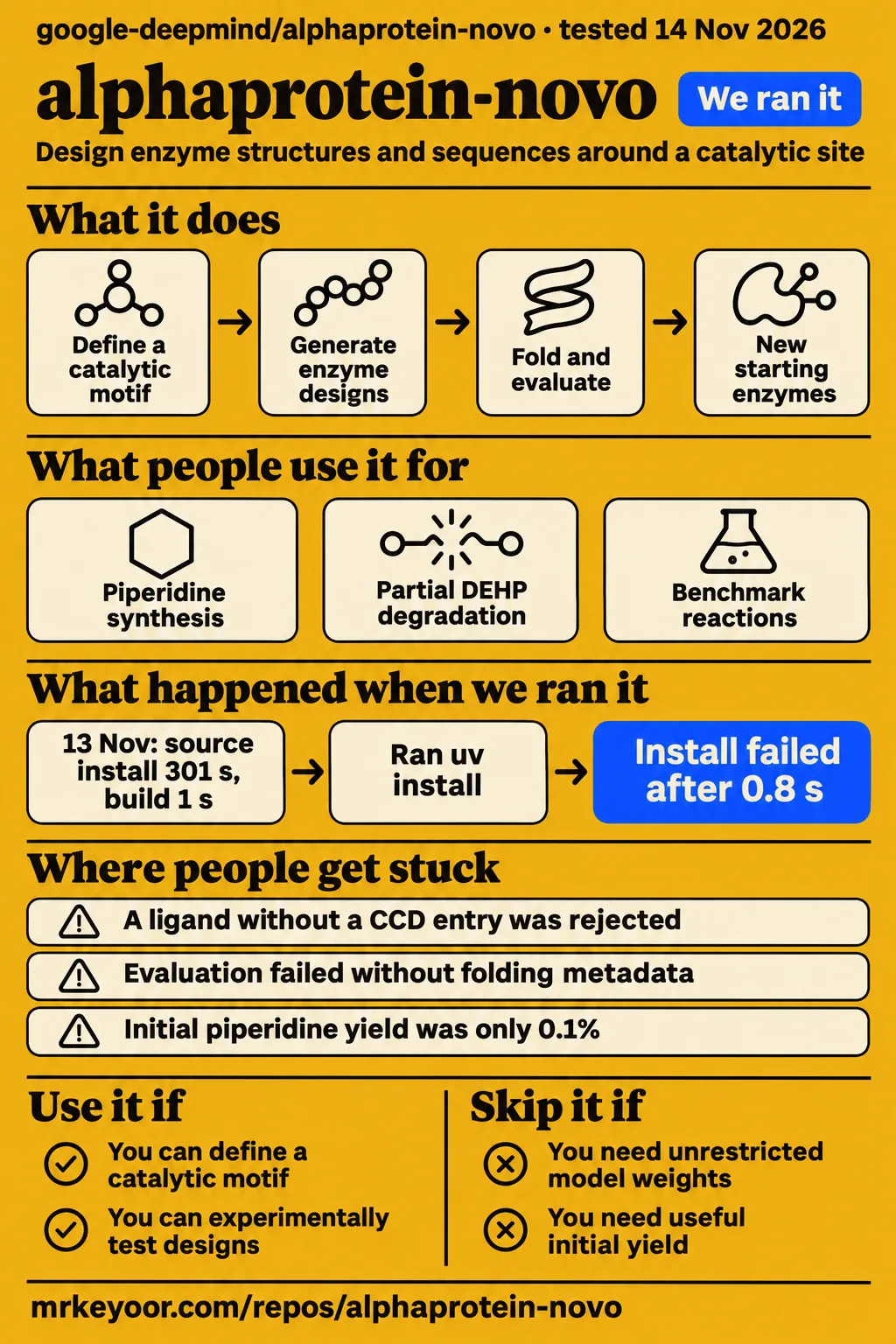
Our sandbox installed AlphaProtein Novo in 301 seconds and recorded 6,411 MB on disk. Use it if you work in an eligible non-commercial research organization and can turn a proposed catalytic site into a wet-lab experiment. Skip it if you need unrestricted model weights or expect a generated sequence to arrive with useful yield already demonstrated. The authors' piperidine campaign explains why: excellent product selectivity came before practical yield.
What people use alphaprotein-novo for
Researchers have used AlphaProtein Novo to propose enzymes for selective piperidine synthesis, partial DEHP degradation and benchmark reactions, while an outside user reports completing a custom-ligand computational pipeline.
| Who used it | What they did | Reported outcome |
|---|---|---|
| Google DeepMind and collaborating researchers | Designed nitrene transferases for piperidine synthesis | Lead design GDM_NT_270 delivered 22 turnovers, 99:1 regioselectivity and 94% enantiomeric excess. Preprint |
| Zach Wu, describing work led by Zi-Qi Li | Refined and evolved piperidine designs | Yield rose from 0.1% to above 60% after design refinement and two directed-evolution rounds, including in 40% DMSO. Author's X account |
| The research team, as reported by CBIRT | Designed DEHP-degrading enzymes for difficult conditions | GDM_DEHP_376 retained activity in 75% acetonitrile and was 14 times more active at 90 °C than at room temperature. CBIRT's account |
| Jack, the reporter of issue #1, with a follow-up attributed to WinstonJump | Supplied a transition-state ligand absent from the chemical component dictionary | Adding a chemical-component block to the input CIF allowed the pipeline to finish and AF3 to predict apo and transition-state complexes. Issue #1 |
The piperidine result addresses a specific problem: which ring the reaction produces. In the preprint's screen of 188 natural and previously engineered heme-protein variants, none above the activity threshold exceeded a 30:70 piperidine-to-pyrrolidine ratio. The designed lead reversed that preference. For a researcher whose existing scaffold keeps producing the wrong ring, that is a reason to consider a new scaffold rather than keep screening similar starting material. Campaign comparison
The benchmark reactions answer a different question. The authors report a Kemp eliminase with catalytic efficiency of 45,000 M⁻¹s⁻¹ at pH 10. Their serine-esterase results distinguish a design with natural structural similarity, at 360,000 M⁻¹s⁻¹, from one without natural similarity, at 4,900 M⁻¹s⁻¹. Keep those categories attached to the figures. Otherwise a reader can mistake the strongest number for the strongest demonstration of a wholly unfamiliar scaffold. Author-reported efficiencies
What happened when we ran it
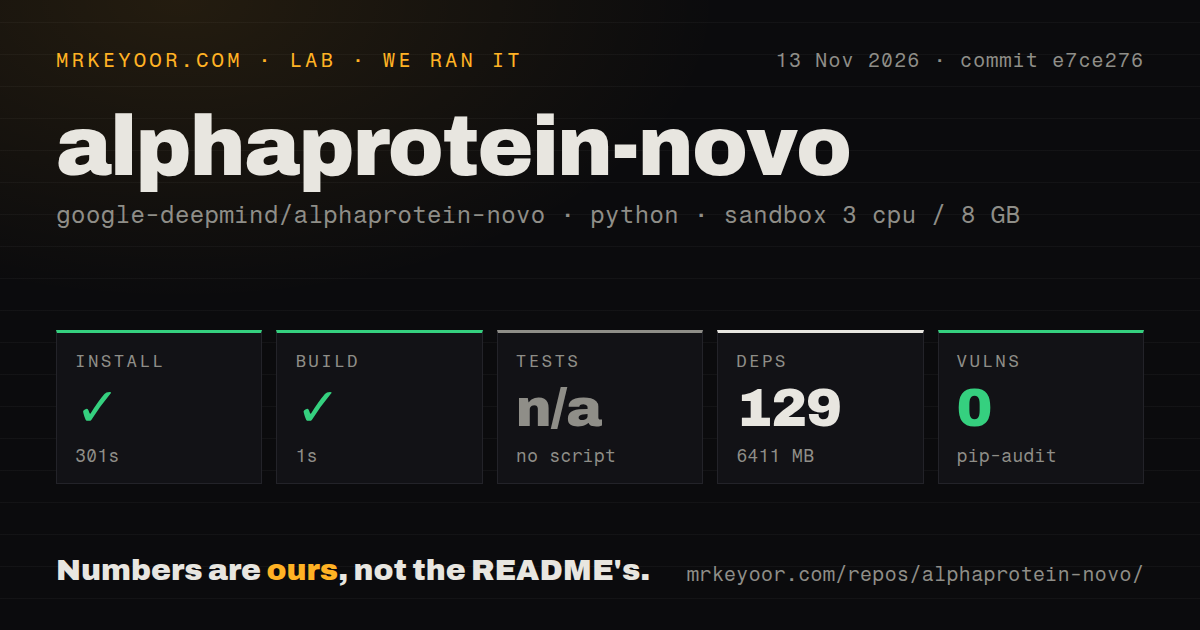
Our November 13 sandbox run installed commit e7ce276 in 301 seconds and completed the build step in 1 second, with 129 dependencies recorded and 6,411 MB on disk.
| Repository harness observation | Recorded result |
|---|---|
| Install | Succeeded in 301 seconds |
| Build | Succeeded in 1 second |
| Tests | Skipped because there was no tests script or target |
| Dependency record | 129 dependencies, 6,411 MB on disk |
| pip-audit | 0 known vulnerabilities |
| Repository scan | 74 files, approximately 22,177 source lines, 1.1 MB checkout |
| Delivery signals | 0 CI workflow files, no Dockerfile, no tests directory |
The configured sandbox had 3 CPUs, 8 GB RAM and image label ghcr.io/astral-sh/uv:python3.12-bookworm. Actual runtime and operating-system versions require the raw toolchain logs. The difference between a 1.1 MB checkout and a 6,411 MB environment is the useful setup warning here: the source download is a poor guide to the space this recorded environment consumed. Reserve room for the environment before treating the small repository as a lightweight research tool.
A separate November 14 hands-on attempt used the quickstart-lib recipe at e7ce276cb4a1 in a fresh unprivileged container configured with 2 CPUs and 4 GB RAM, no published ports and no secrets. Its clone step completed. The attempt then stopped at the package-registry lookup, before an enzyme-design task began.
The command was uv pip install alphaprotein_novo. The step record says it failed, and the finding records the reason: the package was not found in the registry, leaving the requirements unsatisfiable. That is a concrete failure of this recipe. The README instead documents installing the checked-out source in editable mode. Use that documented route; changing the package spelling would be guesswork. The run summary's wording that it “installed” from PyPI conflicts with the failed step, so the step and finding determine our account. Teardown was recorded as successful. source-install instructions
These records concern different setup paths. The successful repository harness and the unsuccessful registry recipe can both be accurate. Neither should erase the other, and neither supplies a measured catalytic result.
Where people get stuck: custom chemistry needs a complete CIF
Issue #1 records a successful custom-ligand workaround: put the chemical-component description into the input CIF rather than assuming every ligand already has a dictionary entry.
Jack had run some benchmarks, then tried a theozyme containing a transition state of p-nitrophenyl acetate. A theozyme is the proposed arrangement of catalytic groups around the reacting molecule. His ligand had no CCD entry, and the pipeline rejected it. He considered modifying the compiled dictionary because he could not find the equivalent of AF3's custom-CCD input option. The follow-up attributed to WinstonJump reports success after adding a _chem_comp block to the CIF, including a component identifier and chemical description. AF3 then folded an apo form and a transition-state complex. The issue is closed. Custom-ligand report and follow-up
That is the first troubleshooting thread I would give a researcher importing a new transition state. Compare the example's component definition with your input before editing a compiled dictionary. The useful outcome is narrower than a chemistry validation: the custom input passed through the software and produced structural predictions. A completed fold is the point at which experimental assessment can begin.
| Reported obstacle | Evidence-backed response | Status in the supplied record |
|---|---|---|
| Ligand missing from CCD | Issue #1's follow-up adds a _chem_comp block to the input CIF |
Successful workaround, issue closed |
| Existing AF3 environment in Singularity | Issue #2 asks how to run AP Novo inside that arrangement | Open, no comments or recipe |
| Eigen fetch failed during the ToolUniverse environment build | An unchanged retry succeeded; constraining CMake below 4 did not help | Provider-reported workaround |
| Evaluation refused a campaign without folding metadata | ToolUniverse added ingestion of external folding predictions and corrected its evaluation input directory | Later computational end-to-end run reported |
| Malformed motif specification discovered after generation | ToolUniverse exposes validation with upstream MotifSpec before generation |
Provider-specific precaution |
The Singularity question deserves its own status. Issue #2 contains a user's existing AF3 setup and a deployment question, not a demonstrated incompatibility. The ToolUniverse rows come from its provider-maintainer account, not our sandbox. Keep that distinction when choosing a workaround for your environment.
Selectivity reaches 99:1; useful yield took more work
Zach Wu reports that initial piperidine designs yielded only 0.1%, followed by design refinement and two directed-evolution rounds that raised yield above 60%.
Selectivity says which product dominates among the products formed. Yield says how much desired product you obtain. A highly selective reaction can still leave you with very little material, as the author's account makes unusually clear. His post attributes the improvement to work led by Zi-Qi Li, including performance in 40% DMSO. For an experimental group, the adoption question is whether AP Novo supplies a better starting point for the optimization work you can afford. Wu's yield account
The DEHP case needs similar care. CBIRT reports that the best design was less active than natural DEHP-degrading enzymes at room temperature, while tolerating heat and solvent conditions that inactivated the two natural comparators. It also says the designs do not fully break DEHP down. Choose the experimental condition before declaring a winner: a solvent-tolerant partial-degradation catalyst and a room-temperature catalyst answer different needs. Calling either result a deployed cleanup system would skip the engineering question the reported experiment actually addressed. DEHP comparison and limits
GPU generation figures cover one stage, not a whole campaign
ToolUniverse's provider maintainers report a 2.0 GiB generation allocation on an NVIDIA GB10 and a substantial compilation cost before a reused generation trajectory runs.
Their account gives a pair at the published 1,000 denoising steps: 193.1 seconds for the design paying compilation and 36.6 seconds for the design reusing it. At 50 steps, it reports 158.5 seconds and 1.99 seconds. These are external generation measurements on that provider's machine. The practical lesson is to separate a cold request from a reused trajectory and record the step setting alongside either figure. Quoting only the fastest value hides the delay a new campaign can encounter. Provider's generation account
The same maintainers report a generate, fold, ingest and evaluate chain through remote endpoints on October 15, 2026. Their native folding path remained blocked by an AF3 weight-entitlement question, so they added an external-prediction ingestion path. They also report running LigandMPNN resequencing on CPU because their older Torch stack could not drive the GB10 GPU for that stage. This is a useful integration account precisely because it names the substitutions. Treat its generation memory figure as a stage-specific observation when planning capacity. External integration report
Apache source comes with separate weight and output restrictions
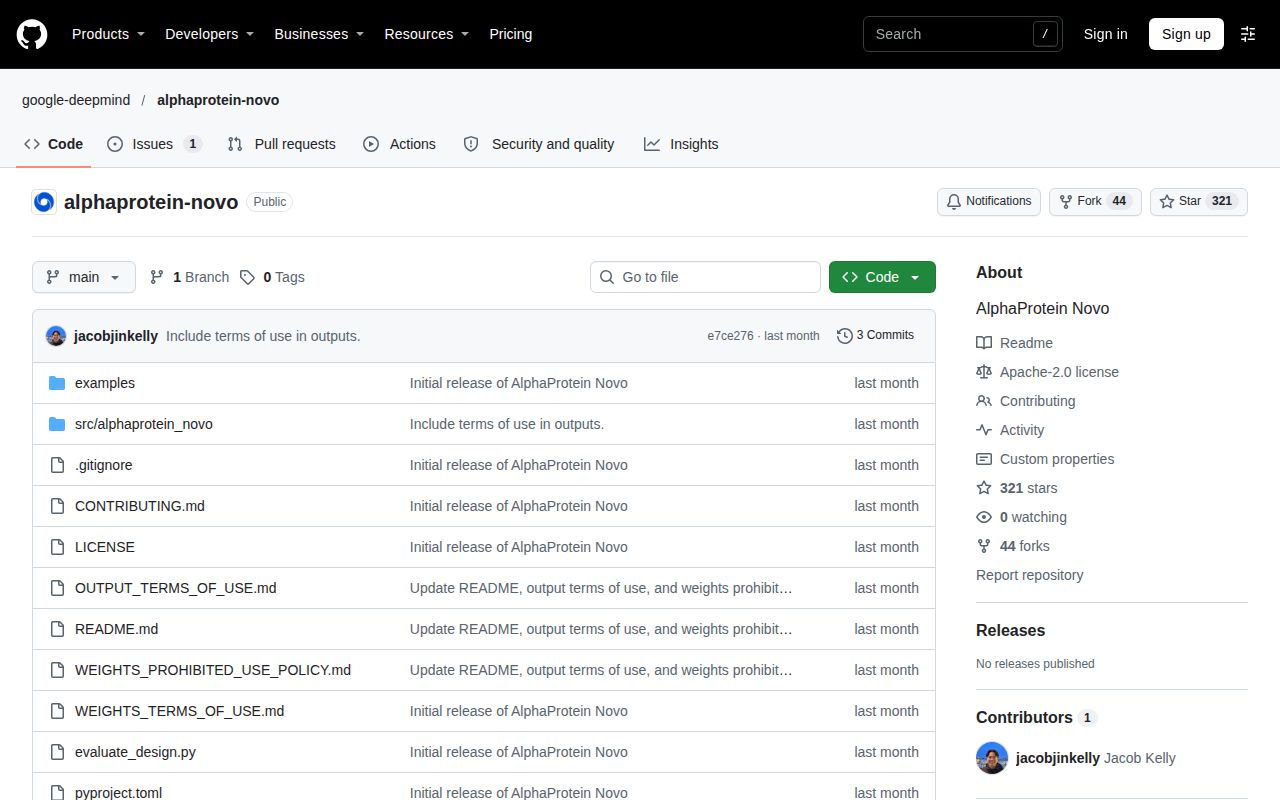
AlphaProtein Novo's Apache-2.0 source license does not make the generator weights or generated outputs unrestricted.
The published weight terms restrict the model parameters and outputs to non-commercial use by or on behalf of non-commercial organizations. Research for a commercial organization is excluded. ToolUniverse's deployment account further highlights direct receipt of weights from Google, organizational sharing boundaries and preservation of output notices. AF3 and LigandMPNN have their own terms. A shared research service therefore needs to settle who can use it and which assets it can distribute before opening access to other groups. Generator terms, provider's deployment contract
The preprint also discloses a US provisional patent application relating to this design approach and commercial interests for most authors, with named exceptions. That disclosure belongs beside the performance claims: these are results reported by the research team, whose affiliated entities also have interests in the work. It gives readers context for the claims without changing the reported experimental outcomes. Competing-interest statement
Our audit recorded zero known vulnerabilities. That is a dependency-audit observation, not a security certification for a hosted design service. The source scan found no CI workflow files or tests directory, and the harness had no test target to run. For teams modifying the pipeline, those are concrete reasons to preserve inputs, outputs and stage logs for their own regression checks.
AlphaProtein Novo vs RFdiffusion2, ColabDesign and experimental alternatives
RFdiffusion2 is the closer software alternative for enzyme active-site scaffolding; ColabDesign offers a broader notebook-based entry to protein design.
RFdiffusion2's README describes atom-level enzyme active-site scaffolding and explicitly supports Apptainer, with Singularity also named. ColabDesign's README lists AlphaFold-based design, ProteinMPNN and RFdiffusion tools. Choose between them by the task and deployment path you need, rather than assuming every protein-design package provides AP Novo's reaction-specific workflow. RFdiffusion2, ColabDesign
The research comparisons also include choices that are experimental methods rather than competing repositories:
| Alternative | Why choose it | What the AP Novo evidence changes |
|---|---|---|
| Screening natural and engineered heme proteins | Begin with existing enzyme diversity | The authors' 188-variant screen favored pyrrolidine; their designed lead achieved 99:1 piperidine selectivity. Preprint |
| Natural DEHP-degrading enzymes | Prefer the reported stronger room-temperature activity | The designed enzyme's attraction was tolerance of heat and solvent that inactivated the two tested natural comparators. CBIRT |
| Directed evolution | Improve a starting enzyme through experimental rounds | Wu reports combining design refinement with two evolution rounds to move piperidine yield above 60%. Author's account |
Directed evolution is the comparison most likely to change a lab's decision. The authors used it alongside AP Novo. If your group already runs mutation-and-screening campaigns, a new scaffold can feed that process. If you need the computational tool to remove those experimental rounds, the piperidine account gives you a reason to walk away from that expectation.
What the other reviews get wrong
The advertised 80% hit rate is retrospective, weight access depends on organizational eligibility, and the lead piperidine result followed a second design iteration.
Gate's launch summary advertises hit rates up to 80%. Its detailed section identifies the 60% and 80% figures as retrospective results from combining sequence-ensemble filtering with partial diffusion. Preserve that qualifier. A retrospective filter result is not a general probability that your next proposed reaction will produce an active enzyme. Gate's summary and detailed explanation
CBIRT groups code and model weights together as free for non-commercial use. The deployment contract is narrower: the organization's eligibility matters, and a non-commercial project inside a commercial organization is not enough. Read the weight terms before assigning compute or arranging a collaboration around access. CBIRT's summary, deployment qualification
Sukhdeep Singh's launch post describes greater-than-99:1 piperidine regioselectivity in a single design round. The preprint describes an initial best piperidine design up to 94:6, followed by a second iteration of 90 scaffolds that produced GDM_NT_270 at 99:1. Use the campaign account when estimating how much iteration the result represents. Launch post, preprint campaign
Questions people ask
A custom ligand without a CCD entry passed the pipeline in issue #1 after a chemical-component block was added to the input CIF.
How do I use a custom ligand or transition state that has no CCD entry in AlphaProtein Novo?
Add the ligand's chemical-component description to the input CIF, following the _chem_comp example in issue #1. The follow-up reports completing the pipeline and obtaining AF3 apo and transition-state-complex predictions. Treat the example as an input-format workaround for that reported case, then check that your own component identifiers and atoms agree. Successful custom-ligand report
Can I run AlphaProtein Novo in Singularity using my existing AlphaFold 3 environment?
The supplied issue #2 offers no working deployment recipe. Its author asks exactly this question, and the record is open with no comments. Existing AF3 operation is useful context, but the thread provides no evidence that AP Novo can simply be added to that container. RFdiffusion2 documents Singularity separately; that documentation cannot answer compatibility for AP Novo. Singularity question
Are AlphaProtein Novo's model weights open, or are they available only under restricted terms?
The weights are available under restricted terms, separately from the Apache-2.0 source. The generator terms cover organizational eligibility and non-commercial use, with obligations for outputs as well. AF3 folding weights have separate terms. Read those conditions together when planning a shared service or a collaboration involving a commercial partner. Weight terms, deployment account
How far can AlphaProtein Novo handle metalloenzymes whose chemistry involves strongly correlated d-electrons?
The supplied discussion gives no measured capability boundary for strongly correlated d-electron chemistry. Amit Brahmbhatt raises this question in response to Pushmeet Kohli's announcement, referring to challenges for ML potentials and DFT. The demonstrated heme-based designs give a concrete starting point for discussion, but the comment contains a question rather than a general validation of this regime. Metalloenzyme question
Could AlphaProtein Novo design a better open and free alternative to NanoLuc?
The supplied discussion contains a request for an open, free NanoLuc alternative, not a demonstrated replacement. Mikhail Koksharov proposes the idea and a substrate in the comments on Kohli's announcement. That is a possible research question. Neither the comment nor the reported campaigns provides a NanoLuc comparison, and AP Novo's output terms still matter to the desired open release. NanoLuc request, output restrictions
What we have not tested yet
Our evidence covers repository setup checks and an aborted registry-based attempt, not an end-to-end enzyme-design workload or independent wet-lab replication.
We have not tested GPU generation, AF3 folding, the custom-ligand workaround, Singularity deployment, campaign throughput or peak whole-pipeline memory ourselves. ToolUniverse's computational integration is an external report, and the supplied records contain no independent wet-lab replication of the authors' catalytic results. The empty video extracts supply no walkthrough outcome to add. No screenshots or known-answer task records accompany our aborted attempt.
The missing test target means there is no passing-suite result to report. The audit supplies a known-vulnerability count without a detailed coverage account. Setup ease, community support and production maturity receive N/A because these records do not support numerical judgments about a supported full deployment, maintainer capacity or sustained operation. Documentation receives 3/5 under this editorial scale: 1 means no actionable route, 3 means concrete instructions with material unanswered workflows, and 5 means those workflows are covered and independently reproduced. The source instructions and custom-ligand thread support the middle rating; the unanswered Singularity request keeps it there.
For an eligible experimental group, the next useful result is one complete campaign tied to a defined reaction, with generation, folding and wet-lab outcomes recorded separately. Make the decision on whether that campaign yields a better starting enzyme for your lab's optimization work.