One client exposes 11 regulatory output types
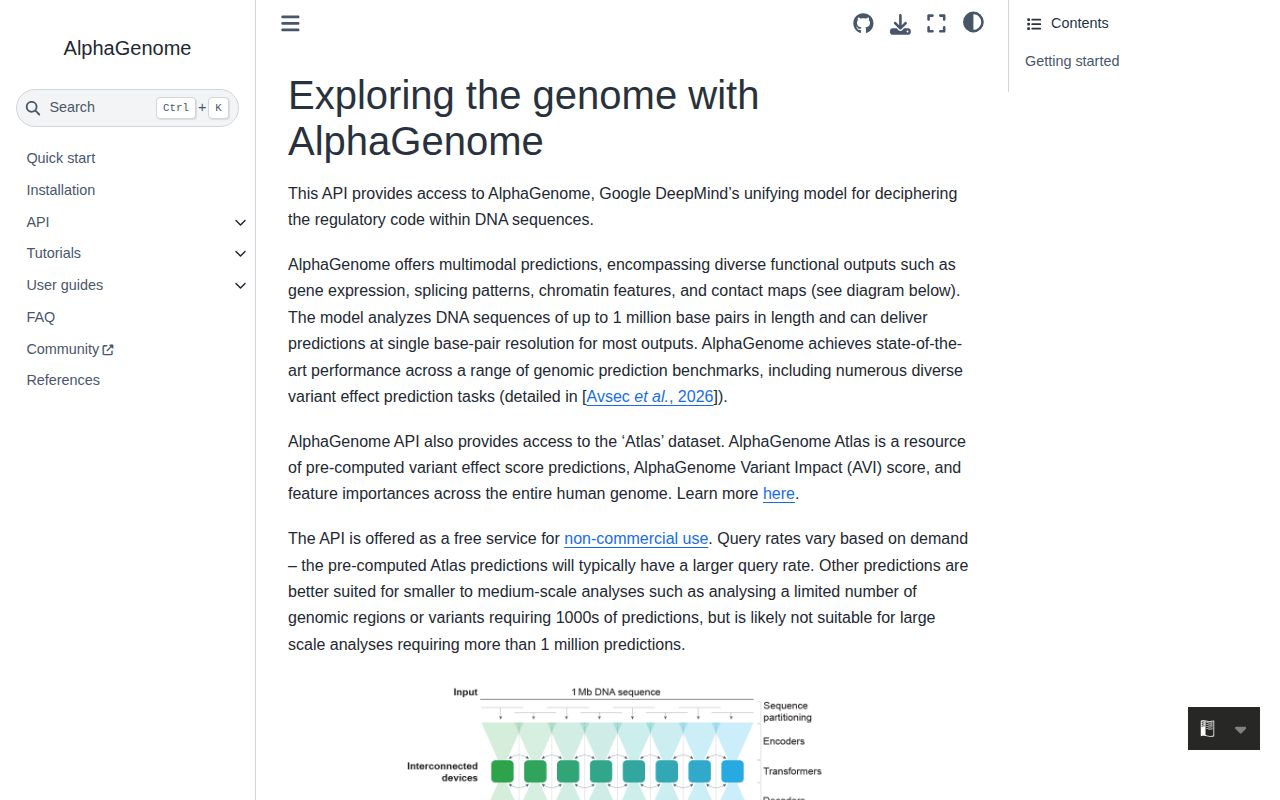
AlphaGenome accepts DNA intervals up to 1,048,576 base pairs and returns 11 documented output types. They include RNA expression, chromatin accessibility, histone marks, transcription-factor binding, splice sites and junctions, splice-site usage, and contact maps. Most output types can reach single-base resolution, while some are binned more coarsely. The client wraps interval and variant objects, gRPC requests, scorers, metadata, and plotting helpers around the hosted model.
The distinction between client and model is essential. This repository contains Python code, examples, generated protocol bindings, reference annotations, and visualization tools. It does not run the AlphaGenome neural network on your laptop. A prediction call sends a sequence request through a client created with an API key. Researchers who need model internals or local execution must use the separate alphagenome_research repository and obtain its weights.
Free access is bounded by purpose and request volume
The README positions custom inference for analyses needing thousands of predictions and says workloads above 1 million predictions are likely unsuitable. Atlas queries use precomputed variant effects and typically receive a larger request rate. Actual rates vary with demand. That makes the service practical for a focused variant set, while a population-scale pipeline needs early confirmation of quotas, batching, cost, and permitted use.
The free API is restricted to non-commercial use under AlphaGenome's service terms. Except for specified downloadable artifacts, generated output and Atlas information must not be used to train other machine-learning models. Google points commercial users to AlphaGenome on Google Cloud. The terms also state that predictions are for research and theoretical modelling, not clinical decisions or professional advice. Those are product boundaries, not fine print to resolve after an analysis ships.
What happened when we ran it
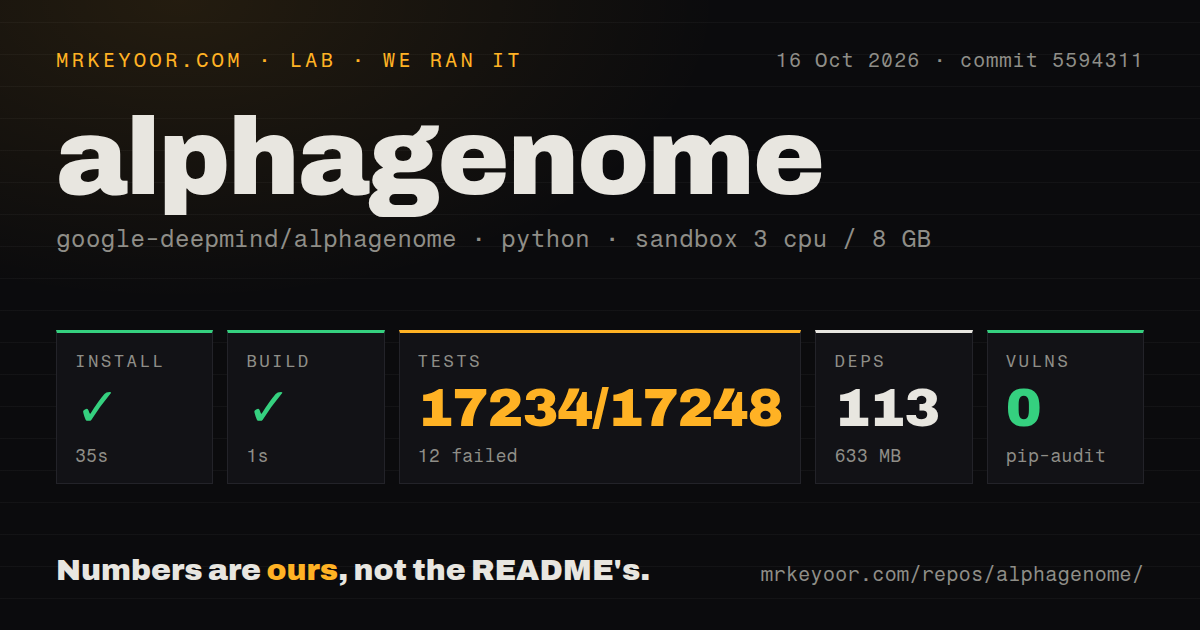
Our sandbox installed commit aa6fc8f in 49 seconds, adding 112 packages and using 663 MB. The build completed in 8 seconds. Pytest ran for 182 seconds and ended with 17,218 passed, 12 failed, and 2 collection or setup errors out of 17,232. It also reported 162 warnings. Pip-audit found 0 known vulnerabilities.
Eight named FoldIntervalsTest cases failed with UnparsedFlagAccessError while accessing Abseil's --test_tmpdir. Four more failures expected a Python TypeError or a TypeCheckError, but no such exception was raised. The supplied tail did not show details for the 2 setup or collection errors. We will not assign causes beyond those messages; the useful result is that the suite was close to green and still failed.
The checkout held 124 files, about 21,901 source lines, and 38 MB. Our scan found 2 CI workflow files, no Dockerfile, and no top-level tests directory. Test modules live beside the package code under src, so directory layout does not imply missing coverage. The 17,218 passing cases show substantial automated checking, while the remaining 14 problems still matter for a client used in coordinate-sensitive research.
Five biological limits narrow valid use
The FAQ names 5 main scope limits. Tissue-specific effects and long-range interactions remain difficult. Training and evaluation cover human and mouse DNA, with other species unbenchmarked. Personal genomes have not been benchmarked. The model predicts molecular consequences rather than the full biology of complex traits. It also consumes one unphased sequence at a time, so heterozygous and parental-allele states are not represented directly.
Large sequence departures deserve extra caution too. AlphaGenome has been evaluated on changes relatively close to the reference, such as SNPs and indels. The docs warn that structural variants, heavily padded sequences, synthetic constructs, and other large departures may be less reliable. Human inputs use hg38 and mouse inputs use mm10. Variants arrive with a 1-based position but expose internal 0-based start and end values, a conversion that should have explicit regression fixtures.
Prediction tracks also need biological metadata, not just an array. The 11 output types vary from 5 tracks to more than 600, tied to tissues, cell types, strands, assays, and ontology identifiers. Picking the wrong ontology term or ignoring strandedness can yield a technically valid response that answers a different question. Save the requested metadata alongside scores and plots so another researcher can reconstruct the interpretation.
TrackData slicing can attach the wrong coordinates
Issue 48 shows a TrackData example at 128-base-pair resolution where slicing [127:383] returns the expected 2 values but assigns the interval [127,383) instead of the actual [0,256). Repeated non-aligned slices in the reproducer grow the coordinate error from 127 bp to 635 bp. Pull request 46 proposes a fix, and both were still open when fetched.
That bug is easy to miss because the values can look plausible while their genomic labels drift. Any pipeline that slices tracks before intersecting genes, variants, or peaks should pin a version and test coordinate alignment on a tiny known interval. The same principle applies to output units and reference builds. A biologically polished plot is not evidence that its coordinates, tissue selection, and allele convention are correct.
v0.9.0 adds Atlas access while issue review stays active
Version 0.9.0 was published on September 8, 2026 and added programmatic access to AlphaGenome Atlas scores. GitHub recorded the last push that day. The repository had 2,072 stars and 6 combined open issues and pull requests when fetched. Current activity included the slicing fix, support for missing slice endpoints, and a request for documentation of enhancer-gene linking with input gradients.
That is healthy maintenance for a focused SDK, though release freshness does not settle scientific validity. Reproduce a small published example, record the package version and service inputs, and keep experimental confirmation outside the model. AlphaGenome is attractive because one API returns many regulatory views. Its value is highest when a genomics team already understands what each track measures and treats the output as a research hypothesis.