It is an ambitious trading control plane, not merely a chat bot
CloddsBot combines an AI conversation layer with market data, strategy automation, portfolio tracking, and order execution. The README says it covers 10 prediction markets, 7 futures exchanges, Solana and EVM finance tools, plus 21 messaging platforms. It tackles the tool switching caused by separate venue dashboards, scripts, alerts, wallets, and chats. Claude is the front door, with a CLI and browser chat for direct access.
The project began as a Colosseum Agent Hackathon build completed in 12 days, yet it has grown into a large TypeScript codebase. Its feature map includes 118+ trading strategies, whale tracking, arbitrage detection, copy trading, DCA bots, backtesting, and a unified risk engine. It also exposes 119 skills through MCP for Claude Desktop and Claude Code. The operational surface is much larger than the two-command quick start suggests.
What happened when we ran it
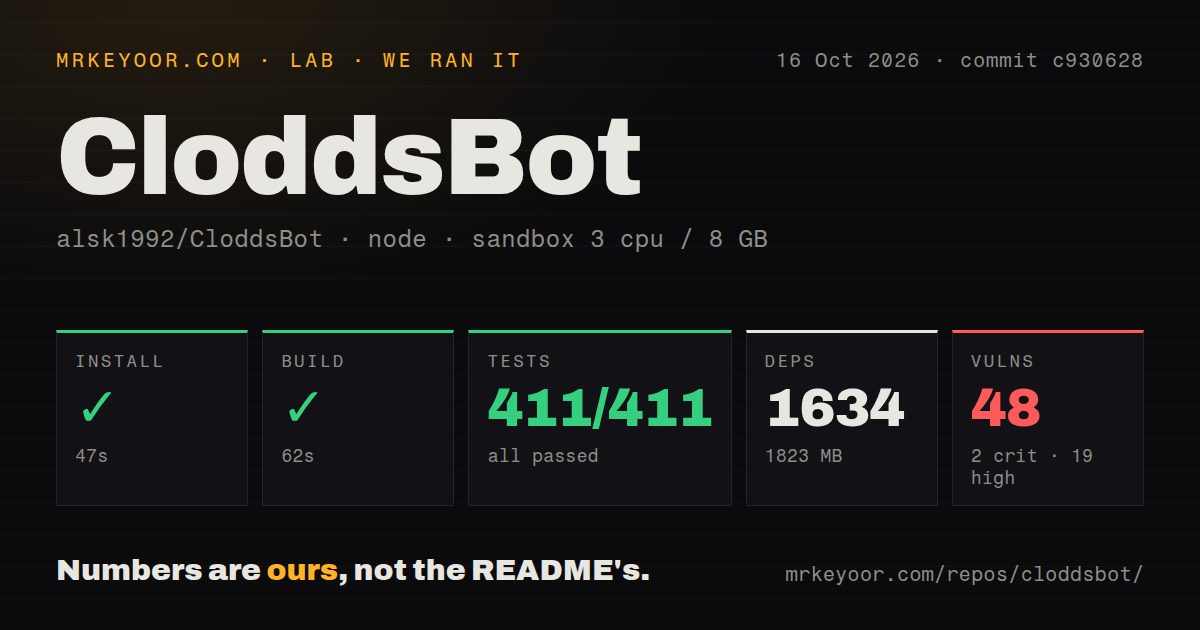
Our run used commit 715fd4a in a fresh, unprivileged Debian container with 3 CPUs, 8 GB of RAM, Node.js 22, and no secrets. Installation succeeded in 80 seconds and pulled 1,686 packages, occupying 1,842 MB. The repository was 12.9 MB, with 827 files and roughly 307,375 lines of source, so dependencies dominate the footprint.
The build succeeded in 48 seconds. Tests completed in 18 seconds with 169 passed and 0 failed out of 169. Those are encouraging baseline results on our box. The repository also has 2 CI workflows, a Dockerfile, a compose file, and a tests directory. We did not measure trading accuracy, order latency, backtest quality, or live venue reliability, so none should be inferred from the green build.
The serious finding is dependency security. npm audit reported 69 known vulnerabilities: 1 critical, 46 high, 22 moderate, and 0 low. An audit count does not establish exploitability, but financial software deserves a strict threshold. Before supplying exchange keys or wallet permissions, inspect affected dependency paths, identify which reach runtime code, apply fixes, and rerun tests and the audit.
Breadth is the clearest strength
Few open-source terminals put prediction markets, centralized exchanges, and on-chain venues under one conversational interface. CloddsBot lists 10 prediction platforms, including Polymarket, Kalshi, Betfair, Drift, Manifold, and Metaculus. Crypto coverage spans spot, perpetual contracts, Solana services such as Jupiter and Raydium, and EVM routes such as Uniswap V3 and 1inch. One place to query positions and compare markets could reduce tool switching substantially.
WebChat offers conversation organization, search, extracted artifacts and code, paginated history, and automatic context summaries using the last 20 messages plus an earlier recap. SQLite handles local state, LanceDB supports semantic memory, and PostgreSQL is listed for analytics. The 10-language claim and 21 channel integrations support varied access, although each channel adds another credential and security boundary.
There is thoughtful machinery around control. The README lists circuit breakers, daily loss limits, a kill switch, VaR and CVaR calculations, stress testing, and Kelly sizing. Backtesting covers historical data, stop-loss and take-profit validation, and profit-and-loss analysis. These features provide places to enforce policy, but we would still require read-only mode, paper trading, and small-value testing before granting order permissions on any of the 16+ execution platforms.
Security and complexity are the main rough edges
CloddsBot asks one process to hold significant trust: AI credentials, messaging tokens, exchange access, wallet interaction, chat history, and analytics data. The README mentions a 75-rule code scanner, 70+ known scam addresses, token checks, and pre-trade validation. Those defenses do not cancel the npm audit result or configuration mistakes. Use a dedicated unprivileged account, isolate network reach, avoid withdrawal permissions, and keep every credential narrowly scoped.
The product surface may outpace what a small team can verify continuously. Supporting 10 prediction platforms, 7 futures exchanges, multiple chains, 8 AI providers, 4 specialized agents, and 18 tools creates many failure combinations. APIs change, chain transactions are irreversible, and conversational instructions can be ambiguous. Treat each connector as a separate deployment gate, with its own dry run, limits, logging, and rollback plan.
Recent activity is healthy, but support quality remains unclear
The repository has 1,336 stars and 31 open issues. Release v1.9.0 landed on August 31, 2026, and the last push followed on September 1, only 9 days before this review. Together, those dates show current maintenance. The supplied data does not show historical release intervals, issue response times, contributor count, or issue types, so it cannot establish community responsiveness.
It fits best beside existing controls
In a real stack, start CloddsBot as a self-hosted research interface, not as the final authority over funds. Feed it market queries, alerts, portfolio views, and backtests. Next, enable 1 venue in paper or read-only mode and record every proposed action. Consider restricted execution only after repeated review, with external account limits and the built-in kill switch as separate layers.
Compared with Freqtrade, Hummingbot, or Jesse, CloddsBot trades a narrower, code-centered workflow for a much broader conversational surface. Choose it when prediction markets, MCP, cross-chain tooling, and chat channels belong together. If you need only a crypto strategy loop or market-making engine, a focused alternative will be easier to understand and secure. The successful 169-test run earns CloddsBot an evaluation; the 69 audit findings keep it out of unsupervised production today.