Choose it for the role content
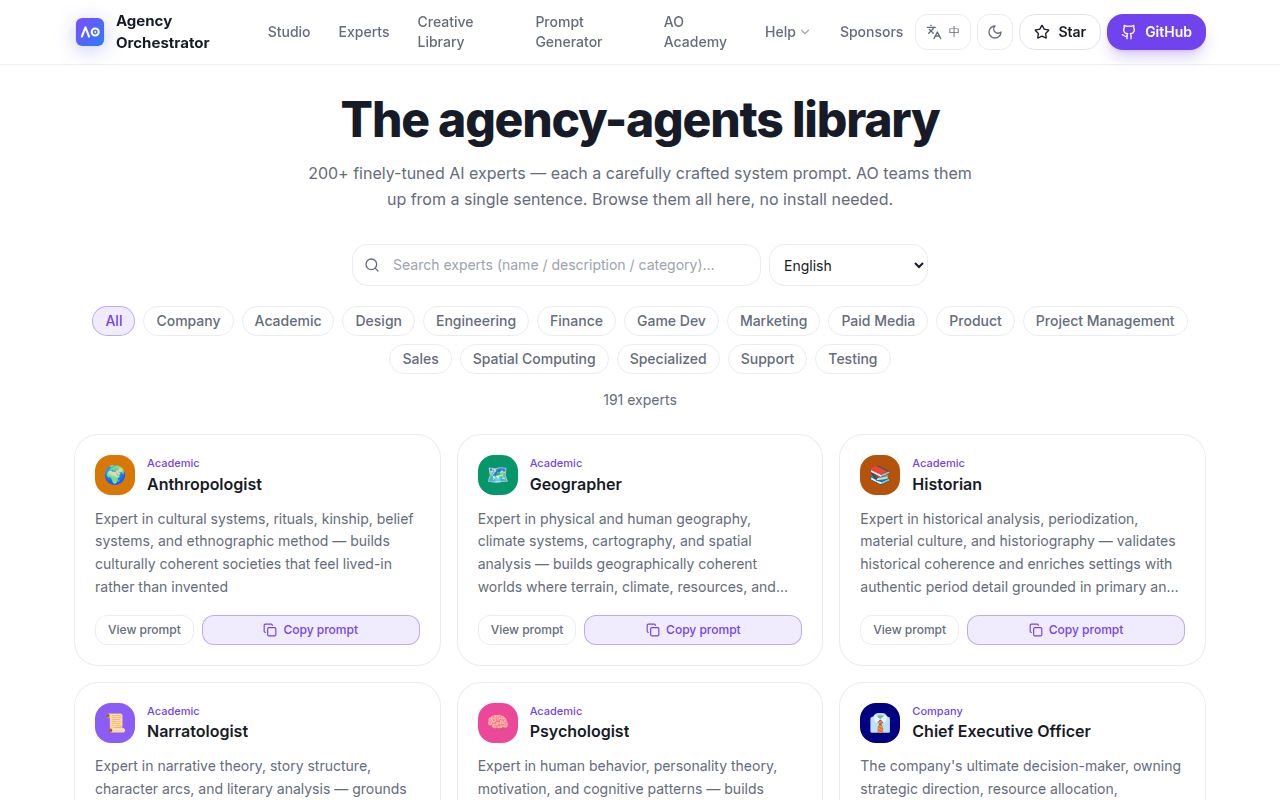
agency-agents-zh gives Chinese-speaking teams role definitions they can inspect before putting them into an AI assistant. Its practical appeal is the range of Chinese platform and business contexts: Xiaohongshu operations, Douyin strategy, WeChat, Feishu and DingTalk integrations, industrial Qt work and other specialist tasks.
The supplied current README reports 328 roles across 22 departments, comprising 261 upstream translations and 67 China-market originals. These are project-reported counts, not a role inventory we independently verified. The README describes each role as having an identity, rules, workflows and deliverables. Those descriptions help readers choose material to adapt; they do not establish the quality of its outputs.
Agency Orchestrator is promoted alongside the repository as an orchestration engine. Keep that separate from the role library when deciding what to install and what this review demonstrates.
Current documentation and our measured checkout differ
Our recorded run took place on October 16, 2026, at commit e5a6c0a730878aaa871ec5b95859aec2c2728475, whose recorded commit date is October 8, 2026. The README at that commit advertised 277 roles across 20 departments. Its scale table listed 213 translations and 64 originals, while introductory and later prose said 63 originals. That discrepancy prevents treating every historical count as a reconciled inventory.
The supplied current README consistently reports 328 roles and 67 originals in its headline and scale table. Our sandbox results apply to the recorded checkout, not to that newer catalog. The page's retained version label, v1.2.6, is also separate from the commit used for the run.
What our recorded run established
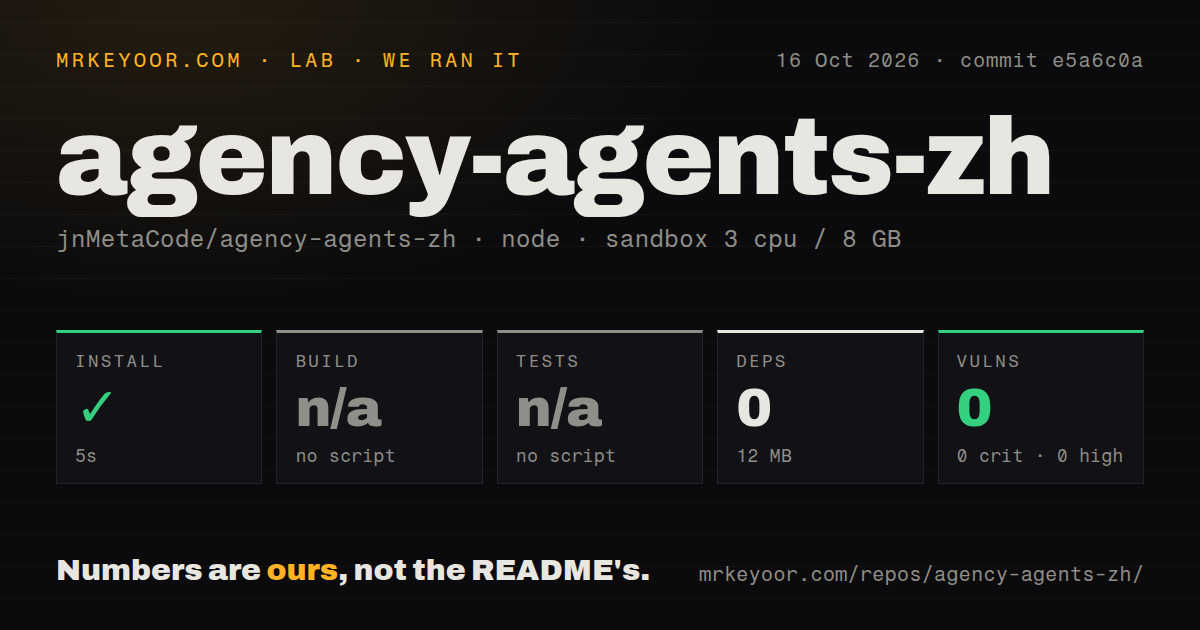
The recorded configuration was 3 CPUs, 8 GB of memory and image lab-node:22. The image label does not establish the actual runtime version. The repository measurement lists 366 files, approximately 2,645 lines of source and 6.9 MB; the harness detected 4 CI workflows.
The dependency setup step finished with exit code 0 after 5,274 ms, rounded to 5 seconds in the summary. Its retained log includes an npm ci error explaining that a suitable lockfile is required, followed by successful npm output. The summary records 0 dependencies and a 12 MB installation measurement. It does not establish dependency downloads, a working installed binary or successful placement of role files into a coding assistant.
The build and test steps were skipped because the harness found no corresponding scripts. These were not failed product tests. The detector did find a check:counts script, and the README documents a separate lint-agents.sh format check. We have no recorded result for either check, so the skipped npm test step cannot support a claim that the repository has no validation mechanisms.
npm audit recorded 0 advisories. Audit coverage is unknown, and this result does not establish that the role instructions, integrations or advertised services are safe. No role workload, model response, desktop client, orchestration workflow or integration compatibility was measured. The stored parser summaries also do not establish exhaustive test coverage.
Setup depends on how you want to use the files
The current README describes browsing and adapting role text, copying files into supported tools, using conversion and installation scripts from a cloned checkout, and obtaining role content through npm. It explicitly says the npm package does not automatically modify AI-tool configuration.
The README advertises 20 tool integrations. It says Claude Code and GitHub Copilot can use the role files directly, while other listed tools require conversion first. That is a documented installation path, not compatibility verified by our run.
For a first evaluation, choose one role with a deliverable you can judge. Read its instructions, follow the documented path for your tool, and confirm that the tool actually loads the intended definition. Then compare its output with the same task given to your usual prompt. These are recommended next steps, not tests we performed.
The README also promotes desktop and online options. Neither was evaluated in our recorded run, so their advertised convenience does not affect our setup rating.
Where the library fits
This edition is worth considering when the Chinese instructions and local platform vocabulary match recurring work. A specialist title alone should not decide the choice: inspect whether the file asks for the evidence, constraints and deliverable your task needs.
For legal, financial or medical work, require review by someone qualified to assess the result. Our evidence contains no measured accuracy for those roles. Likewise, the presence of security-related personas does not establish enforcement of permissions or protection against unsafe actions.
The supplied README includes sponsor offers and companion products. Their pricing, availability and service claims are outside this review's measured scope.
Alternatives with a narrower reason to choose them
Agency Agents upstream is the original English-language collection. Its README describes agent files containing identity, workflows, technical deliverables and communication guidance, and invites readers to copy or adapt them. Choose it when you prefer the upstream English definitions. Chinese-platform roles also appear in its supplied roster, so localization should not be read as proof that those subject areas exist only in this edition.
Awesome Claude Code Subagents describes specialized Claude Code assistants for development tasks. Choose it when that specific environment and task focus fit your needs. We did not compare the output quality of either alternative with agency-agents-zh.
How to read the scores
These are editorial evidence ratings, not benchmark results. The scale is 1 for insufficient support, 2 for limited support with major gaps, 3 for useful documented support with material verification gaps, 4 for strong support with narrower gaps, and 5 for extensive corroboration within the stated scope. Community ratings concern evidence of participation and support, not star totals alone. Unknowns lower confidence rather than proving a product defect.
The setup and documentation scores reflect concrete instructions with unverified execution. Community evidence shows contribution instructions and contact channels, but does not establish response quality. Maturity remains provisional because the recorded run did not evaluate role behavior or integration reliability.
Choose a few relevant definitions and evaluate their outputs before expanding the selection. That is the useful next step the catalog supports; its size does not answer whether a role improves your work.