Choose the app before estimating the work
Awesome Generative AI Apps advertises a shared SaaS foundation, but the measured voice folder has different requirements. The root README describes Next.js, PostgreSQL, Google login and Stripe billing. The AI Voice Agent guide names Python 3.11 and Deepgram plus OpenAI keys. Choosing a catalog entry therefore comes before estimating its setup and operating work.
The catalog groups applications by task and provides folder links alongside links to original repositories. Use those tables to shortlist an idea, then follow the selected app's source link. The root's claim of 50 complete AI SaaS products is the author's description, not a collection-wide finding from our sandbox.
What happened when we ran it
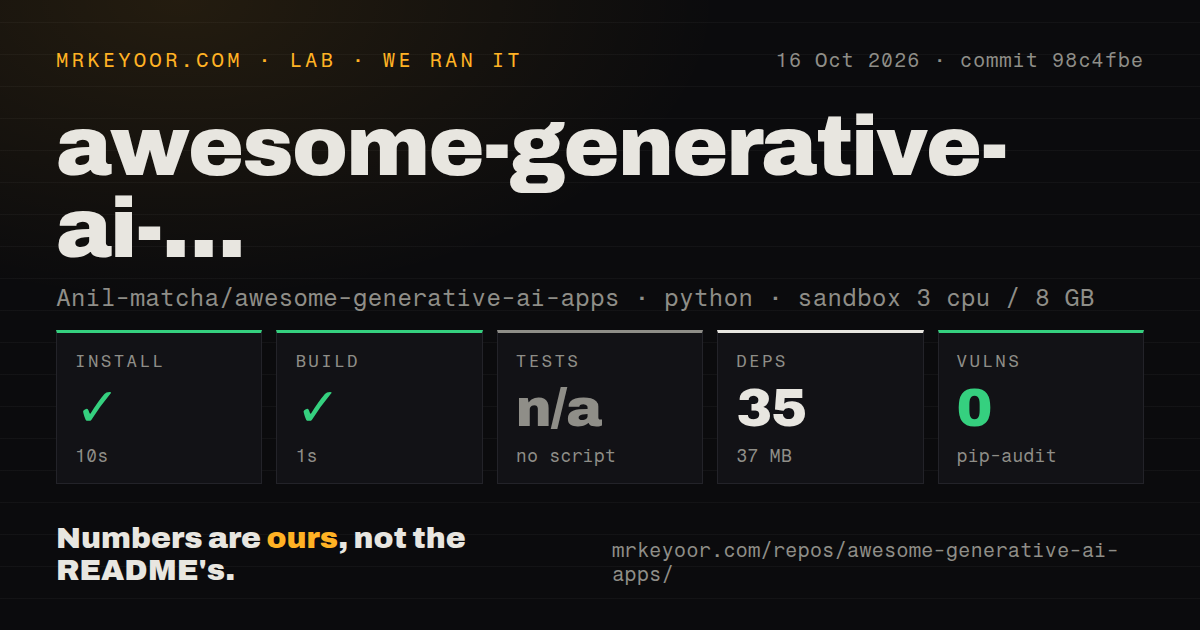
On October 16, 2026, our sandbox installed ai_agents/AI-Voice-Agent at commit 98c4fbe in 10 seconds, recording 35 dependencies and 37 MB on disk. The build completed in 1 second. These results establish that the selected Python example completed the lab's installation and build steps.
Tests were skipped because the harness found no test script or target. The scan recorded 0 CI workflow files, no Dockerfile and no tests directory. The supplied results contain no measurement of conversational accuracy, latency, interruptions or recovery from provider errors.
Pip-audit reported 0 known vulnerabilities. However, the harness recorded audit.packages=0, so the report does not establish confirmed audit coverage of all 35 dependencies. Treat it as a reported result with unresolved coverage.
The checkout contained 2,311 files, approximately 187,248 source lines and 191.2 MB of material. The recorded sandbox configuration was 3 CPUs and 8g RAM, using image ghcr.io/astral-sh/uv:python3.12-bookworm. Actual runtime and operating-system versions require the raw toolchain logs. GitHub's October 24, 2026 metadata snapshot lists JavaScript as the repository's primary language; the lab classified the selected folder as Python.
The voice guide and root quick start describe different setups
The AI Voice Agent guide requires Python 3.11 and Deepgram plus OpenAI keys. It directs readers to configure those keys in .env, create a virtual environment, install requirements.txt and run app.py. These are documented instructions, not additional steps verified by this correction or evidence of successful live calls.
The root quick start tells readers to clone a selected template, configure database access and authentication, add Stripe and MuAPI credentials, then initialize the database. That recipe should not be treated as the voice folder's setup guide.
Before adopting an app, record its original repository, required accounts and acceptance criteria. For a voice service, include representative conversations and provider failures in your evaluation. For an app that sells credits, check payment events, balance updates and failed generation requests. These are recommended checks, not defects demonstrated by the sandbox run.
The commercial pitch remains unverified
The README presents the templates as products readers can rebrand and launch over a weekend. It also includes illustrative headshot revenue and margin calculations. The supplied measurements establish no customer revenue, operating margin or delivery schedule.
Estimate provider usage and support costs for the selected app before setting a price. Check its license and decide whether you will maintain the included folder or the linked original repository. The catalog's commercial framing does not answer those ownership questions.
October activity concerns the catalog
The GitHub metadata snapshot observed on October 24, 2026 records an October 22 push and 3 open issues and pull requests. A verified October 21 pull request proposes adding Spaceora, an AI room and garden designer; its author discloses being on the Spaceora team.
Those records show repository activity and a proposed catalog addition. They do not establish support quality, response times or maintenance of the voice example. Inspect the selected application's own changes and issue discussions before relying on it for a commercial fork.
Alternatives for a narrower starting point
Open SaaS documents a Wasp-based template with authentication and payment integrations. Consider it when you have chosen the product idea and want a SaaS foundation to evaluate.
Vercel Chatbot is a chatbot template built with Next.js and the AI SDK. Consider it when chat is the product and you want a focused application to inspect. Neither alternative was measured in this sandbox run.
Use Awesome Generative AI Apps to choose an example, then evaluate that codebase on its own requirements. For the voice folder, the next useful step is a representative conversation evaluation: installation and build results leave that behavior unanswered.