Airbyte standardizes source-to-destination syncs
Airbyte gives data teams one place to configure a source, destination, streams, schedule, and sync mode. Connectors handle authentication, schema discovery, pagination, incremental state, and destination writes. The platform records runs and exposes failures through its interface and API. This is attractive when the alternative is maintaining separate scripts for every SaaS API and database, each with its own retry and checkpoint conventions.
The repository advertises more than 600 connectors, but the number is a catalog size rather than a quality guarantee. Our checkout had 16,845 files and about 560,992 source lines, spread across connectors, platform code, documentation, and supporting tools. Evaluate the exact source, destination, stream, and connector versions a pipeline needs. A mature PostgreSQL path says little about a newly rewritten niche SaaS connector.
Connector state is where correctness can fail quietly
Incremental syncs depend on cursors and state that survive between runs. A connector must interpret pagination, late records, deletions, schema changes, rate limits, and API quirks without losing or duplicating data. Airbyte provides the protocol and shared development kits, though each connector still encodes source-specific behavior. A green platform health check cannot prove that a connector emitted every expected record.
Issue 85049 gives a precise example in the Slack source. Above 10,000 thread partitions, the report says a state migration ignores the global-cursor shape and resets the read window, turning later syncs into expensive history crawls. Issue 76465 reports the opposite failure in Chargebee: a successful full refresh silently missed subscriptions. These are different bugs with one lesson. Monitor record counts, cursor movement, source API calls, and destination invariants.
What happened when we ran it
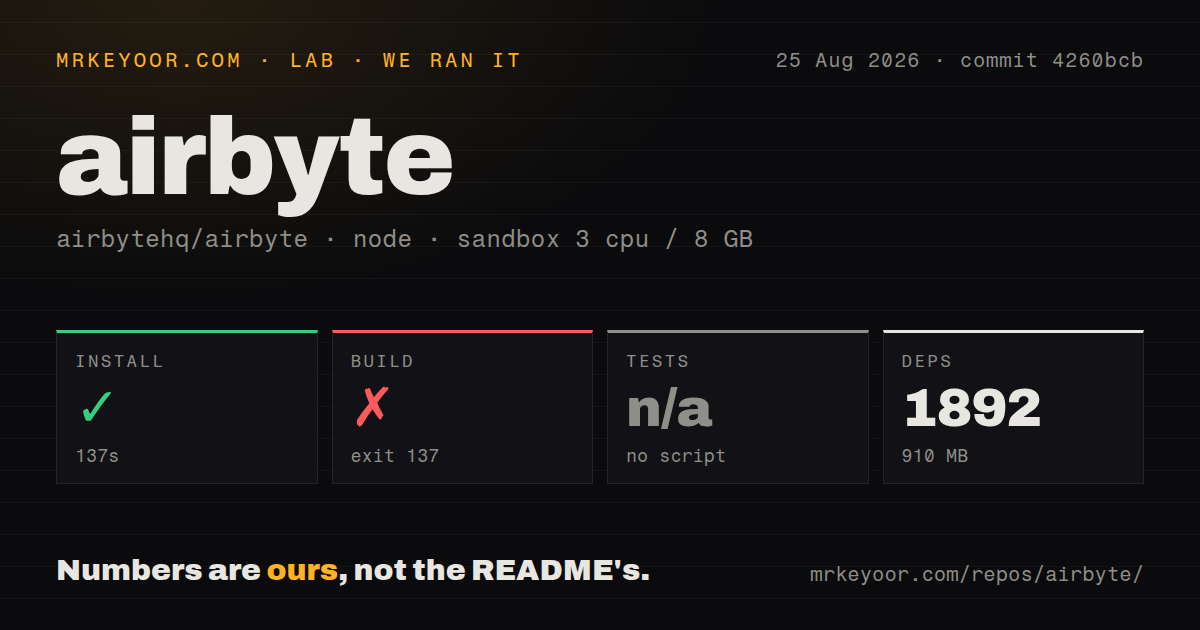
We cloned commit 4260bcb into an unprivileged Node 22 container with 3 CPUs, 8 GB of RAM, and no secrets. The checkout occupied 914.4 MB and contained 16,845 files with roughly 560,992 source lines. Our harness found 85 CI workflow files, no root Dockerfile, and no root tests directory. It selected the pnpm documentation project under ./docusaurus/.
Installation completed in 137 seconds. pnpm added 1,892 packages and used 910 MB on disk. The build generated API reference pages, downloaded a schema, and began Docusaurus's optimized production build. After 179 seconds the final output printed Killed, and pnpm reported exit code 137. The supplied log does not say whether memory, an external signal, or another condition killed it.
The workspace had no test script or target, so our harness skipped tests. That is neither a pass nor a repository-wide absence of testing: the checkout contained 85 CI workflow files across many subsystems. Our result applies only to the docs project chosen by the Node harness. We did not deploy Airbyte, run a connector, move records, or test the control plane, and the review does not imply that we did.
Self-hosting is a Kubernetes operation
Airbyte's open-source quickstart now leads to a platform deployment rather than a small local library. The 2.0 release requires a current abctl for that upgrade path and says newer versions move fully to Helm chart V2. A real installation needs cluster resources, persistent state, ingress, access control, source and destination credentials, and a place for connector jobs to run. Backups and upgrade rehearsals matter because sync state is operational data.
Cloud is the simpler buying choice for teams that do not need to own the control plane. Enterprise Flex places managed control and customer-run data planes between the two. The correct option follows data sovereignty, networking, and staffing, not ideology. Our 910 MB docs dependency tree is separate from deployment sizing, yet it illustrates how broad the project has become. Contributors should narrow their checkout work to one component before trying full-repository tasks.
Connector upgrades need data tests
Airbyte can pin connector versions, which is important because connector behavior can change independently from the platform. Issue 82729 reports Redshift destination version 4.0.3 converting empty source strings to NULL after a rewrite, breaking downstream non-null expectations. The reporter's workaround was to roll back. A normal unit test around row counts would miss that semantic change unless fixtures include empty strings and destination constraints.
Build reconciliation around business facts: source and destination row counts by date, uniqueness, nullability, money totals, deletion behavior, and late-arriving records. Canary a new connector version on copied data before upgrading a production connection. Keep the old image available for rollback. Airbyte reduces connector implementation work, but the team that owns the data still owns proof that a successful sync preserved its meaning.
The main branch is active despite an older platform release
GitHub recorded a push on August 26, 2026, and same-day connector reports show an active tracker. The latest GitHub release marked v2.0.0 was published in October 2025, but a stale tag alone is not evidence of abandonment. The repository showed 2,355 open issues and pull requests combined, a large queue that reflects platform work plus hundreds of connector surfaces. Filter activity by the components you intend to run.
Licensing also needs component-level review. The README displays MIT and ELv2 badges rather than promising one license for the whole checkout, then points to a license file and FAQ. Airbyte earns its place when its connector breadth removes a continuing maintenance burden and the team can validate results. If you need three stable sources and have strong Python ownership, a smaller code-first pipeline may be easier to reason about.