A 33-stage engine puts gates around agent-written software
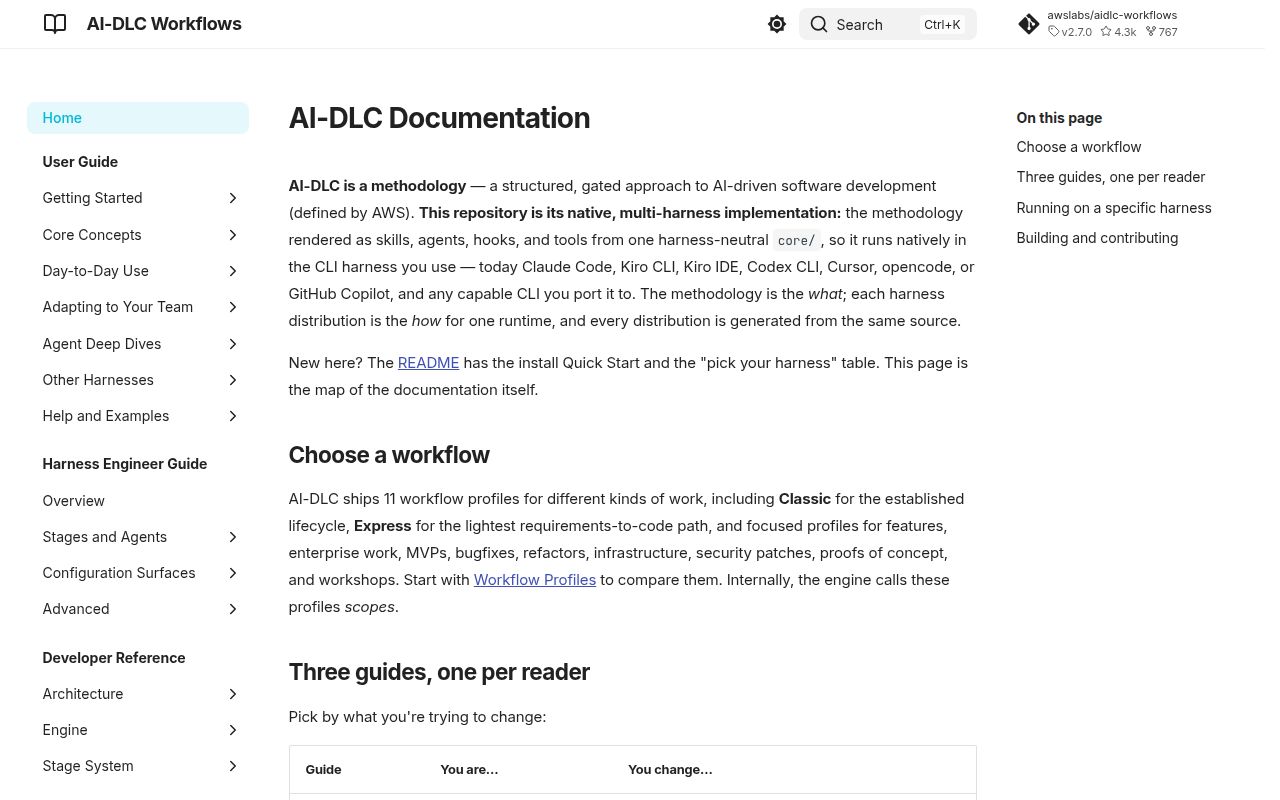
AI-DLC Workflows turns an AI coding session into a persisted project process. Its 5 phases cover initialization, ideation, inception, construction, and operation, with 33 possible stages and human approval points. The repository supplies 14 agent roles, including domain specialists, reviewers, and a workflow composer. Teams can select 1 of 11 scopes and set separate depth and test-strategy levels, so a bug fix does not have to travel through every product-planning artifact.
The attraction is continuity. Decisions, questions, state, artifacts, and corrections live under an aidlc/ workspace instead of disappearing in chat history. A two-tier knowledge system separates the shipped method from team-managed rules. Resume, redo, and stage-jump commands work from recorded checkpoints. That can help when a task spans people or sessions. It also changes the repository: AI-DLC state and shared records become part of normal review, versioning, and cleanup.
Seven harnesses share one generated core, but installation differs
Version 2.7 supports 7 named surfaces: Kiro IDE, Kiro CLI, Claude Code, Codex CLI, Cursor, opencode, and GitHub Copilot. Maintainers edit a neutral core/ plus thin harness adapters, then generate committed dist/ trees. Users copy the matching tree into a project. That avoids separate methodology forks, although each assistant still has its own discovery rules, hook format, permission model, login, and model provider.
Bun is the common runtime. The Codex route requires version 0.145.0 or newer, a Git repository, copied .codex and .agents folders, an AGENTS.md merge, and trusted hooks. Claude Code and the supplied Codex configuration use AWS Bedrock, so they also need model access, a region, and credentials. Kiro, Cursor, opencode, and Copilot use their own configured provider paths. A doctor command verifies files, but it cannot approve cost or permissions for the team.
What happened when we ran it
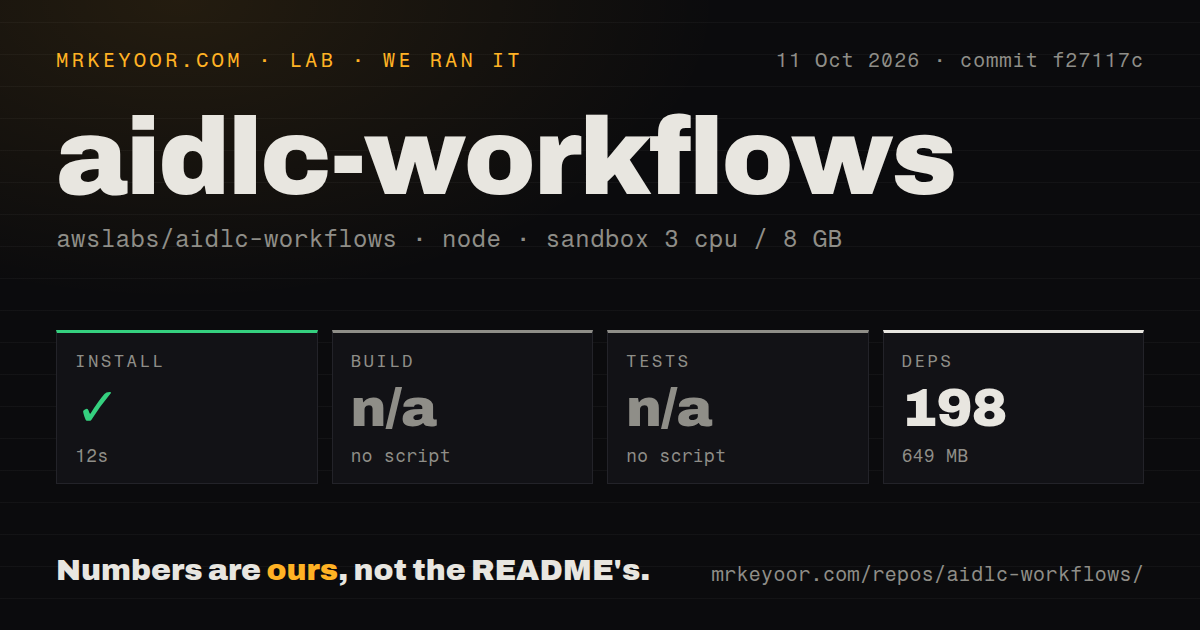
Our sandbox installed 129 packages in 124 seconds and consumed 698 MB. We tested commit a277af2 in an unprivileged container with 3 CPUs, 8 GB of RAM, no secrets, and the lab's Node 22 image. The repository itself contained 1,174 files, about 356,238 source lines, and occupied 19.3 MB before dependencies. Installation succeeded, so the dependency layer was obtainable in that fresh environment.
The lab found no build script or target, so it skipped the build. It also found no test script or target and skipped tests. We did not substitute a command or claim a pass. The checkout does contain a tests directory and 8 CI workflow files, while the README documents custom Bun test commands. Those repository signals do not change our measured result: this run produced neither a build outcome nor a test count that a buyer can use as confirmation.
Ninety-one audit events buy traceability at the cost of more state
The audit model defines 91 event types for workflow activity, approvals, reviews, state changes, and agent attribution. Verification gates check links between artifacts before later phases use them. Construction can run units in worktrees or independent clones, and a ladder prompt lets the user keep later stages gated or permit more autonomous progress. Failures still stop the flow. This is a much stricter contract than a prompt file that asks an agent to write tests.
Strict state also creates failure modes of its own. The troubleshooting guide covers missing PATH entries, untrusted hooks, stale plugin state, and provider access. Upgrades replace a complete harness distribution while no workflow process is running, followed by plugin synchronization and, for Codex, renewed hook trust. Teams need to decide which generated records belong in Git and which machine-local cursors stay ignored. That maintenance is justified only when the resulting evidence will be read.
Issue 999 shows an approved mockup can miss code generation
Open issue 999 traces a real 11-of-33-stage run where a saved-segments list was approved above a builder but appeared below it in generated code. The report says mockup artifacts had no declared construction-stage consumer, and the layout detail survived only when another text artifact happened to repeat it. That is exactly the kind of gap an auditable method is meant to prevent. Until the dependency chain is fixed, teams should verify UI decisions against generated screens rather than trust the stage receipts alone.
Other reports expose platform edges. Issue 989 says 4 tests fail on a clean v2 checkout on macOS. Issue 984 asks for a first-class uninstall path, which matters because installation merges several project-owned files. The recent queue is not dormant: maintainers closed issue 995 about a plan-approval deadlock on September 2, and commit a277af2 carries that fix. Active repair is good evidence of maintenance, while the number of fresh workflow bugs argues for a pilot before organization-wide use.
Version 2.7.0 shipped two days before the September 3 push
GitHub listed 4,300 stars, 94 open issues, 34 open pull requests, and a last push on September 3, 2026. Release v2.7.0 arrived September 1 with support for existing requirement documents, shorter Classic and Express paths, bounded build-and-test recovery, and updates across all 7 harnesses. The main README labels the implementation 2.7.1, so users should pin a known-good revision as the project itself advises. The dated activity and quick fixes point to a maintained but fast-moving system.
AI-DLC is easiest to justify where evidence has a real consumer: a compliance review, a handoff across teams, or a long project that repeatedly loses context. Its files and gates can make an agent's decisions inspectable. They cannot guarantee that every artifact reaches code or that every harness behaves alike. Our missing test outcome, the 698 MB install, and the current issue reports make a limited trial the sensible entry point, with human review kept exactly where the README requires it.