Should you use OpenShell?
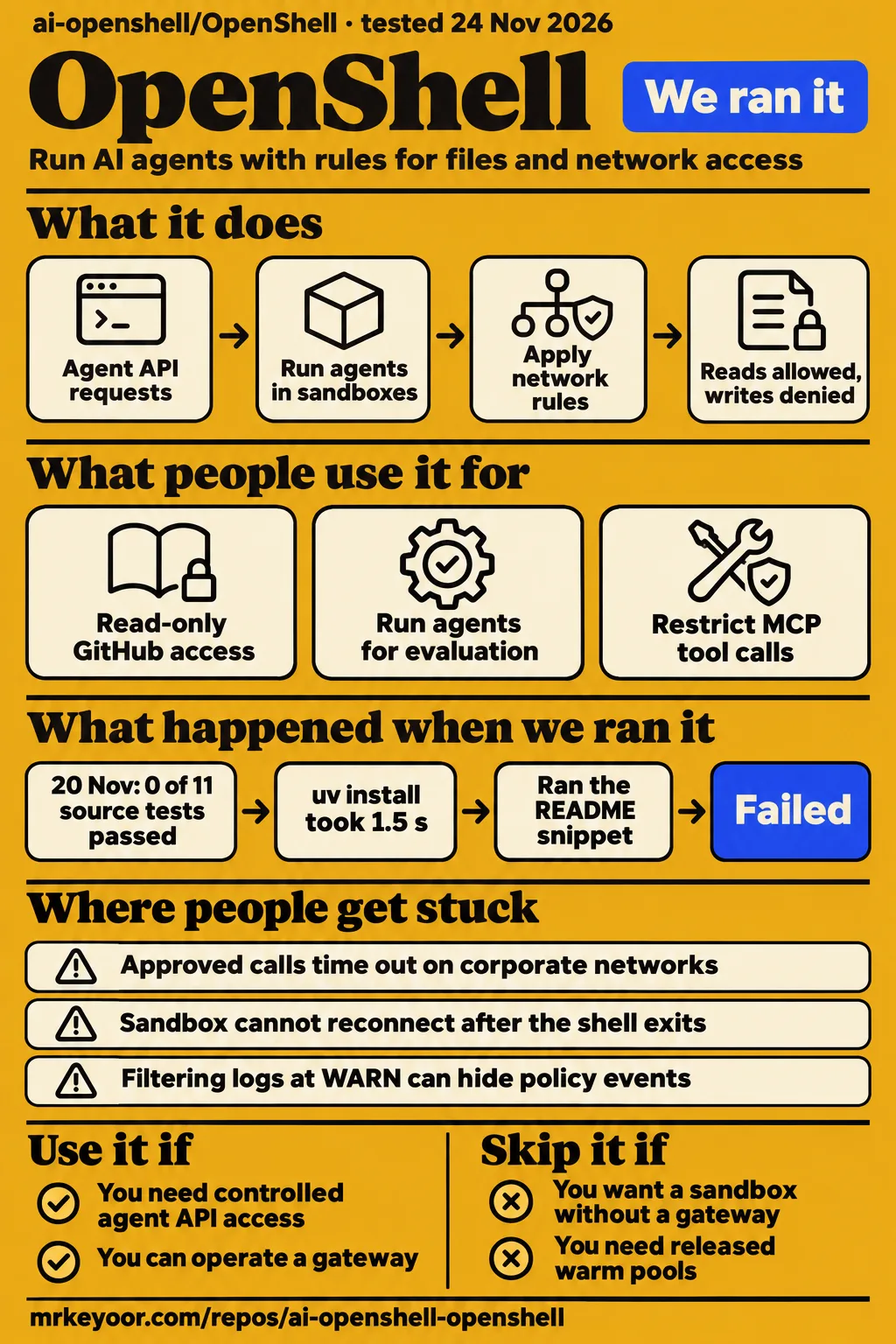
Our OpenShell source check installed successfully in 18 seconds and built in 1 second, then pytest finished with 4 failures and 7 errors. Use it if you operate agents that need narrowly controlled API access and you can own a gateway and its compute driver. Skip it if you want a quick laptop sandbox without a separate control service: Josh from Better Stack recommends Anthropic's lighter sandbox runtime for that job in his OpenShell walkthrough.
OpenShell is an open-source runtime for AI agents, separate from the Windows Open-Shell Start menu utility. Its most useful demonstrated distinction is simple: let a process read GitHub while preventing it from creating an issue on GitHub. Josh demonstrated that sequence on a Mac, including a network-policy update without restarting the sandbox. That is a reason to consider the platform if a host allowlist gives your agent too much authority, rather than a reason to move every local script into it.
What people use OpenShell for
Josh from Better Stack demonstrated denied filesystem writes and read-only GitHub access; other users are extending the runtime for evaluation and corporate networks.
| Who used it | What they did | What happened |
|---|---|---|
| Josh from Better Stack | Tried writes outside permitted paths, then GitHub API requests | Writes were denied. After a policy update, a GET worked and an issue-creation POST was denied in his Mac demonstration. |
| ralphbean, working on fullsend | Ran sandboxed agents against external services using ephemeral GitHub repositories | The approach works, but the author calls it slow, expensive and dependent on GitHub availability in issue #1733. |
| kevin-pedretti | Tried a contributor branch with a corporate web proxy and custom certificates | The branch worked in that environment after the user located the gateway configuration, according to issue #1792. |
| rhuss | Connected a contributor revision to Collector and Tempo, tools for collecting and viewing traces | On Podman at revision 3fae097a5, denial records carried trace identifiers that resolved in Tempo in issue #2640. |
The evaluation case is particularly useful if you build agents rather than simply run one. ralphbean wants fixed mock responses so an evaluation measures the agent's decisions without creating throwaway repositories or relying on a live API. The thread records that request and a suggested redirection approach. It does not report delivery of the requested mock-response workflow. Keep that distinction when choosing an evaluation harness.
What happened when we ran it
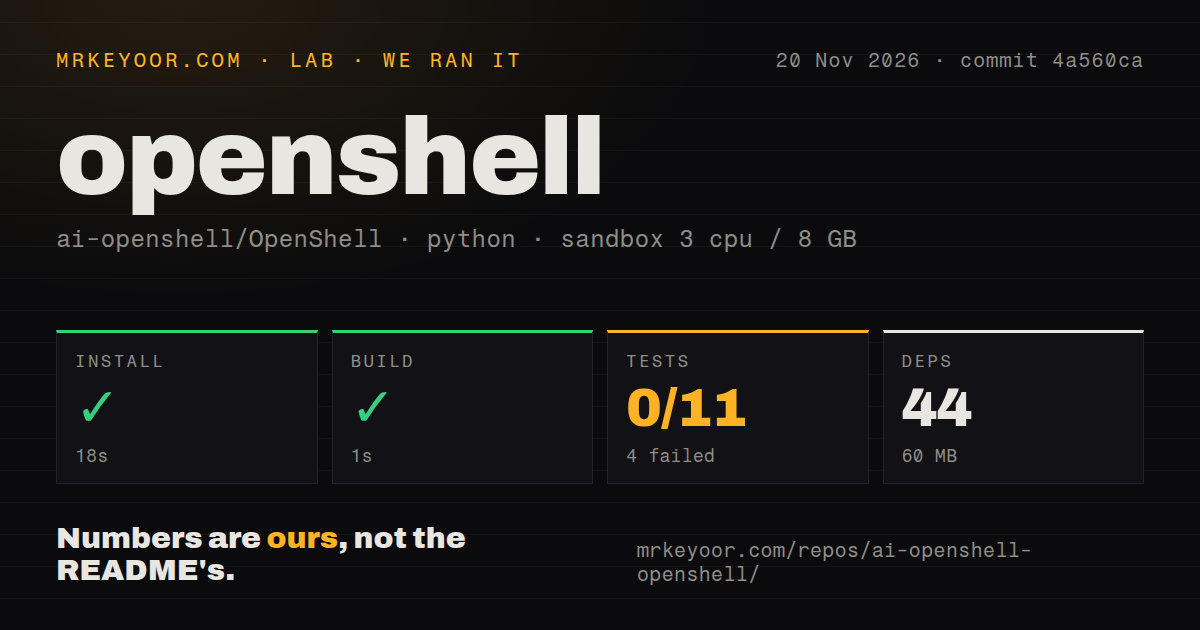
In our November 20 source run, installation took 18 seconds and the build took 1 second, then the test command exited 1 after 2 seconds with no passing tests. These are repository checks at commit 4a560ca, not elapsed times for starting an agent sandbox.
| Recorded step | Result | What the result covers |
|---|---|---|
| Install | Succeeded in 18 seconds | 44 dependencies recorded; 60 MB on disk |
| Build | Succeeded in 1 second | The recorded build step completed |
| Tests | Failed, exit 1, in 2 seconds | 0 passed, 4 failed, 7 collection/setup errors of 11 |
Our measurement setup used a sandbox with 3 CPUs and 8 GB RAM, with image label ghcr.io/astral-sh/uv:python3.12-bookworm. That label identifies the requested image; actual runtime and operating-system versions require the raw toolchain logs. The scan found a tests directory and 57 CI workflow files, but no Dockerfile. Those are checkout observations, not an inventory of every upstream deployment artifact.
Installation completed, then the build step completed. Pytest stopped us: its summary said collected 4 items / 7 errors. Both parameterized package-relative binding cases in python/generate_python_proto_test.py failed with subprocess.CalledProcessError. The displayed command is truncated, so the tail gives us neither its complete arguments nor the underlying subprocess error.
The synchronous and asynchronous cases in python/grpc_typing_test.py were more explicit: the interpreter returned No module named ty. Collection/setup errors also named python/openshell/openshell_test.py, providers_test.py, sandbox_cleanup_test.py and sandbox_test.py. The footer reported 4 failed, 1 warning, 7 errors in 0.54s; that is pytest's duration, while 2 seconds is the recorded outer test step. The missing module is an observed failure, not a complete diagnosis of every error.
A separate November 24 SDK-only check, at commit 152c59d31780, attempted to find a runnable Python example in the README. The snippet step failed because the README had no Python code block to run. That is a failed example-discovery step, not an agent crash. The run's teardown completed successfully. Its SDK-only procedure is separate from the source checks in the table.
Where people get stuck: gateway state, proxies and shell lifetime
A policy can allow a request while the connection still fails: issue #1792 describes the supervisor trying to reach the destination directly on a network that requires a corporate proxy.
| Symptom and source | What the report supports | Useful action |
|---|---|---|
| Approved external calls time out, issue #1792 | Contributor branches address proxy chaining and custom certificates; kevin-pedretti reports success on one branch. | Check the supervisor's proxy configuration and whether its CA bundle is reachable from the Podman VM. |
| CLI and interactive terminal disagree, SufficientAbility821 on r/artificial | The user switched to MicroVM and later reported policy-fetch failures and inability to restore working state after reboot. No successful fix is reported. | A commenter suggests matching one failing operation against gateway and engine logs, including the container ID and exit code. |
| Tutorial sandbox cannot reconnect after the shell exits, first-network-policy tutorial | Exiting stops the main process; the default restart policy leaves it unavailable for reconnection. | Keep that shell open and apply policy from a second host terminal; use --no-keep for deletion on exit. |
| Denials vanish from a WARN-filtered log stream, the same tutorial | Policy events are INFO-level records regardless of severity. | Retain INFO policy events in your audit pipeline. |
The workstation report deserves a careful reading. SufficientAbility821 says the same sandbox definition worked once and then failed when its supervisor requested policies from the gateway. After reboot, the user says they could not recover the previous working state. They suspect a mismatch between persisted gateway data and engine state. That is the user's hypothesis; the thread contains no confirmed database diagnosis. Deleting state on that basis would turn an investigation into a different problem.
For corporate networks, the successful branch report is encouraging precisely because it names a configuration detail: the custom certificate bundle had to be accessible inside the Podman VM. The issue being closed is less useful than that concrete account. Ask whether your chosen release includes the needed proxy path before treating the contributor branch as your deployment instructions.
Repeated sandbox creation exposes a different bottleneck
Issue #2157 asks for Kubernetes warm pools because the described creation path cold-starts sandboxes instead of assigning already prepared ones.
In the warm-pool discussion, manstis says cold-start latency would be unacceptable for their intended use. Other contributors describe proposals and revised pull requests. The issue remains open. One complication is identity: a prestarted workload must acquire the correct sandbox identity when it is assigned. The issue also says certain per-claim environment and volume settings force a cold start, so a pool alone does not settle every creation path.
If you intend to create a sandbox for every short request, make creation and assignment part of your acceptance workload. If the agent stays alive for a long session, those costs enter your decision differently. Neither case can be decided from the source build's 1-second result. Building code and provisioning an execution environment are separate operations.
Security controls need a policy and an audit path
OpenShell's documented network rules reload at runtime, while filesystem and process restrictions are locked when the sandbox is created.
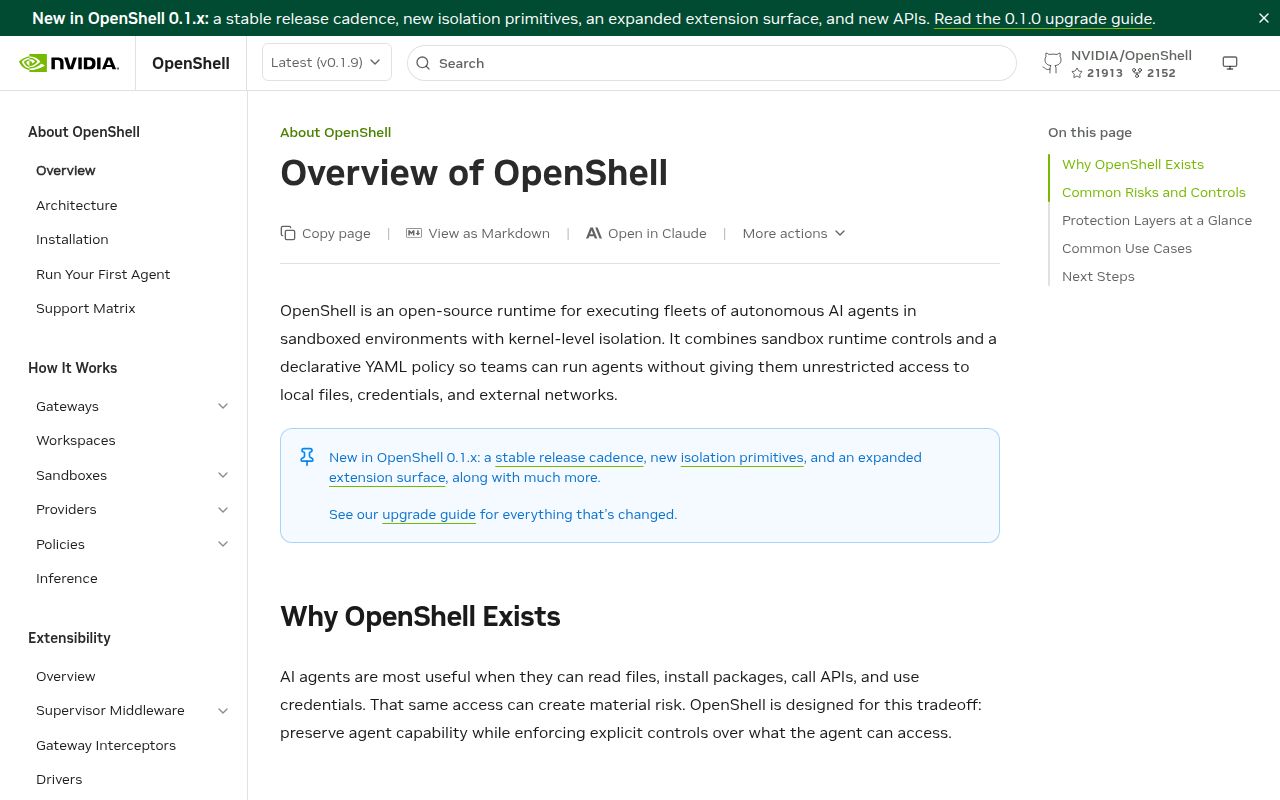
The overview describes filesystem restrictions for declared paths, syscall restrictions for process behavior, and provider profiles that resolve opaque credential placeholders only at authorized endpoints. This is the product's control model. It lets you ask a useful question about an agent: which operation should this particular process be allowed to perform on this destination? The Better Stack GET-versus-POST demonstration gives that question a visible outcome.
Do not confuse logging a denial with being able to follow it into a trace. The current summary of issue #2640 says HTTP correlation has landed, while connection-level correlation at the default log level remains outstanding. rhuss's successful Collector/Tempo exercise used a named contributor revision. That result belongs to that revision and setup, rather than proving the issue's remaining work is complete.
MCP, the Model Context Protocol that assistants use to call outside tools, adds another policy layer. The reporter in issue #1793 built an external governance gateway to restrict tool calls. They say it works but adds latency and deployment complexity and bypasses OpenShell's integrated audit infrastructure. Maintainer discussion directs implementation review toward a generic JSON-RPC parser. A host rule, an HTTP method rule and an individual MCP tool permission answer different access questions.
OpenShell vs Docker Sandboxes, Docker, Nono and hosted sandboxes
OpenShell adds request-level policy to an execution environment; plain Docker isolation alone does not distinguish a GitHub read from an issue-creation request in Better Stack's comparison.
| Choice | Why consider it | Where OpenShell changes the decision |
|---|---|---|
| Plain Docker or VM isolation | You need a boundary around code execution. | Josh's walkthrough shows per-process API permissions above that boundary. |
| Nono | Its author describes a single binary wrapping a local process, with runtime expansion of filesystem capabilities. | The author's comparison contrasts that local-process model with a platform; its March description of OpenShell's drivers is dated. |
| Anthropic sandbox runtime | Josh recommends it for a quick laptop coding sandbox with less setup. | His comparison identifies credential mediation and request policies as reasons to consider OpenShell. |
| E2B or Daytona | The video positions them as hosted disposable code-execution environments. | Josh positions OpenShell as self-hosted and intended for longer-running agents. |
| NemoClaw and OpenClaw | NemoClaw packages a stack for running OpenClaw assistants. | NVIDIA's launch article says that stack incorporates the OpenShell runtime. |
For OpenShell vs Docker Sandboxes, keep the branded Docker Sandboxes product separate from plain Docker. The comparison above explains the demonstrated plain-container distinction. It is not a feature-by-feature test of Docker Sandboxes.
OpenShell vs NemoClaw is a question about layers: NemoClaw uses the runtime, and OpenClaw is the assistant being run. Likewise, the architecture discussion treats gVisor and Kata as possible isolation components beneath policy, rather than automatic replacements for the whole platform. Choose the boundary you need before comparing download commands.
What the other reviews get wrong
Nono's March comparison and Andrew's OpenShell review contain dated details that can send you toward the wrong setup path.
Nono's comparison describes every OpenShell sandbox as a pod in K3s inside Docker. The installation documentation now lists Docker, rootless Podman and MicroVM drivers. The closing update on issue #1737 reports delivery of the Isolation Backend interface, authenticated Sandbox Protocol, separate runtimes and driver integrations. A historical architecture comparison should not decide today's compute choice.
The same comparison's platform table says OpenShell is unsupported on macOS and Windows. The current quickstart lists Apple Silicon macOS and experimental Windows WSL 2. CLI and gateway availability still need to be distinguished from the environment that enforces workload restrictions. Mac support does not mean a native macOS agent boundary.
Andrew's review mixes a newer repository-facts block naming v0.1.9 with a quick-reference table naming v0.1.2 as latest stable. It also lists @nvidia/openshell-sdk; the repository now names @ai-openshell/sdk. Use the repository and release page for those moving details.
There are two further setup corrections. The NousResearch README mirror presents uv tool install -U openshell as a CLI route and says agent tools come in the default sandbox. The installation docs say PyPI provides only the SDK, and the current README says the default image is minimal Ubuntu with no agent installed. NVIDIA's launch article also describes live policy updates broadly; the overview limits that behavior by policy domain, with filesystem and process rules fixed at creation.
Questions people ask
OpenShell is an AI agent runtime; Windows Open-Shell is a separate Start menu utility, which explains many otherwise confusing search results.
What is NVIDIA OpenShell, and how does it differ from the Windows Open-Shell Start menu utility?
NVIDIA OpenShell governs agent execution and access through sandbox policies, according to its overview. XDA's OpenShell review concerns the classic Windows Start menu utility. Windows 7 skins, StartAllBack, Classic Shell and adding skins concern that other project.
Where is the official OpenShell GitHub repository, and how do I download it?
The OpenShell GitHub home is ai-openshell/openshell. The README says development moved there from NVIDIA. For an OpenShell download, the installation guide offers the native installer and direct release artifacts; PyPI supplies the SDK rather than the CLI.
Does OpenShell work on Windows 11, and what requires WSL 2?
The quickstart lists Windows with WSL 2 as experimental and separately points to a native Windows build/runtime guide with limitations. That is the relevant Windows route for this agent runtime, rather than installing the similarly named Start menu utility.
What does the OpenShell gateway do?
The gateway is the control plane for sandboxes, policy and access in the README. SDK applications connect to it; the installer sets up a local gateway alongside the CLI. Installing the Python SDK alone does not supply that running control service.
How does OpenShell differ from NemoClaw and OpenClaw?
NemoClaw is a stack for running OpenClaw assistants that incorporates OpenShell, according to NVIDIA's launch article. OpenShell supplies the governed runtime rather than the assistant's behavior.
How does OpenShell compare with Docker Sandboxes or plain Docker?
Better Stack demonstrates a GitHub GET allowed and a POST denied, a distinction beyond plain container isolation. Docker Sandboxes is a separate comparison target; a direct test of that product belongs in the unfinished work below.
How does OpenShell compare with Open Sandbox?
The search suggestions include this comparison, but the runtime demonstration compares OpenShell with other named choices, not an identified Open Sandbox release. There is no supported winner to recommend from that comparison here.
Can I use OpenShell for VS Code remote development?
Andrew's review identifies an upstream vscode-remote-sandbox.md example. That gives you an example to investigate, rather than a result from our Python source checks.
What exactly does OpenShell protect an AI agent from?
The overview describes controls against unauthorized file access, outbound traffic, provider use and privilege escalation. These protect the resources around an agent by limiting what it can do. They do not grade the truth or usefulness of its answers.
Is OpenShell useful for Claude Code or Codex, or is a container or VM enough?
The overview names both coding agents as supported use cases. Choose OpenShell when the per-request access rule demonstrated by Better Stack is a requirement; the container or VM remains the execution boundary underneath it.
Does the search for OpenShell versus passthrough refer to inference routing or another feature?
The autocomplete result contains that wording without identifying a feature or competing product. It does not justify recommending a passthrough configuration.
What we have not tested yet
Our checks cover source setup and a failed README-example search, not deployed agent containment or production reliability.
We have not tested escape resistance, credential isolation across configurations, or the guarantees of the policy prover. The source run's Python checks do not qualify the Rust runtime, gateway lifecycle or any driver. The exact cause of the binding-generation failures and the seven collection/setup errors needs fuller logs. The later SDK check never reached a runnable Python snippet.
Reboot-and-reconnect recovery is a priority because of SufficientAbility821's report. Corporate proxy coverage needs a versioned matrix covering drivers, custom CAs, HTTPS proxy connections and authentication modes. Audit correlation needs a released-version exercise that separates HTTP records from connection-level denials at the default log level.
There are no cold-start, warm-start, idle-memory or sustained-concurrency benchmarks in our run. We have not tested Docker Sandboxes or an identified Open Sandbox release side by side. VS Code remote development, deterministic mock responses, post-credential auditing and MCP transport/method coverage also need separate runs. For MCP, that means tool names and arguments, parser failures, Streamable HTTP, SSE and messages in both directions, rather than a single successful connection.
Before giving an agent sensitive access, make its first acceptance task concrete: read an allowed API endpoint, attempt a prohibited write to the same service, then find both decisions in your exported logs after reconnecting. That sequence tests the permission you intend to rely on.