511 lessons cover math through production agents
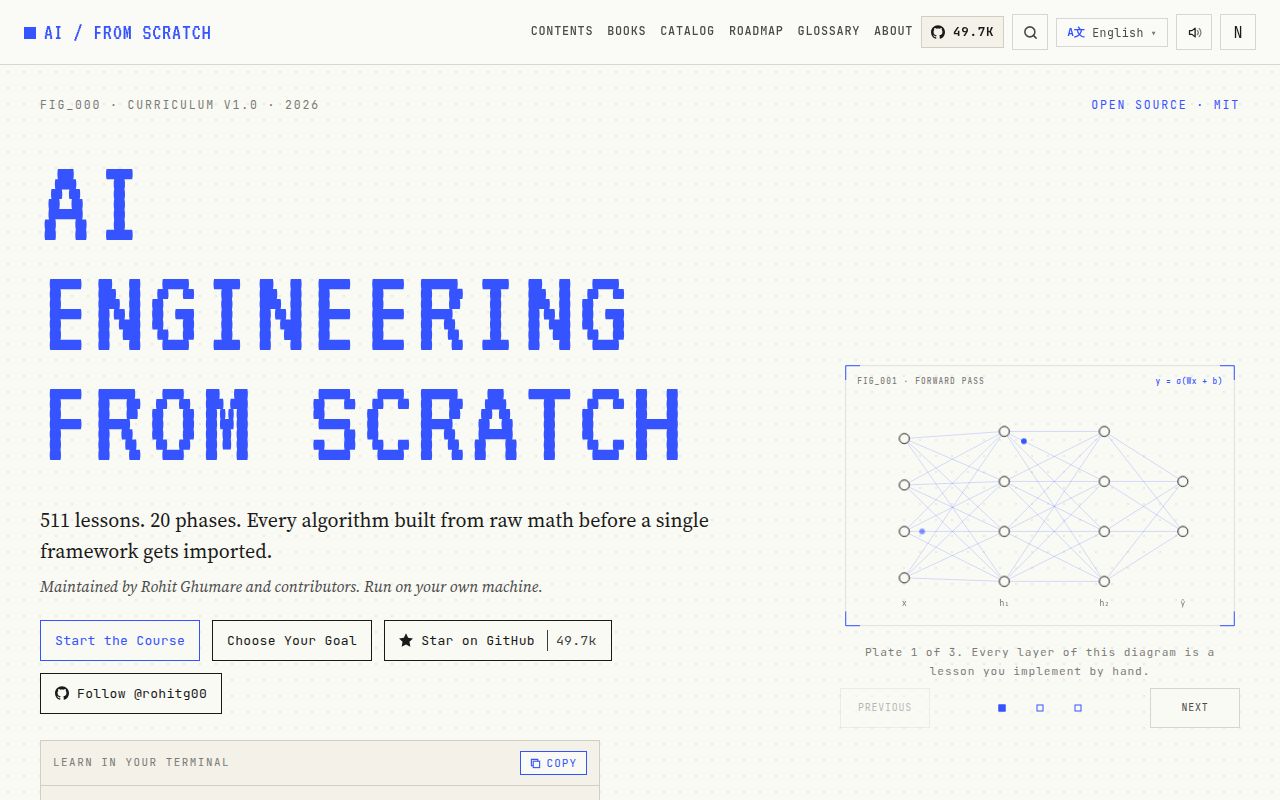
AI Engineering From Scratch is closer to a technical school in a repository than a normal software package. Its 20 phases begin with development setup and linear algebra, then move through machine learning, vision, language, transformers, reinforcement learning, LLM engineering, MCP, agents, infrastructure, safety, and capstone work. The README estimates about 329 hours. That range can save a motivated learner from stitching together unrelated tutorials, but it is far more course than most people will finish.
Each lesson follows a repeated build pattern. The learner reads the concept, derives or implements a smaller version, tries the production library, runs code, and keeps evidence of the result. Lesson folders contain narrative material, runnable code, and outputs such as prompts, skills, agents, or MCP servers. The insistence on command, working directory, exit code, meaningful output, and changed artifact is excellent teaching practice. It encourages verification instead of rewarding someone for merely scrolling through 511 pages.
A focused route avoids reading all 20 phases
The README offers starting points for beginners, Python developers, LLM application builders, agent engineers, MCP learners, Agent Skills authors, and Claude certification candidates. A placement tutor can save a personalized plan to LEARNING.md. Separate MCP and Agent Skills routes save their own progress files. This routing matters because following every prerequisite in order may be unnecessary for an experienced engineer who only needs protocol security or evaluation work.
The MCP path contains 17 lessons covering requests, transports, bidirectional work, security, reliability, registry governance, and conformance evidence. The Agent Skills path contains 5 lessons on the skill contract, discovery, invocation, sandbox boundaries, and release evaluation. These are useful slices because they end in runnable artifacts rather than stopping at vocabulary. They also make the repository relevant to working agent developers who would never commit to the full 329-hour curriculum.
What happened when we ran it
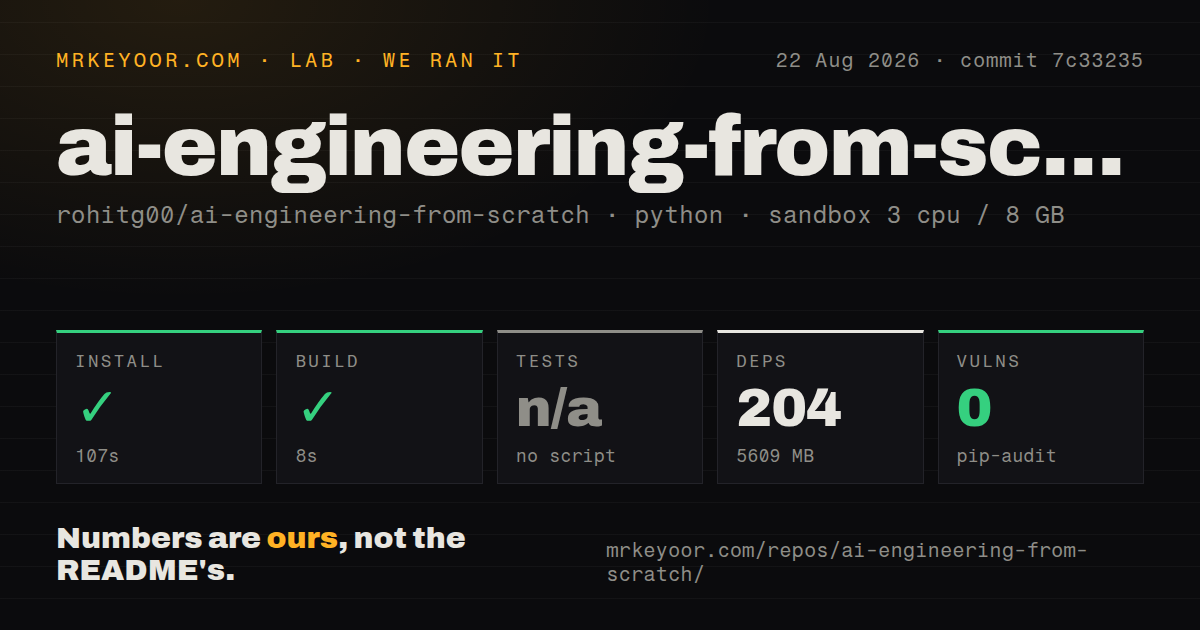
Our sandbox installed 204 Python packages in 107 seconds and occupied 5,609 MB on disk. The build succeeded in 8 seconds. The harness found no test script or target, so it skipped tests rather than choosing commands from individual lessons. Pip-audit reported 0 known vulnerabilities in the installed packages. This run used commit 7c33235 in a fresh unprivileged Debian container with 3 CPUs and 8 GB of RAM.
The checkout itself was only 22.2 MB, with 3,197 files and roughly 208,211 lines of source. It had 3 CI workflow files, no Dockerfile, and no tests directory. The 5,609 MB installed result shows that a broad educational environment can dwarf its lesson text and source. It does not mean every learner needs that full environment: a dependency-free Python lesson has a much smaller path, while later GPU, Rust, Julia, model, or agent work brings different requirements.
No unified test target leaves lesson quality uneven
A course with 511 runnable lessons needs verification at two levels: repository generation and the code inside each lesson. Our build covered the available build path in 8 seconds, but the absence of a harness-recognizable test target means we cannot report a repository-wide correctness result. CI files exist, and many lesson instructions ask learners to run specific commands. That is not equivalent to one suite proving that every language version and threshold case still works.
Open issue 434 gives a concrete example. The Julia implementation for Phase 2's logistic-regression lesson calls sum() over an empty generator when a strict threshold produces no positive predictions. On Julia 1.12.7, the reporter reaches an ArgumentError before the threshold table completes. The lesson is marked complete in the roadmap, so status means authored rather than exhaustively tested across all conditions. Run the selected language implementation before relying on it for teaching or portfolio evidence.
Agent tutors make progress easier and assessment less certain
The repository ships skills for placement, lesson tutoring, topic routing, MCP study, Agent Skills study, certification preparation, and phase quizzes. Installation uses npx skills add, after which Codex, Claude Code, or another compatible host invokes the skill using its own syntax. The tutor can stream lesson prose without a clone, while executable labs need the repository and relevant runtimes. This is a sensible split between reading and doing.
Agent-mediated assessment has an open integrity problem. Issue 409 reports Codex quiz prompts whose reply examples leaked the correct letters, such as showing Q1: B, Q2: B when B was the answer. The reporter observed it in placement, pre-phase, and mid-phase flows. Local prompt edits appeared to fix that user's setup, but the issue remained open. A learner should answer before reading format hints and use code output or a human review for any assessment that matters.
English is canonical across 12 translated landing pages
The README links translated landing pages in 12 languages and clearly identifies English as canonical. Lesson pages on the translations branch are machine-translated, while code, math, tables, and diagrams are meant to remain unchanged. That improves access for readers who would otherwise stop at an English landing page. It does not make every technical explanation equivalent to a human-reviewed translation, especially around statistics, security, or protocol terms.
The dated activity is healthy. GitHub recorded 49,667 stars and 97 combined issues and pull requests when fetched. The last push was August 23, 2026, and current learner issues were updated on August 25. Edition v2026.08 was released August 10 with certification routes, translations, navigation work, and corrections to quiz answer distribution and statistics examples. The release history and issue activity together show ongoing maintenance, while the open lesson bugs show why learners should keep running the code.
This repository is a strong map for someone who wants breadth and accepts self-directed verification. The 8-second build and 0 audit findings are encouraging, but the 5,609 MB environment and missing unified test target are meaningful costs. Pick one route, keep terminal evidence, and leave the full 20-phase promise alone until the current slice is genuinely complete.