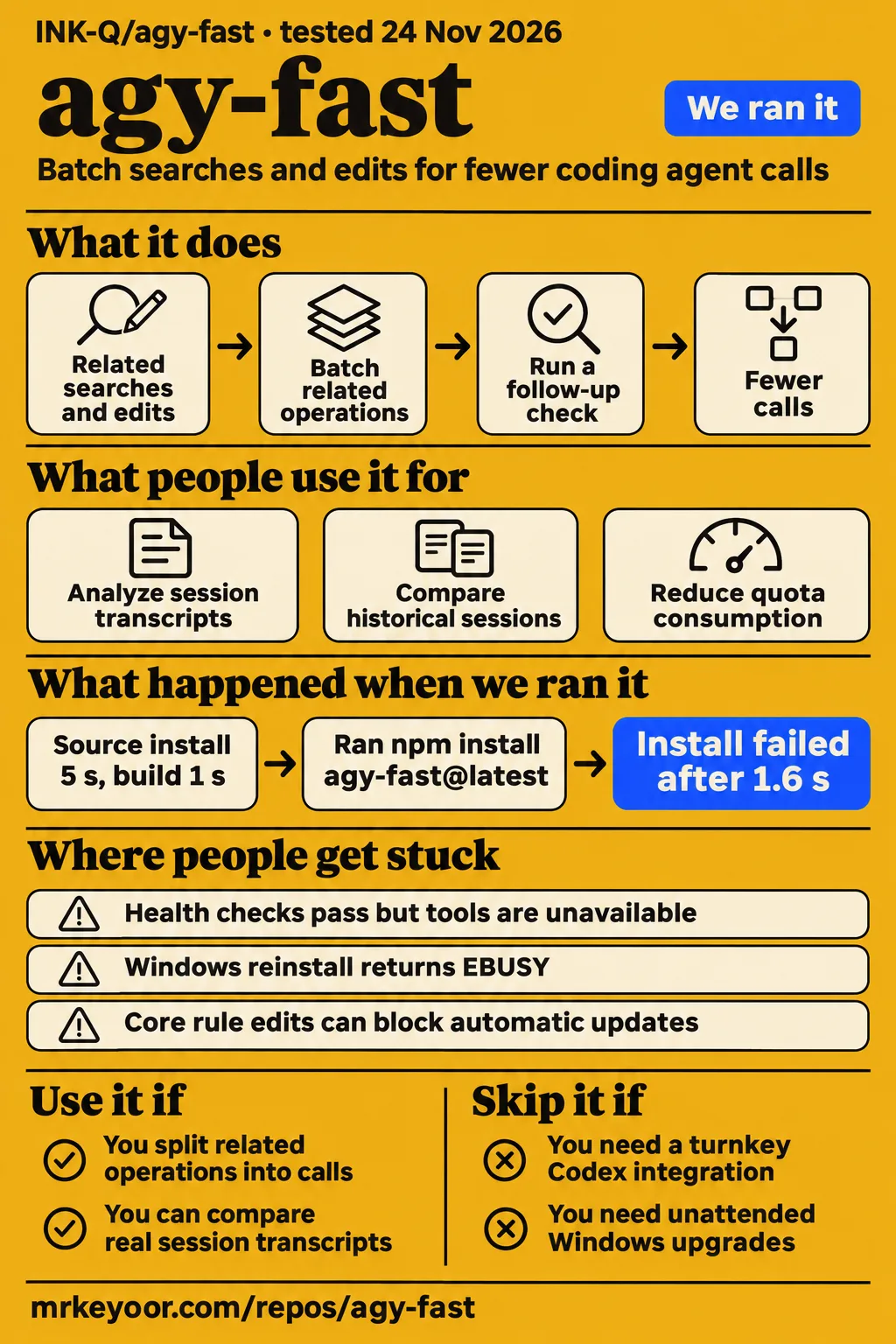
agy-fast batches searches, outlines, edits and checks through a local MCP server, the protocol AI assistants use to call outside tools. It keeps Antigravity's native reads in the workflow. Use it if your coding sessions repeatedly split related operations into separate calls. Skip it if you need a turnkey Codex or Claude Code integration: issue #61 describes manual mounting and host-specific routing work.
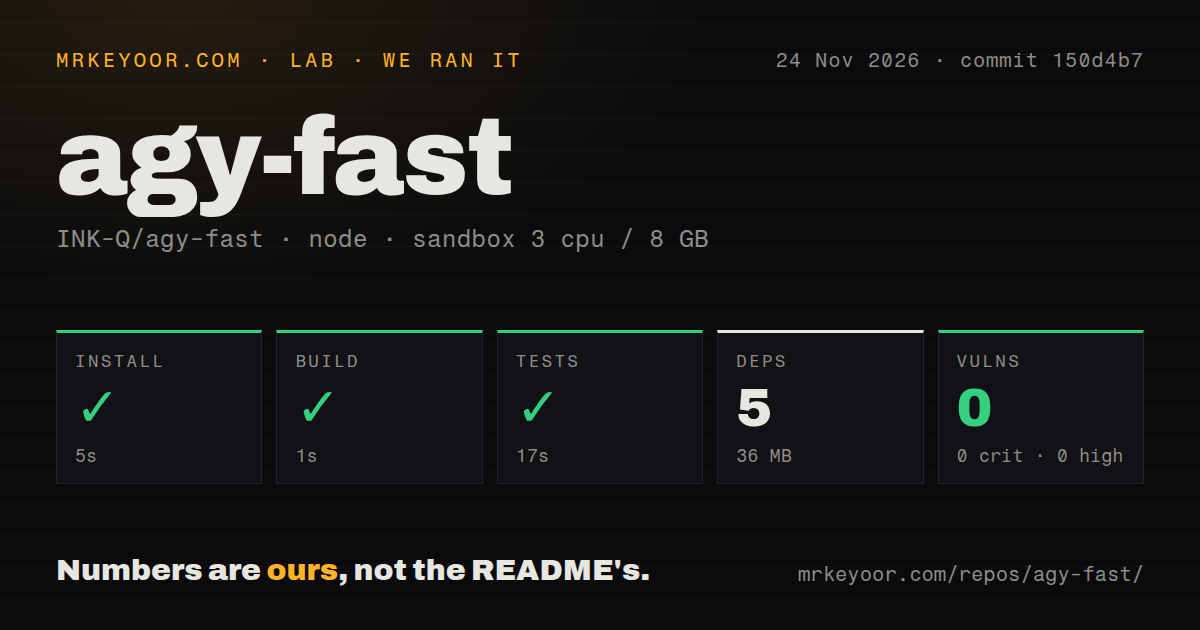
Our repository harness completed installation in 5 seconds, the build in 1 second and tests in 17 seconds. That makes the source practical to work on. The adoption decision rests on a different question: whether fewer calls also mean less waiting on your tasks.
Five tools batch work while native reads stay available
The README documents five tools: batch_search, apply_edits, read_slices, quick_outline and run_checks. A startup hook also supplies a workspace snapshot. The tools batch related operations, so an agent can search several symbols together, map large files before reading them, or change several files and run a follow-up check in one call.
You don't need to route everything through it. The routing rules keep small files and known line ranges on native read_file. A single lightweight shell command can also stay native. This is the sensible part of the design: adding an intermediary to an already cheap read would give you another configuration surface without making the task easier.
The useful unit is a logical operation, such as one search or edit, rather than the number of MCP calls. Packing several operations into one call can reduce the model's back-and-forth. Whether the completed task gets faster depends on what else that task spends time doing.
What people use agy-fast for
GitHub user gaofeng21cn reports using agy-fast across 73 active sessions spanning main sessions, subagents and Swarm workers. Those are more informative uses than a directory listing or a launch announcement because they expose both packing gains and routing mistakes.
| Who used it | What they did | What they reported |
|---|---|---|
| gaofeng21cn, issue #59 | An intensive coding workload with main sessions and delegated workers | 4.28 logical operations per MCP call and 42.7% fewer main-session turns per 10 operations. |
| The Windows engineering reporter in issue #27 | An offline comparison of historical sessions with and without the plugin | Less multi-tool stream waiting, but effective throughput fell from 31.8 to 21.2 tokens per second. The groups contained different workloads. |
| INK-Q, the project author | Transcript analysis of batched coding operations | 33.7% fewer turns per logical action and 31.5% lower estimated billable quota in the main-session comparison. |
| piecarlos__ on X | Recommended the linked repository to someone discussing quota consumption | Claimed 30-60% lower consumption depending on the task, without a reproducible comparison in the post. |
The author's quota figure is an estimate under stated input, cache-read and output weights. It isn't a receipt showing that every subscription lasts that much longer. The Windows report is also useful precisely because its results disagree across metrics: less tool waiting can coexist with lower overall throughput. Treat those as separate outcomes when deciding what you want to improve.
What happened when we ran it
The configured sandbox had 3 CPUs, 8 GB of RAM and image label lab-node:22. That label identifies the configured image, rather than the actual runtime or operating-system version.
| Repository harness step | Recorded result |
|---|---|
| npm installation | Succeeded in 5 seconds; 5 dependencies recorded, 36 MB on disk |
| Build | Succeeded in 1 second |
| Tests | Succeeded in 17 seconds |
| npm audit | 0 known vulnerabilities: 0 critical, 0 high, 0 moderate and 0 low |
| Repository scan | 71 files, approximately 31,697 source lines, 2.4 MB checked out |
| Project signals | 2 CI workflow files, a Dockerfile and a tests directory |
The source checks finished cleanly. The separate quickstart attempt took a wrong route: after cloning the project, it ran npm install agy-fast@latest. The registry returned HTTP 404 for its GET request: E404, saying 'agy-fast@latest' is not in this registry. The attempt stopped at installation and recorded an npm debug-log location, then teardown completed successfully.
That error tells you about the attempted distribution route. It doesn't contradict the successful repository harness. The README's documented route uses the repository installer and bundled dist files, rather than that npm package command. If you are evaluating agy-fast as a plugin, start with that route, enable it in Antigravity and open a new session.
Where people get stuck: healthy checks can hide missing tools
The macOS reporter in issue #25 passed doctor and strict validation on agy CLI 1.5.14, yet the new session exposed neither the eager tools nor call_mcp_tool. Their working workaround was to switch to lazy loading and open another session. The maintainer released the persistent loading-mode setting in v0.3.0.
This gives you a troubleshooting order with an observable finish. Run the health check, inspect the tools available inside the new conversation, then ask for a combined search and git-status operation. A successful health check answers whether the server responds. A visible batch_search call answers whether the agent actually used it.
| Symptom | What the reporter found | Resolution or current action |
|---|---|---|
| Searches return plugin files | GoodCoder666's Desktop Hub call omitted cwd | v0.2.10 shipped a plugin-directory guard. Pass the workspace cwd explicitly. |
| Missing property toolSummary | The issue #61 reporter followed Quick Schemas that omitted a host-injected field | v0.3.1 release notes document the toolSummary guidance. |
| Windows reinstall returns EBUSY | The issue #65 reporter had an MCP host holding the live directory open | PR #69 was submitted for an atomic replacement fallback. Close the locking host before retrying, especially for linked installations. |
| update --force stays notify-only | An extracted archive containing src was classified as dev-source | Issue #65 identifies that classification; PR #69 proposes a scoped correction. |
| Personal rule edits interfere with updates | The issue #16 discussion describes a dirty clone after core rules were edited | v0.2.9 introduced preserved rules/*.local.md overrides. |
A different report helps prevent a false diagnosis. In issue #53, Firm-ideal posted a benchmark with zero agy-fast tool calls, then clarified that it came from before installation. They said first-token speed returned to normal after compacting context. That sequence supports checking context and actual plugin usage before crediting or blaming agy-fast for a long wait.
Fewer turns and faster completion are different results
The Windows reporter's 31.8-to-21.2 tokens-per-second result came from a usage split with 70 baseline sessions and eight plugin sessions described as deep, complex tasks. Issue #27 reports both those groups and the throughput decline. You can't turn that comparison into a controlled verdict that the plugin slows identical work.
You also can't discard the decline because the other metrics improved. For your own comparison, record completed-task time alongside turns per logical operation, estimated quota, output size and result quality. Keep the host, model, starting repository state and task instructions as consistent as possible. Otherwise a harder implementation job can look like a plugin regression, or a shorter task can look like a breakthrough.
The README documents offline analyze and compare commands for local transcripts. Use the analyzer to identify calls that actually used the plugin, then inspect why remaining turns occurred. The practical break-even comes when the saved exchanges outweigh the extra rules and tool definitions carried by the session. An agent already editing efficiently has a different starting point from one issuing a separate call for every hunk.
Windows and Swarm workers need explicit routing
Swarm workers do not automatically receive the MCP tools, routing rules or SessionStart hook, according to the project's routing guide. Their task brief needs the installed CLI path and instructions for batched operations. Installing the plugin for the main conversation doesn't complete that delegation setup.
gaofeng21cn's workers guessed --pattern for CLI search and received Unknown option '--pattern'. The issue discussion first put alias support in dev; v0.3.1 subsequently lists --pattern, --type and expanded CLI guidance as released changes. Give workers examples matching the installed version, rather than relying on their guesses from MCP parameter names.
Windows adds a separate boundary. The reporter in issue #62 describes protected-path probes hanging before Access is denied, plus process startup costs unlike the macOS measurements. The v0.3.1 notes describe home-directory snapshot shortcuts and returning from complete JSON input without waiting for EOF. Those specific changes shouldn't be read as a blanket resolution of protected-directory access stalls.
Local execution still gives commands real authority
The README says the tools and transcript analyzer run locally, while the updater contacts GitHub. It also documents update modes auto, notify and off. If you want to review changes before applying them, choose the corresponding update setting rather than assuming the installed runtime stays fixed.
Local processing is useful for code and transcript handling, but the available tools still include file edits and shell commands. The README presents dangerously-skip-permissions as an optional host flag, with a trusted-repository or sandbox qualification. Keep that choice separate from enabling batching. You can evaluate fewer calls without treating every command the agent constructs as pre-approved.
The clean npm audit from our repository run describes known dependency advisories. It isn't a security review of command execution, path handling or the updater. For an unfamiliar repository, the host's permission boundary still matters when run_checks executes a command or apply_edits runs its follow-up check.
agy-fast vs native tools, agy-dart and agy-staff
Native Antigravity tools remain part of agy-fast's documented routing, while agy-dart adds context-management features and agy-staff delegates work to agy. Choose by the job you need before comparing performance claims.
| Option | Documented distinction | Pick it when |
|---|---|---|
| Native read_file and run_command | Small reads, known ranges and lightweight commands remain native in the routing guide. | Your tasks already use a few precise operations and you want the existing workflow. |
| agy-fast | Batched searches, outlines, edits and independent checks. | Repeated fragmented operations are the problem you want to measure. |
| agy-dart | Its README describes local context indexing, cache monitoring and a Sidecar dashboard, and asks users to disable standalone agy-fast. | You also want those context-management functions and accept its additional configuration. |
| agy-fast-io | Like Do identifies oil-oil/agy-fast-io as an unofficial plugin with a similar pitch. | You want another candidate for a same-task comparison. |
| agy-staff | Its README describes using agy as a worker for other coding hosts. | You need delegation from another agent, rather than operation batching inside a session. |
agy-dart also specifies a different runtime floor: Node 22.16 or later in the 22.x line, or Node 24 or later, with a SQLite FTS5 check. That's a requirement from its README, not the runtime observed in our agy-fast sandbox. The repository now resolves to zou172866/Antigravity-agy-dart, so use that current name when locating it.
What the other reviews get wrong
Talira's four-tool description omits quick_outline, while the README and installer identify five tools. Talira lists four composite tools; the project lists quick_outline alongside the other four. That changes the recommended exploration workflow because you can request a flat outline without constructing a larger read request.
Glama's claim that agy-fast replaces built-in tools also overstates the routing. Glama describes replacement, whereas the project's rules explicitly retain native reads and lightweight commands. Quanta's summary blurs a different distinction: its 55-session framing should be separated from the README's main-session savings comparison of 14 baseline sessions against seven plugin sessions. The analysis report uses 55 sessions for bottleneck analysis.
The project's own snapshot headline needs qualification too. The README opens with a sub-50ms claim, but gaofeng21cn reports roughly 108-227ms snapshots, and issue #62 describes a home-directory case taking 2-3 seconds. The later snapshot fixes have named targets; none makes one latency figure universal across directories and hosts.
Questions people ask
Author and user reports show fewer turns, while the Windows usage split also reports lower effective throughput. Your repository's result needs a comparison that records both completed work and elapsed time.
Does agy-fast reduce turns, quota use and elapsed time on my own repository?
The author reports 33.7% fewer turns and 31.5% lower estimated billable quota per action in the main-session comparison. Issue #27 shows why that doesn't settle elapsed time: the user's waiting metrics improved while throughput fell. Use the README's offline transcript comparison to distinguish those outcomes for your tasks.
Will agy-fast officially support Codex, Claude Code and other MCP agents?
The issue #61 reporter describes working manual mounts across hosts, while asking for installer output and rules adapted to those hosts. The maintainer discusses modular support and tracks follow-up work. Manual MCP connectivity and a supported installation experience are separate parts of that request.
Can I expose only batch_search, quick_outline and run_checks to reduce schema overhead?
The issue #61 follow-up describes PR #64 for --tools and AGY_FAST_TOOLS. The maintainer says the PR is in review. Treat those switches as proposed work in that discussion, rather than instructions guaranteed to work in the released server.
Why does Antigravity reject a call with missing property toolSummary?
Antigravity's eager mode injects a required toolSummary field, which the Quick Schemas omitted, according to issue #61. The v0.3.1 release notes include the documentation correction. Follow the host's exposed tool definition when forming the call.
Why are agy-fast tools unavailable even though doctor and strict validation pass?
The issue #25 reporter saw successful health checks with empty eager declarations and no lazy invocation path. Switching to lazy loading and opening a new session restored calls. The maintainer's reproduction behaved differently, so that thread doesn't identify one universal cause for missing tools.
How do I switch agy-fast between eager and lazy tool loading?
Use node ~/.gemini/config/plugins/agy-fast/scripts/install.mjs config --tool-loading lazy, then open a new session. Replace lazy with eager to switch back. Issue #25 confirms that the persistent setting shipped in v0.3.0, so updating no longer requires repeatedly editing the generated configuration by hand.
Why does agy-fast search its installation directory instead of my workspace?
The Desktop Hub report in issue #22 omitted cwd and the host supplied no usable workspace root. v0.2.10 shipped a guard for that plugin-directory fallback. Pass the workspace cwd explicitly, especially when mounting the server in another MCP host.
Can I preserve my personal rules without blocking automatic updates?
Use rules/AGENTS.local.md with trigger: always_on YAML frontmatter. The maintainer says v0.2.9 released preserved local overrides. That gives your preferences their own file instead of turning changes to the maintained routing file into a dirty clone.
Does output truncation hide important compiler errors or search matches?
The issue #27 reporter and maintainer identified search starvation and long lines losing the matched term. v0.3.0 shipped broader file coverage and match-centered windows. Command output uses head-tail folding under a size budget, so inspect the complete log when the compact response doesn't contain the diagnostic you need.
Why does the Windows installer fail with EBUSY while another MCP host is running?
The issue #65 reporter found that a running server held the installed directory open while reinstall tried to remove it. PR #69 proposes atomic replacement for ordinary installed directories. Closing the locking host is the fallback described for linked or symlink installations.
Why does update --force remain notify-only for an extracted source installation?
Issue #65 describes a directory containing src but no .git being classified as dev-source, including inside plugins/agy-fast. That classification keeps the updater notify-only. PR #69 proposes narrowing the detection; the discussion records submission, rather than a released resolution.
How should Swarm workers invoke CLI search without --pattern errors?
Use CLI examples for the installed version and include the installed server path in the worker brief. v0.3.1 released --pattern and --type support after gaofeng21cn reported workers guessing those flags. Workers still need explicit guidance because their sessions don't inherit the main agent's plugin setup.
What we have not tested yet
Our successful repository checks cover source setup, build, tests and npm audit at commit 150d4b7, not a completed coding task inside Antigravity. We did not measure quota savings, task completion time, first-token latency, snapshot speed or edit correctness in an installed host. The separate registry attempt stopped before activation. Its container used a different CPU and memory allocation, and its npm failure isn't a supported-route installation result.
We have not run matched tasks against native tools, agy-dart or agy-fast-io. No comparison here establishes a performance winner. The user telemetry groups differ in workload, and older benchmark results also need care because v0.3.0 corrected out-of-order response matching and separated truncations, result limits and follow-up-check failures.
The v0.3.1 changes are release-note claims, not regressions reproduced by our lab. We have not tested protected Windows paths, live-directory upgrades, archive classification, the pending tool-subset switch or cross-host rules. Nor have we audited the updater's network traffic or command-execution boundary. English documentation exists, but several detailed issue discussions require reading Chinese. The unrelated YouTube and Bilibili results found during research add no agy-fast demonstration to this review.
For your next comparison, keep the task and starting commit fixed, confirm actual plugin calls in the transcript, and record elapsed time plus correctness alongside quota estimates. Keep agy-fast if the work you finish improves enough to justify its configuration.