ARC scales GitHub runners inside Kubernetes
Actions Runner Controller watches demand for GitHub Actions and manages self-hosted runners as Kubernetes resources. Its current supported model uses runner scale sets, which can add runner pods for queued work and remove ephemeral capacity afterward. This fits organizations that need custom build images, private network access, or control over where CI code executes.
The benefit depends on an existing cluster. ARC does not remove the work of building images, setting resource limits, isolating untrusted jobs, or controlling secrets. It turns those concerns into Kubernetes operations. For a team already running that platform, the controller can be a natural place to manage CI capacity. For a five-person product team on standard GitHub-hosted runners, it creates a second scheduling system without a clear payoff.
Runner scale sets are supported; older autoscaling modes are not
The README draws an important line between autoscaling runner scale sets and the older controller modes. GitHub documentation covers the scale-set quick start and deployment path. Legacy modes remain in the repository and have their own documentation, but the README says community maintainers support them. Buyers should not assume that every manifest under docs/ has the same ownership or support promise.
Release gha-runner-scale-set-0.14.2 also publishes experimental controller and scale-set charts. Its notes say these are not supported for production workloads and may change or be republished without notice. That warning is specific enough to act on: pin the normal chart and image artifacts for production, and keep experimental charts in an evaluation cluster.
What happened when we ran it
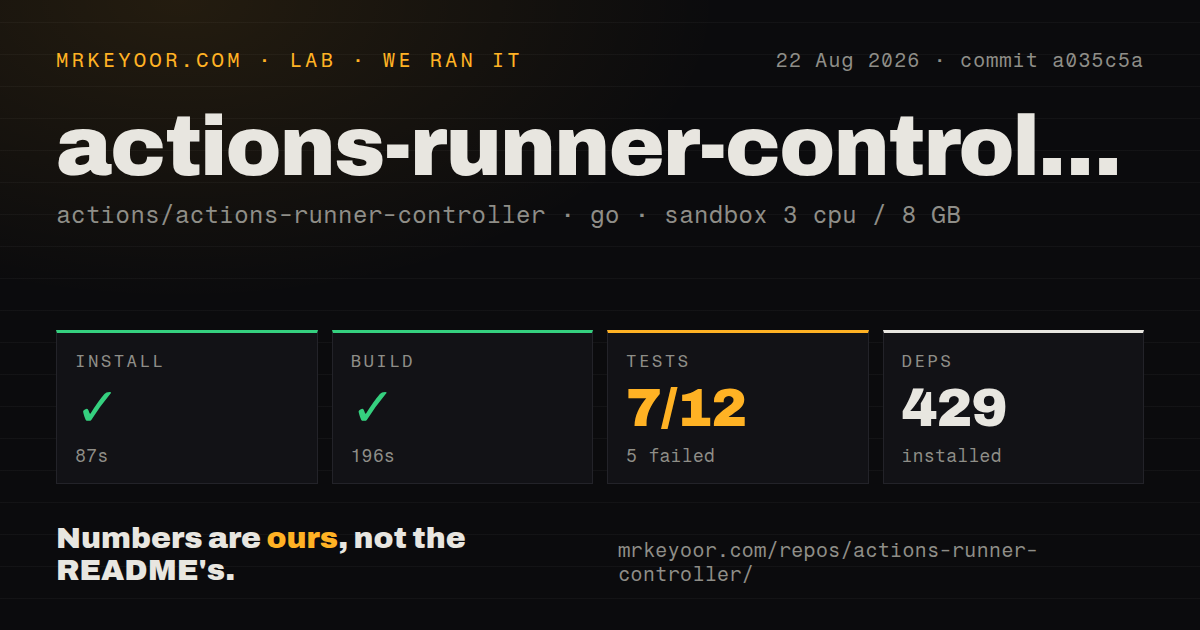
Our unprivileged Debian sandbox installed 429 Go packages in 87 seconds. The checkout at commit a035c5a held 600 files, about 50,889 lines of source, and used 17.4 MB. The build completed successfully in 196 seconds. We found 14 CI workflow files, a Dockerfile, and a tests directory.
The test command failed with exit code 1 after 56 seconds. The harness summarized 7 passing and 5 failing packages out of 12. The final log shows the end-to-end package failing, then TestARCJobs reporting that /work/home/.kube/config did not exist. Several other packages had no test files, while the Azure Key Vault package passed in the shown tail.
That result is different from a compiler failure. The code built, and the logged end-to-end failure asked for access to a Kubernetes configuration absent from the sandbox. We did not supply a cluster, GitHub credentials, or secrets. The log does not establish whether all 5 failed packages share that requirement, so the defensible conclusion is that the repository's full test command is not self-contained in this fresh container.
A real installation needs cluster and GitHub authority
The supported quick start uses Helm to install the controller and create a runner scale set. ARC then needs permission to register and manage runners against a GitHub repository, organization, or enterprise. That authentication is valuable and sensitive: compromise can expose source, workflow secrets, and whatever networks the runners can reach. Use a narrowly scoped GitHub App or documented token path and keep it in a Kubernetes secret system with restricted access.
Runner pods execute repository-controlled code. Namespace separation alone does not make hostile workflows safe. Review service accounts, mounted volumes, container privileges, node placement, egress, image provenance, and cleanup behavior. The v0.14.2 notes include fixes for an orphan ServiceAccount and secret reconciliation, which are reminders that the controller participates directly in the cluster's identity boundary.
Custom images solve dependencies and create an image pipeline
Self-hosted runners appeal to teams that need large caches, internal tools, unusual compilers, or network routes unavailable on GitHub-hosted machines. ARC can schedule containers built for those jobs. Ephemeral pods reduce residue between workflows, but the base image still needs patching and provenance, while persistent caches and volumes can carry data across runs.
Capacity planning is also yours. Scale sets respond to workflow demand, yet nodes must exist or arrive quickly enough to place runner pods. Image pulls, cluster autoscaler delay, registry throttling, and job burst size shape queue time. Our 196-second source build says nothing about those production timings. Test the actual runner image and a representative workflow burst in the cluster that will host it.
Current maintenance does not make every mode equivalent
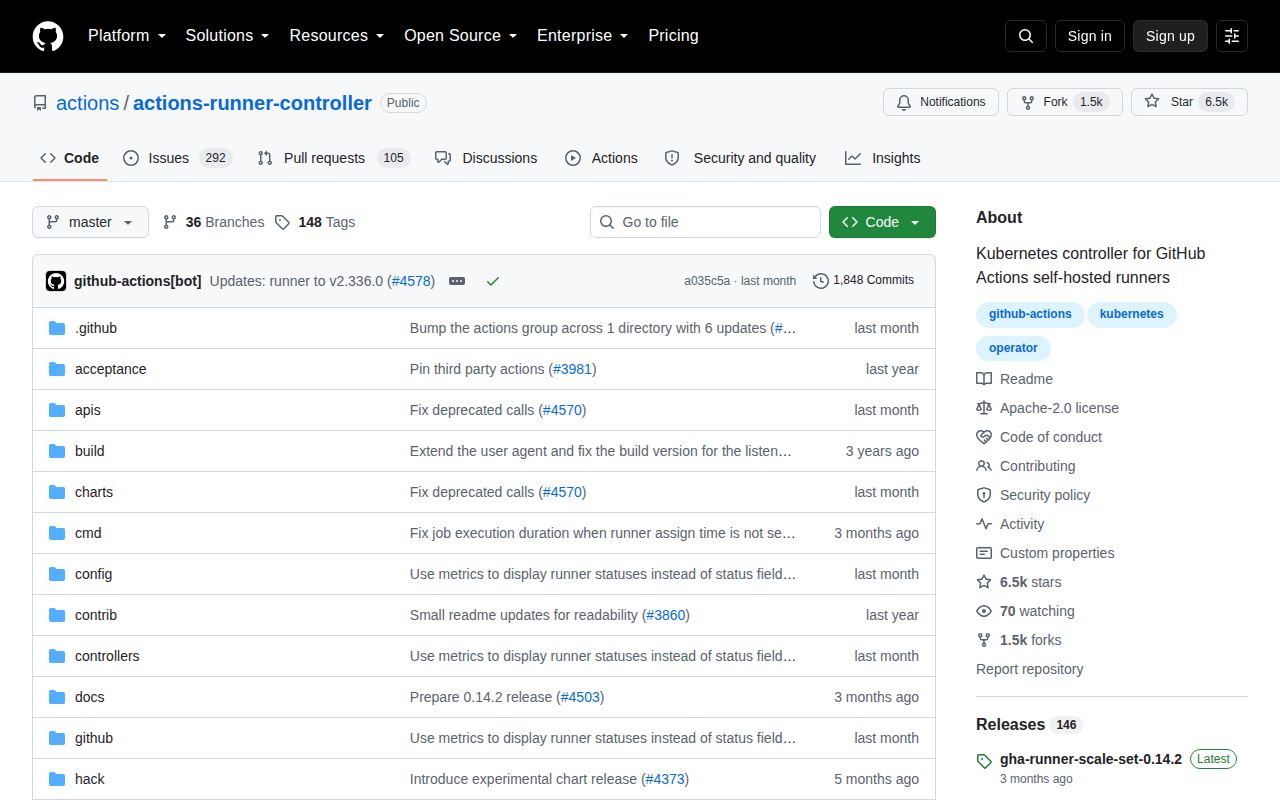
GitHub showed 6,460 stars, 397 open issues and pull requests, and an Apache-2.0 license. The last push was August 24, 2026. The latest listed release, gha-runner-scale-set-0.14.2, was published May 22 and contains controller, chart, security-toolchain, health-probe, and reconciliation changes. The later push confirms repository activity beyond that release date.
ARC is the strongest fit when a platform team can treat CI runners as another managed Kubernetes workload. The successful build and kubeconfig-dependent test failure match that audience: the controller code compiles in isolation, while meaningful validation crosses into a real cluster. If the organization does not already have that operating model, a cloud VM runner project or GitHub's hosted fleet is easier to explain and maintain.