XGBoost 3.4.2 spans laptops, GPUs, and distributed clusters
XGBoost trains gradient-boosted decision trees for classification, regression, ranking, and related tabular problems. The same project exposes Python, R, Java, Scala, and C interfaces, then reaches larger jobs through Dask, Spark, Kubernetes, Hadoop, and other distributed environments. That breadth is the reason to shortlist it: one tree library can follow a model from a notebook into a service or cluster without turning training into a hosted dependency.
Breadth also makes the repository heavier than the one-line Python install suggests. At commit 56d0a6f, our checkout contained 1,587 files and about 193,163 lines of source before dependencies. Python lives under python-package/, while native code and other language bindings share the repository. If you only consume a wheel, most of that structure stays out of sight. Contributors and source builders have to learn which part of the tree owns their test and build commands.
The Python wheel is simple, but GPU support depends on the platform
The stable Python path is pip install xgboost, and a smaller xgboost-cpu package is available when GPU algorithms are unnecessary. Current Linux wheels use CUDA Toolkit 13.x by default; a separate xgboost-cu12 package covers drivers that support CUDA 12 but not 13. Local CPU work needs no service account, model download, or API credential. You install a library and train against your own data.
Platform details can change the decision. The installation guide lists GPU support for Linux x86_64, Linux aarch64, and Windows x86_64, but not for either macOS architecture or Windows aarch64. Multi-node, multi-GPU training is limited to Linux. Windows also needs the Visual C++ Redistributable unless Visual Studio already provides the DLLs. Those limits are documented clearly, but they belong in the infrastructure plan before anyone budgets hardware.
What happened when we ran it
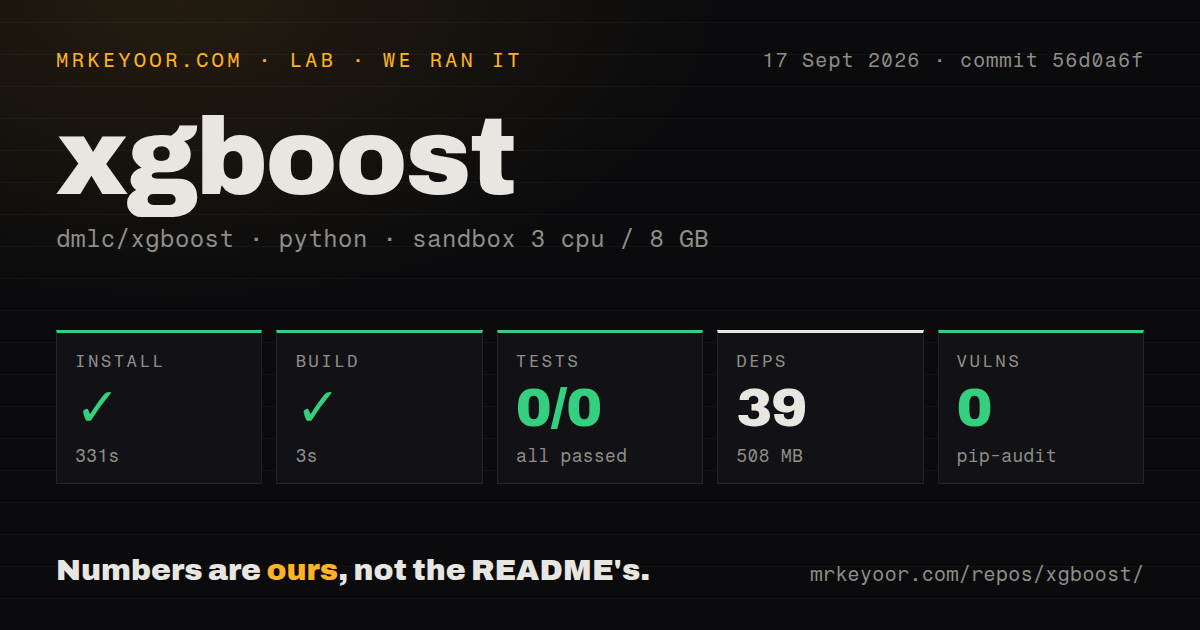
Our sandbox installed the Python project in 331 seconds, pulling 39 packages and occupying 508 MB. The build completed successfully in 3 seconds. We ran commit 56d0a6f inside an unprivileged Debian container with 3 CPUs, 8 GB of RAM, Python 3.12, and no secrets. The result says the package can install and build in that clean environment; it does not measure training or inference speed.
The test step failed with exit code 5 after 4 seconds. Pytest reported 0 passed and 0 failed because it collected 0 tests, and the final line was no tests ran in 0.01s. The log does not say why collection found nothing, so we will not assign a cause. A buyer working from source should identify the repository's intended Python test entry point and prove it against the same package layout they plan to change.
Pip-audit found 0 known vulnerabilities among the installed Python dependencies. The checkout had 17 CI workflow files and a tests directory, though the command used by our harness did not execute those tests. It had no Dockerfile. Taken together, the run gives you a clean dependency audit and a successful build, while leaving test verification unfinished rather than passed.
Categorical handling is strongest in the Python interface
XGBoost has accepted categorical data since version 1.5, and the current guide supports partition-based or one-hot splits with the histogram tree methods. The scikit-learn wrapper can read pandas or cuDF category dtypes when enable_categorical=True. Models containing categorical information must be saved as JSON or UBJSON, because the older binary format loses that information. This is workable, but it puts data types and serialization choices inside the correctness boundary.
Automatic recoding arrived for Python in version 3.1. The guide says R, Java, C, and other interfaces do not store the original category mapping, so their preprocessing must keep encodings consistent between training and prediction. Prediction semantics vary too: scikit-learn and R use the best iteration after early stopping by default, while the native Python Booster.predict uses the full model unless you pass an iteration range. Cross-language deployments need contract tests around both behaviors.
An open XGBoost4J report affects one Linux service pattern
Open issue 12545 reports native memory growth in XGBoost4J 2.1.4 through 3.4.0 on Linux x86_64 when a service repeatedly creates a DMatrix, predicts with it, and disposes it. The reporter says reusing one matrix stayed flat and macOS did not reproduce the behavior. This remains an issue report, not our lab finding, but its reproducer is close enough to a common request-per-matrix service pattern to justify a soak test before JVM deployment.
Project activity is current rather than inferred from an old tag. GitHub recorded a push on September 17, 2026, and release v3.4.2 was published on September 15. The repository had 28,776 stars and 438 combined open issues and pull requests when fetched. Recent discussion covered R builds on Apple Silicon, typed CPU and CUDA kernels, documentation, and prediction behavior, which shows active maintenance across the broad surface that makes XGBoost useful.
The best fit is tabular work with a tested deployment path
XGBoost earns its place when boosted trees suit the data and the team wants mature Python plus distributed and native options. The 3-second build is encouraging, while 0 collected tests means our checkout did not receive the verification we wanted. Pin the wheel, preserve categorical mappings, test early-stopping predictions, and reproduce your actual CPU, GPU, or JVM service path. That work is modest beside model validation, and skipping it would turn a well-established library into an avoidable deployment gamble.