The 2,992.3 MB checkout is a warehouse, not an SDK
Our clone of Google Fonts occupied 2,992.3 MB and contained 19,923 files. The README says the project mainly stores the binary font files served by Google Fonts. Family directories add METADATA.pb records and English descriptions, while the catalog directory holds designer profiles and images. That makes the repository valuable as a versioned corpus. It also makes a full clone an extravagant way to add one typeface to a website.
The layout is designed for machines as much as people. Top-level directories group families by license, and each family has the .ttf files that users receive. Tooling can inspect metadata for designer names, categories, and license information without scraping the catalog website. The repository has only about 7,308 lines of source because code is not the main asset. Most of the weight sits in font binaries and their supporting records.
Every family carries its own license terms
The README names 3 common font-license families: SIL Open Font License 1.1, Apache 2, and Ubuntu Font License 1.0. It tells users to read the license inside each family directory rather than assuming one repository-wide grant. Some OFL families also use a Reserved Font Name. You may be allowed to modify the font while being barred from distributing that modified version under the reserved name.
Source files are a separate question. Google Fonts says they are often available from the designer or another googlefonts repository, which means this 2,992.3 MB checkout should not be treated as a complete editable source archive. The files here are useful for self-hosting under their individual terms, auditing what the service ships, and testing rendered output. A designer planning substantial changes should find the actual upstream project first.
What happened when we ran it
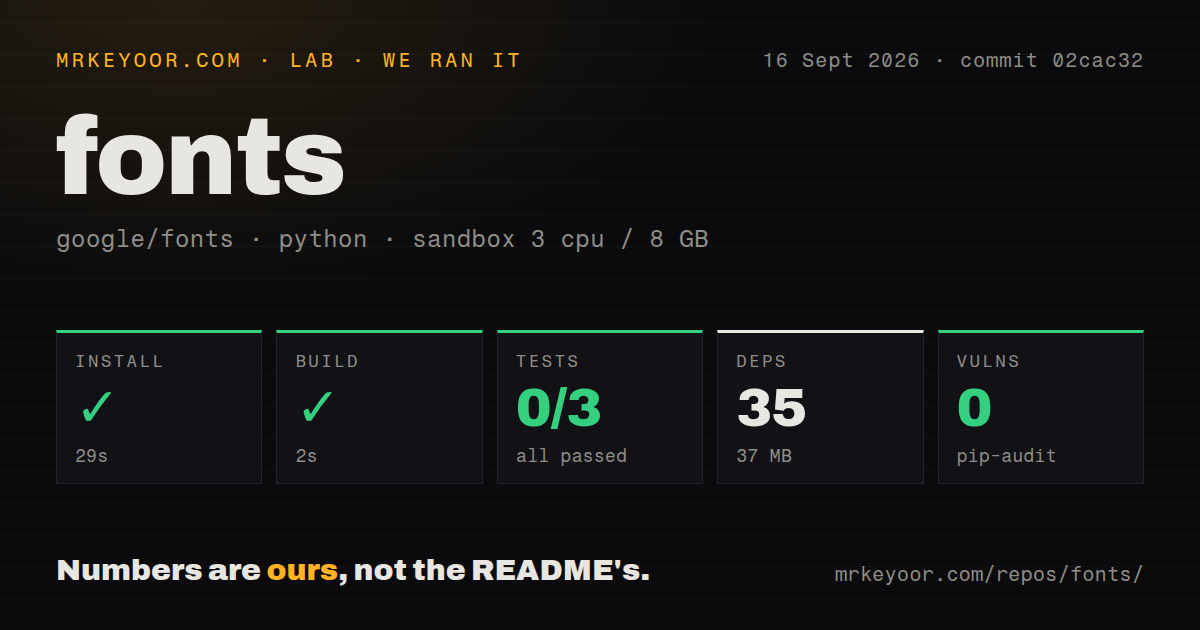
Our sandbox entered ./axisregistry/, installed 35 packages in 29 seconds, and used 37 MB for that Python environment. The package build finished successfully in 2 seconds. We ran commit 02cac32 in an unprivileged Debian container with 3 CPUs, 8 GB of RAM, Python 3.12, and no secrets. Pip-audit reported 0 known vulnerabilities in the installed packages.
Pytest returned exit code 1 after 4 seconds. It collected no runnable tests: all 3 test modules stopped during import or setup with ModuleNotFoundError: No module named 'axisregistry'. The affected files were test_axisregistry_api.py, test_names.py, and test_wellformed.py. The log establishes an import failure, but it does not show whether installation mode, path configuration, packaging, or another detail caused that failure.
The repository scan found 9 CI workflow files, no Dockerfile, and a tests directory. Install and build success show that the Axis Registry package can be resolved and built in the stated environment. They do not turn the 3 collection errors into passed tests. Anyone embedding the Python API should reproduce the install exactly as their application will use it, confirm the import, and then run the upstream suite before trusting registry lookups.
Axis Registry changes belong in the upstream project
Google Fonts describes /axisregistry as a synchronized subtree and explicitly says not to change it directly in this repository. The maintained home is googlefonts/axisregistry, whose latest GitHub release was v0.4.20 on August 6, 2026. The subtree documents tags, display names, ranges, defaults, precision, and fallback positions for variable-font axes. An axis present in a font but absent from this registry will not work through the Google Fonts API.
Even the upstream main branch is not the final product record. Its README says definitions become final when they appear in the live Google Fonts variable-font page, and repository data can run ahead of production. That distinction matters for build pipelines. A 2-second local package build can read the checked-out data, but it cannot prove that the public API has adopted the same definition. Pin the data source you mean and distinguish repository state from live-service state.
A web project rarely needs all 19,923 files
For ordinary page delivery, the repository README points to Fontsource for bundled npm packages and fnt for installing individual fonts on supported systems. Google Fonts itself serves selected families without making your build carry a 2,992.3 MB history. Those paths are easier to update and easier to audit at the application level. A full clone makes sense for an offline mirror, bulk analysis, or tooling that must compare many families at once.
Self-hosters still need to subset deliberately. Choose the family and styles, copy the required binaries, preserve the license, and test the actual browser output. Variable fonts add axis definitions and fallback positions that deserve their own checks. The repository gives you raw files, metadata, and an issue tracker. It does not choose preload policy, CSS declarations, subsets, cache headers, or page-performance budgets for your site.
September 17 activity comes from fonts and their users
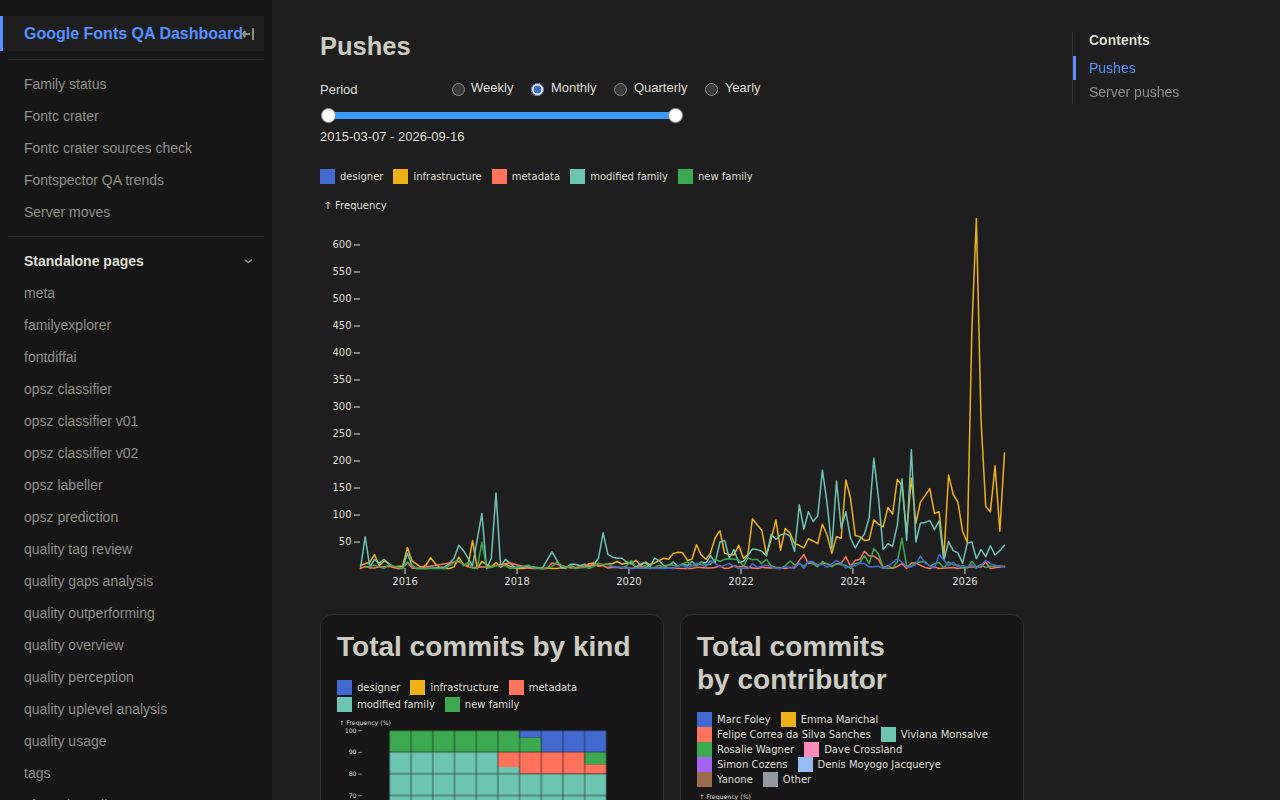
The repository was pushed on September 17, 2026, and GitHub showed 20,492 stars. We found 1,402 open issues and 19 open pull requests. Recent activity included new-family submissions, font upgrades, and reports about individual glyphs. That mix explains why the issue count should not be read as 1,402 defects in one software package. This repository doubles as the public intake and correction queue for the Google Fonts collection.
GitHub's latest-release endpoint returned no release record, which fits a collection distributed from its main branch and through the Google Fonts service. The same-day push and active issue queue show ongoing maintenance even without release objects. Clone it when the collection itself is your input. If the job is simply to put a font on a page, a per-family delivery path avoids almost 3 GB of material you will never ship.